

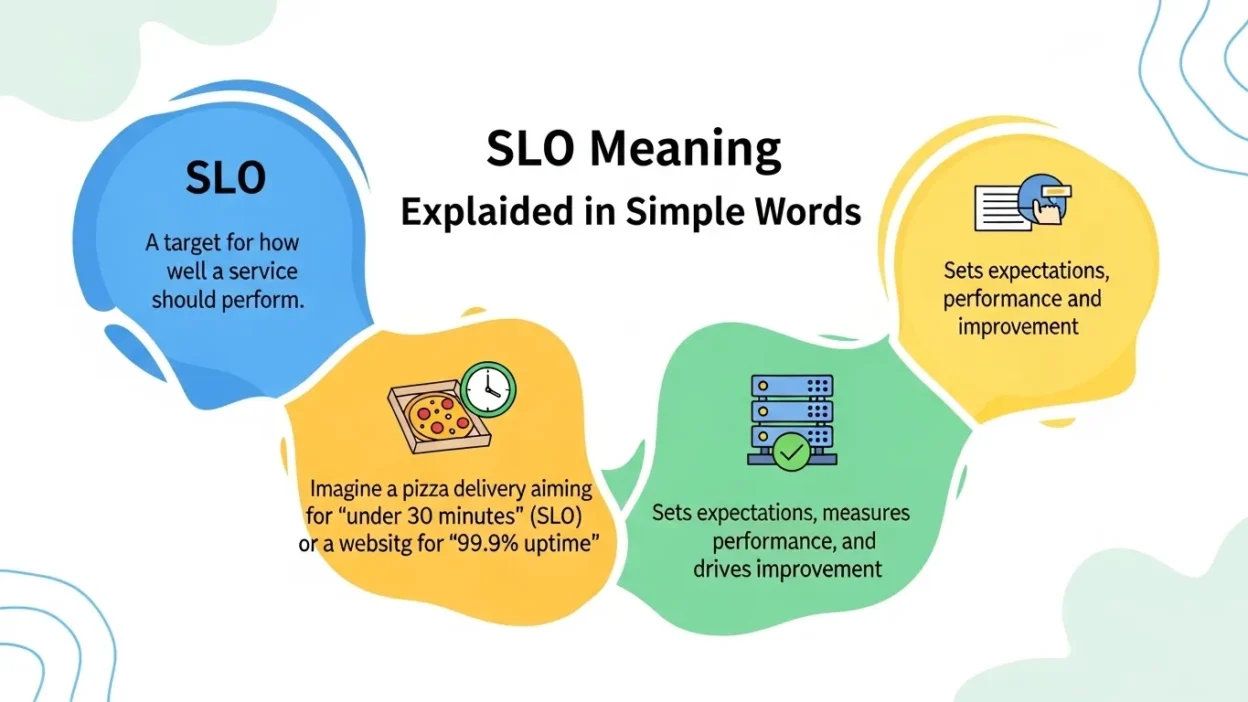
Every industry, from technology to education, uses abbreviations that can be confusing at first glance. One such term that often pops up is SLO. But what does SLO actually mean?
Depending on the context, SLO can have multiple interpretations, but the most widely recognized meaning is Service Level Objective a key concept in IT, DevOps, and business operations.
Essentially, an SLO defines measurable targets that a service or team aims to achieve, helping organizations maintain reliability, efficiency, and performance.
Beyond technology, SLO also appears in education as Student Learning Objectives, highlighting academic goals for students and teachers.
In this article, we will dive deep into the meaning of SLO across various industries, explain its real-world applications, compare it with related terms like SLA and SLI, and provide practical examples.
Whether you are a professional, student, or curious learner, this guide will clarify everything you need to know about SLO.
What Does SLO Mean?
The term SLO stands for Service Level Objective, and it plays a crucial role in defining measurable performance goals for services, systems, or teams. At its core, an SLO sets a target for reliability, availability, or performance that a service is expected to achieve over a specific period. For example, a website might have an SLO of 99.9% uptime per month, meaning the site should not be down for more than 43 minutes in a month.
In the technology and business world, SLOs help teams align expectations with clients or stakeholders, ensuring everyone understands what “good performance” looks like. Unlike a Service Level Agreement (SLA), which is a formal contract, an SLO is usually internal and measurable, providing a clear benchmark for teams to evaluate their performance.
Interestingly, SLO is not limited to IT. In education, it can also stand for Student Learning Objective, which defines academic goals for students or educators over a semester or year. Similarly, in different industries, SLO may appear in various contexts, such as social media, project management, or operational planning.
By setting clear and measurable objectives, SLOs act as a guide for performance improvement, risk management, and accountability. They ensure that services remain reliable and goals are realistic and achievable. Understanding SLO is the first step to implementing effective performance strategies, whether you are managing a software system, a business process, or educational programs.
SLO Full Form Explained
The abbreviation SLO stands for Service Level Objective, a term widely used in IT, DevOps, and business management. Breaking it down word by word helps clarify its meaning and purpose.
- Service: Refers to a system, platform, or process that provides value to users, customers, or stakeholders. Examples include a website, an API, cloud services, or customer support.
- Level: Indicates the standard or target for performance, quality, or reliability. It specifies how well the service should perform under normal circumstances.
- Objective: Denotes a clear, measurable goal. Unlike a vague aspiration, an objective is quantifiable, trackable, and time-bound.
Put together, an SLO is a specific, measurable goal that defines the acceptable performance of a service. For example, a cloud service provider may set an SLO that their servers will be available 99.95% of the time each month. This measurable target helps teams prioritize improvements, monitor service health, and manage customer expectations.
It’s important to note the difference between an SLO and an SLA (Service Level Agreement). While an SLA is a formal contract between a service provider and a client, an SLO is often internal and focuses on performance goals rather than legal obligations.
By understanding the full form of SLO, organizations can set realistic performance targets, monitor outcomes, and continuously improve services. Whether in technology, business operations, or even education, knowing the SLO’s full form helps clarify expectations and define actionable goals.
SLO Meaning in DevOps & IT
In the world of DevOps and IT, SLOs are essential for maintaining service reliability, performance, and customer satisfaction. Here, SLO (Service Level Objective) refers to specific, measurable targets that a system or service should meet over a defined period. For example, an online application may have an SLO to maintain 99.9% uptime monthly, ensuring minimal disruptions for users.
SLOs in DevOps are closely linked to SLIs (Service Level Indicators), which are the metrics used to measure performance. Common SLIs include response time, error rate, latency, and availability. These metrics provide the data needed to determine if the SLO is being met. For instance, if a website’s response time exceeds 200 milliseconds more than 1% of the time, the SLO is considered violated, prompting corrective actions.
Another important concept related to SLOs in IT is the error budget. An error budget is the acceptable margin of failure within an SLO. It allows teams to balance reliability with innovation developers can release updates quickly as long as the error budget is not exceeded.
Setting SLOs in DevOps also helps teams align with business objectives. Clear, measurable targets reduce misunderstandings, provide accountability, and create a framework for continuous improvement. Whether managing cloud services, APIs, or web applications, SLOs act as a roadmap for maintaining high-quality service while enabling teams to respond proactively to potential issues.
By using SLOs effectively, organizations ensure system reliability, customer satisfaction, and operational efficiency, making them a cornerstone of modern IT and DevOps practices.
SLO vs SLA vs SLI – Key Differences
Understanding the differences between SLO, SLA, and SLI is crucial in DevOps and business operations, as these terms often appear together but serve distinct purposes.
- SLO (Service Level Objective): This is a specific, measurable target for a service’s performance or reliability. It defines the goal your system should meet, such as 99.9% uptime or response time below 200 milliseconds. SLOs are often internal benchmarks used by teams to monitor and improve performance.
- SLA (Service Level Agreement): An SLA is a formal contract between a service provider and a client. It defines the agreed-upon level of service, and failure to meet it can result in penalties or compensation. While SLOs are internal objectives, SLAs are legally binding and focus on customer guarantees.
- SLI (Service Level Indicator): An SLI is a metric or measurement used to track the performance of a service against the SLO. Examples include uptime percentage, latency, error rate, or throughput. SLIs provide the data needed to determine whether the SLO is being met.
Quick Comparison Table
| Term | Definition | Purpose | Example |
| SLO | Service Level Objective | Internal target | 99.9% uptime |
| SLA | Service Level Agreement | Contractual obligation | 99.9% uptime guaranteed |
| SLI | Service Level Indicator | Measurement metric | Actual uptime measured at 99.85% |
In summary, SLIs measure, SLOs target, and SLAs guarantee. Properly defining all three ensures teams maintain reliability, meet customer expectations, and manage performance effectively.
How SLOs Work in Real Life
In practical terms, Service Level Objectives (SLOs) provide a clear framework for measuring and managing service performance. Organizations use SLOs to define what “good” looks like and to set expectations for both teams and customers.
For example, consider a web hosting company. They might set an SLO of 99.9% uptime per month for their servers. This means that over a 30-day period, the servers should be down no more than 43 minutes. To monitor this, the company would track its Service Level Indicators (SLIs), such as actual uptime or server response time. If performance dips below the SLO, the team knows immediate action is required.
SLOs also integrate with error budgets, which define how much deviation from the target is acceptable. Using the previous example, if the uptime falls to 99.8%, the error budget has been partially used, signaling that corrective measures, such as additional monitoring or infrastructure improvements, may be necessary.
Beyond IT, SLOs apply to customer support, business operations, and even education. For instance, a call center might define an SLO to respond to 95% of customer inquiries within 24 hours. In schools, educators set SLOs as Student Learning Objectives, measuring student progress toward academic goals.
By establishing SLOs in real life, organizations can track performance, prioritize improvements, and align operational practices with strategic goals. They provide a measurable way to ensure services remain reliable, efficient, and satisfactory for end users, creating transparency and accountability at every level.
Examples of SLOs
To better understand SLOs (Service Level Objectives), looking at real-world examples can clarify how they are applied across different industries.
1. IT and DevOps
A common SLO in IT is website uptime. For instance, an e-commerce platform may set an SLO of 99.9% uptime per month, meaning the site should not experience more than 43 minutes of downtime. Another example is API response time, where an SLO might specify that 95% of requests must respond in under 200 milliseconds. These objectives help teams monitor service reliability and prioritize fixes before users are affected.
2. Customer Support
In customer service, SLOs define response and resolution times. For example, a support team might set an SLO to respond to 90% of customer inquiries within 24 hours. This ensures consistency and enhances customer satisfaction.
3. Business Operations
Businesses often use SLOs to measure operational efficiency. A shipping company could define an SLO where 98% of packages are delivered on time, giving teams a clear target and accountability for performance.
4. Education
In schools, SLOs appear as Student Learning Objectives, such as 80% of students achieving mastery in a math skill by the end of the semester. This measurable goal guides teaching strategies and tracks student progress.
Across industries, SLOs serve as benchmarks for success, aligning teams, improving performance, and ensuring accountability. By defining clear, measurable objectives, organizations can monitor outcomes, identify issues early, and maintain consistent service quality for customers, students, or stakeholders.
SLO Meaning in Business
In the business world, SLO (Service Level Objective) represents a specific, measurable target that organizations set to ensure operational efficiency and customer satisfaction. While often associated with IT and DevOps, SLOs in business extend to processes, service delivery, and performance management.
For example, a retail company might set an SLO to process 95% of online orders within 24 hours. This objective provides a clear benchmark for the operations team and ensures customers receive timely service. Similarly, a logistics company could define an SLO where 98% of shipments are delivered on time, giving the team measurable goals to maintain reliability and reduce errors.
SLOs in business are closely linked with key performance indicators (KPIs) but differ in focus. While KPIs track overall performance trends, SLOs define specific targets that indicate acceptable performance for a particular service or process. In this sense, SLOs act as actionable goals, helping teams focus on maintaining standards rather than just observing metrics.
Another critical aspect of business SLOs is their role in customer experience and trust. By defining measurable objectives, companies can anticipate problems, allocate resources effectively, and ensure consistent quality. For instance, a customer support team may set an SLO to resolve 90% of complaints within 48 hours, directly improving client satisfaction.
Overall, SLOs in business provide a framework for accountability, performance monitoring, and continuous improvement, enabling organizations to align operational practices with strategic objectives while ensuring measurable and realistic targets.
SLO vs KPI – Are They the Same?
Many people often confuse SLOs (Service Level Objectives) with KPIs (Key Performance Indicators), but they serve different purposes in business and operations. Understanding the distinction is essential for effective performance management.
An SLO is a specific, measurable target that defines the expected performance of a service, process, or team. It sets the benchmark for what is considered acceptable, such as 99.9% uptime for a website or resolving 90% of customer support tickets within 24 hours. SLOs are actionable objectives that guide teams toward maintaining service quality.
A KPI, on the other hand, is a metric that tracks overall performance trends over time. KPIs are broader indicators that help organizations monitor progress toward strategic goals, like customer satisfaction score, average revenue per user, or employee productivity rate. KPIs provide insights but do not necessarily define the precise threshold of acceptable performance.
Key Differences:
- Purpose: SLOs define the target; KPIs measure performance.
- Scope: SLOs are specific to a service or process; KPIs can track overall business objectives.
- Actionability: SLOs prompt immediate corrective action when not met; KPIs are mostly analytical indicators.
In practice, SLOs and KPIs complement each other. A KPI might indicate a trend, while an SLO sets the standard that ensures that trend stays within acceptable limits. Using both allows organizations to measure, manage, and improve performance systematically.
SLO Meaning in Education
In the field of education, SLO commonly stands for Student Learning Objective. Unlike its usage in IT or business, where SLOs focus on service performance, in education, SLOs are measurable academic goals set for students over a specific period, such as a semester or school year. These objectives help teachers plan instruction, track progress, and ensure students achieve key learning outcomes.
A typical educational SLO might be: “By the end of the semester, 85% of students will be able to solve algebraic equations correctly on assessment tests.” This SLO is specific, measurable, achievable, and time-bound criteria that make it effective for monitoring student performance.
SLOs in education serve several purposes:
- Guidance for teachers – SLOs help educators focus on the skills or knowledge areas that require improvement.
- Accountability – Schools and districts can evaluate teaching effectiveness based on how well students meet the objectives.
- Data-driven decision-making – Tracking SLOs provides measurable data to identify areas where students struggle, informing curriculum adjustments.
In addition, SLOs support personalized learning. Teachers can set individual or group objectives to cater to varying skill levels, ensuring every student receives targeted instruction.
By defining clear and measurable learning goals, SLOs help educators enhance student outcomes, improve teaching strategies, and maintain accountability within schools. Understanding SLOs in education illustrates how this concept extends beyond IT and business, demonstrating its versatility as a performance and progress measurement tool.
Other Possible Meanings of SLO
While SLO is most commonly known as Service Level Objective in IT and Student Learning Objective in education, it can have several other meanings depending on the context. Understanding these alternative uses can prevent confusion and provide a broader perspective.
1. SLO in Geography
SLO is the airport code for San Luis Obispo Airport in California, United States. It is often used in travel itineraries, flight bookings, and location-based discussions.
2. SLO in Social Media or Business
In some industries, SLO may be used as an abbreviation for phrases like “Sales Lead Optimization” or “Social Listening Output”, depending on the organization’s internal terminology. These interpretations are typically context-specific and less standardized than IT or education uses.
3. SLO in Gaming or Technology
Gamers or tech communities might encounter SLO as a shorthand for certain software tools, online systems, or project codes, where it is used internally among users.
4. Miscellaneous Industry Uses
Different sectors sometimes adopt SLO as part of process management, operational goals, or project naming conventions. For example, in construction or manufacturing, SLO could represent a Standard Labor Objective, specifying productivity targets for a team.
Despite these varied uses, the most recognized and widely applicable meanings remain Service Level Objective for IT/business contexts and Student Learning Objective for education. When encountering the abbreviation SLO, it is important to consider the context to accurately interpret its meaning.
By being aware of alternative definitions, readers can avoid misunderstandings and apply the term correctly in professional, educational, or casual settings.
Why SLOs Matter
Service Level Objectives (SLOs) play a critical role in ensuring reliability, accountability, and efficiency across industries. Whether in IT, business, or education, SLOs provide a measurable benchmark that teams and organizations can use to maintain high standards and achieve goals consistently.
In IT and DevOps, SLOs help ensure system reliability. For example, an SLO for 99.9% uptime ensures that servers, applications, or APIs remain operational most of the time. By defining clear objectives, teams can monitor performance, identify issues early, and prioritize improvements before problems impact users.
In business operations, SLOs align team efforts with organizational goals. A retail company might set an SLO to ship 95% of orders on time, creating transparency and accountability within operations. Clear objectives help employees focus on what matters most and support data-driven decision-making.
In education, SLOs guide teachers in achieving student learning outcomes, providing measurable targets that inform instruction and help track progress. This ensures that students achieve necessary skills and knowledge while allowing educators to adjust methods for maximum effectiveness.
Overall, SLOs matter because they provide clarity, structure, and measurable expectations. They create a shared understanding of what constitutes acceptable performance, reduce ambiguity, and help organizations balance risk, quality, and efficiency. By implementing effective SLOs, teams can improve performance, maintain trust with stakeholders, and continuously enhance processes or services.
Step-by-Step Guide to Creating an SLO
Creating an effective Service Level Objective (SLO) requires careful planning and clear definitions. A well-structured SLO ensures measurable performance, accountability, and alignment with business or operational goals. Here’s a step-by-step guide:
1. Define the Service or Process
Identify the system, service, or process for which the SLO will apply. For example, this could be a website, an API, a customer support team, or a classroom learning objective. Clearly defining the scope ensures relevance and clarity.
2. Choose Relevant Metrics (SLIs)
Determine which Service Level Indicators (SLIs) will measure performance. Common metrics include uptime, response time, error rate, resolution time, or customer satisfaction. Metrics should be quantifiable and directly tied to the service’s quality.
3. Set Measurable Targets
Establish the specific goal for each metric. For instance, 99.9% uptime for a website or resolving 90% of support tickets within 24 hours. Targets should be realistic yet challenging, motivating teams to maintain high standards.
4. Define the Time Frame
Specify the measurement period, such as daily, weekly, monthly, or per semester in education. This ensures consistent tracking and timely evaluation of performance against the SLO.
5. Monitor and Adjust
Regularly track performance against the SLO using dashboards or monitoring tools. If objectives are consistently missed or easily achieved, adjust targets or processes to maintain accuracy and relevance.
By following these steps, organizations can create SLOs that clarify expectations, guide teams, and improve performance, whether in IT, business, or education. A properly defined SLO ensures measurable outcomes and fosters accountability across the board.
Common Mistakes When Setting SLOs
While Service Level Objectives (SLOs) are powerful tools for measuring performance and improving reliability, organizations often make mistakes that reduce their effectiveness. Recognizing these pitfalls helps ensure SLOs achieve their intended purpose.
1. Setting Unrealistic Targets
One common mistake is setting SLOs that are too ambitious or unattainable. For example, aiming for 100% uptime is unrealistic for most services and can demoralize teams. SLOs should be challenging but achievable, reflecting real-world conditions.
2. Confusing SLOs with SLAs
Another error is mixing up SLOs and SLAs. While SLAs are formal agreements with clients and may carry penalties, SLOs are internal objectives meant to guide performance. Confusing the two can lead to misaligned priorities and misunderstandings about accountability.
3. Ignoring Data and Metrics
Some organizations set SLOs without defining clear metrics (SLIs) or fail to track them consistently. Without proper measurement, it’s impossible to determine whether objectives are being met, making the SLO ineffective.
4. Having Too Many Objectives
Setting numerous SLOs simultaneously can dilute focus and overwhelm teams. It’s better to prioritize a few key objectives that matter most to service quality and business outcomes.
5. Lack of Review and Adjustment
SLOs are not “set and forget.” Failing to review performance and adjust targets as circumstances change can make SLOs outdated or irrelevant. Regular evaluation ensures they remain realistic and aligned with current needs.
By avoiding these common mistakes, organizations can create effective, actionable SLOs that drive performance, improve reliability, and enhance accountability. Properly managed SLOs become a strategic tool for continuous improvement.
What is an Error Budget?
An error budget is a concept closely tied to Service Level Objectives (SLOs), primarily in IT and DevOps. It represents the allowable margin of failure within a service, defining how much deviation from an SLO is acceptable before corrective action is needed. Essentially, an error budget balances reliability with innovation, helping teams manage risk while still delivering new features.
For example, if a website has an SLO of 99.9% uptime per month, the error budget is the remaining 0.1%, which translates to about 43 minutes of downtime in a 30-day period. Within this budget, teams can deploy updates, run experiments, or perform maintenance without breaching the SLO. Once the error budget is exhausted, teams must prioritize fixing issues and stabilizing the service before continuing new deployments.
Error budgets provide several key benefits:
- Risk Management – They quantify acceptable failure, allowing teams to make informed decisions about releases or system changes.
- Team Alignment – Developers, operations, and management can coordinate efforts around a clear performance threshold.
- Performance Monitoring – Tracking error budget usage highlights system weaknesses before they impact users significantly.
In essence, an error budget transforms an SLO from a static target into a dynamic operational tool. It encourages innovation without compromising service quality, helping organizations maintain both reliability and growth. By managing error budgets effectively, teams can strike a balance between risk, speed, and customer satisfaction, ensuring long-term operational excellence.
Tools Used to Track SLOs
Effectively tracking Service Level Objectives (SLOs) requires the use of monitoring tools and platforms that provide real-time visibility into system performance. These tools help teams measure Service Level Indicators (SLIs), evaluate error budgets, and ensure that SLO targets are met consistently.
1. Monitoring & Observability Platforms
Tools like Prometheus, Grafana, Datadog, and New Relic are widely used in DevOps environments. They collect performance metrics such as uptime, latency, error rates, and response times. By visualizing these metrics on dashboards, teams can quickly identify deviations from SLOs and take corrective action before problems escalate.
2. Incident Management Tools
Platforms like PagerDuty and Opsgenie integrate with monitoring tools to alert teams when SLO thresholds are breached. These alerts enable proactive responses to potential service disruptions, helping maintain reliability and minimize downtime.
3. Project & Service Management Tools
Tools like Jira, ServiceNow, and Trello help teams track progress on operational objectives and align SLO-related tasks with broader business goals. They ensure accountability and transparency across departments.
4. Reporting & Analytics Tools
Reporting tools like Tableau, Power BI, and Google Data Studio allow organizations to analyze trends in SLO compliance over time. Insights from these reports can guide process improvements, optimize resource allocation, and refine SLO targets.
Using the right combination of tools ensures that SLOs are measurable, actionable, and continuously monitored. With proper tracking, organizations can maintain service reliability, improve performance, and strengthen trust with users and stakeholders.
Frequently Asked Questions
1. What does SLO stand for?
SLO stands for Service Level Objective, a measurable target that defines the expected performance or reliability of a service. In education, it can also mean Student Learning Objective, which sets academic goals for students.
2. Is SLO the same as SLA?
No. An SLA (Service Level Agreement) is a formal contract with a client or customer that guarantees a specific level of service. An SLO, on the other hand, is usually internal and defines performance targets for teams or services without contractual obligations.
3. How do you measure an SLO?
SLOs are measured using Service Level Indicators (SLIs), which are metrics such as uptime, response time, error rates, or customer satisfaction. Monitoring tools track these metrics to determine whether the SLO is being met.
4. What is a good SLO percentage?
The target depends on the service or industry. For IT services, common SLOs range from 99% to 99.99% uptime. In education, a student learning SLO might target 80–90% mastery of a skill by a certain date.
5. Why are SLOs important?
SLOs provide clarity, accountability, and measurable benchmarks. They guide teams, help prioritize improvements, and ensure consistent quality, whether in IT, business, or education.
6. What is an error budget in relation to SLOs?
An error budget defines the allowable margin of failure within an SLO. It helps teams balance reliability with innovation, allowing controlled risk while maintaining service quality.
By addressing these common questions, readers gain a complete understanding of SLOs, their purpose, and their practical applications across different industries.
Conclusion:
Service Level Objectives (SLOs) are essential tools for measuring, managing, and improving performance across IT, business, and education.
At their core, SLOs provide specific, measurable targets that define what constitutes acceptable performance, whether it’s uptime for a website, timely responses in customer support, or student learning achievements.
In the IT and DevOps world, SLOs help teams maintain system reliability, monitor key metrics through Service Level Indicators (SLIs), and manage error budgets to balance innovation with service quality.
By setting clear objectives, organizations can prevent downtime, ensure smooth operations, and align team efforts with business goals.
In business, SLOs guide operational performance, improve accountability, and provide measurable standards for customer satisfaction. Examples include on-time deliveries, response times, and process efficiency targets.
Meanwhile, in education, SLOs help teachers set Student Learning Objectives, track academic progress, and ensure students achieve desired learning outcomes.
A well-implemented SLO framework also includes tracking tools, regular monitoring, and adjustments over time. Avoiding common mistakes like unrealistic targets, unclear metrics, or confusing SLOs with SLAs ensures SLOs remain actionable and effective.
In summary, SLOs are versatile, measurable, and strategic. They provide clarity, drive accountability, and enable continuous improvement. If you are managing technology services, business operations, or educational programs, understanding and applying SLOs effectively can significantly enhance performance, reliability, and overall success.

Welcome to TextFlirtz.com, your ultimate destination for fun, flirty, and clever pick-up lines that spark conversations and make hearts skip a beat! Whether you’re looking to impress your crush, add some humor to your chats, or just have a playful time texting, we’ve got you covered with lines that are witty, spicy, and unforgettable. Dive in, explore our collections, and start flirting the smart way—because at TextFlirtz.com, words are your best wingman!