
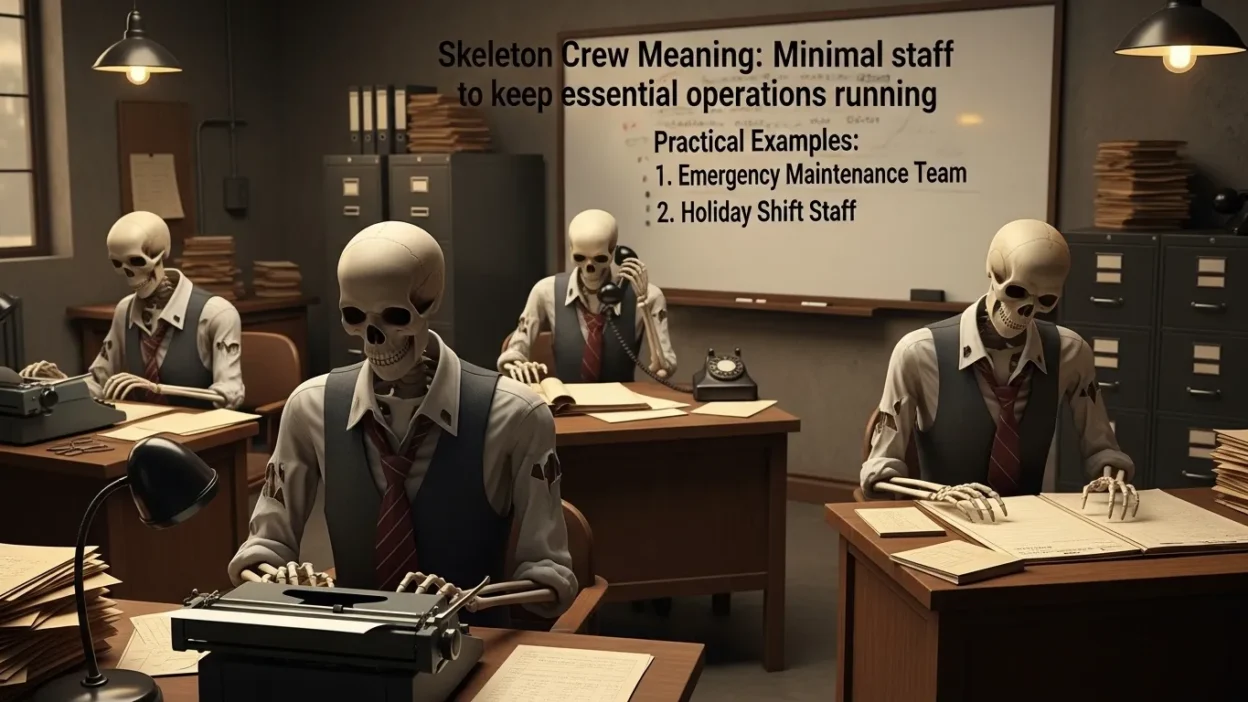
The term “skeleton crew” is commonly used in workplaces, businesses, and even in emergency situations, but many people aren’t entirely sure what it means. Simply put, a skeleton crew refers to the minimum number of staff needed to keep an operation running.
It’s a way for organizations to maintain essential functions while operating with fewer employees than usual. This concept is especially relevant during holidays, emergencies, or periods of low activity, when only the most essential personnel are required.
Originally a nautical term, skeleton crew described the minimal number of sailors needed to navigate a ship safely. Today, it’s widely used in offices, retail, healthcare, and other industries.
Understanding what a skeleton crew entails can help employees, managers, and business owners plan staffing efficiently and avoid confusion. In this guide, we’ll explore the definition, origin, examples, synonyms, and practical uses of a skeleton crew in different contexts.
What Does “Skeleton Crew” Mean?
A skeleton crew refers to the smallest number of people required to keep an organization, business, or operation functioning. The idea is to have just enough staff to maintain essential tasks while temporarily operating below normal capacity. This term is often used in workplaces during holidays, off-peak seasons, emergencies, or situations where full staffing is unnecessary or unavailable.
In simpler terms, imagine a company that usually has 20 employees but only needs 5 to handle critical operations during a slow period. Those 5 employees would form the skeleton crew. The concept ensures that work continues smoothly without overwhelming the remaining staff or compromising safety and service quality.
While the phrase might sound negative, it’s mostly neutral and practical. It doesn’t imply laziness or inefficiency; rather, it highlights careful planning and prioritization. A skeleton crew focuses on the core operations, avoiding non-essential tasks until the full team returns.
The term is versatile. It can apply to offices, factories, hospitals, retail stores, airports, and even ships. Essentially, any environment that requires ongoing operations can temporarily rely on a skeleton crew to maintain continuity.
In short, a skeleton crew is a minimalist staffing approach that balances efficiency with practicality, allowing organizations to continue operating with fewer people while keeping essential functions intact.
Skeleton Crew Meaning in Business
In a business context, a skeleton crew refers to the minimum number of employees needed to maintain core operations when the organization is running at reduced capacity. Many companies rely on skeleton crews during holidays, seasonal slow periods, or temporary staff shortages to keep essential functions running smoothly without overstaffing.
For example, a retail store during Christmas or New Year’s might operate with just a few cashiers, a manager, and a stock clerk, while non-essential roles like extra sales assistants are temporarily absent. Similarly, in an office environment, a skeleton crew may handle customer service, payroll, or IT support during weekends or public holidays, ensuring that vital operations continue uninterrupted.
Operating with a skeleton crew allows businesses to save costs, manage resources efficiently, and maintain business continuity. However, it requires careful planning to ensure that workloads are manageable and that key responsibilities are covered. Employees on a skeleton crew often wear multiple hats, taking on additional tasks temporarily to meet the organization’s critical needs.
It’s important to note that a skeleton crew is not the same as being understaffed permanently. It’s a temporary strategy to operate efficiently with fewer people while minimizing disruption. Companies use this approach during slow periods, emergencies, or when full staffing is unnecessary. By understanding the concept, managers can plan schedules better, avoid employee burnout, and maintain a high level of service even with a minimal workforce.
Origin of the Term “Skeleton Crew”
The phrase “skeleton crew” has its roots in maritime history. Originally, it described the minimum number of sailors required to keep a ship operational while at sea. In the days of sailing ships, a vessel might have a full crew for regular operations, but during long voyages, port stays, or emergencies, only a few essential sailors were needed to navigate, maintain the ship, and ensure safety. This minimal crew became known as the skeleton crew because they represented the bare bones of the full team.
Over time, the term expanded beyond nautical use. By the 20th century, businesses, offices, and other organizations began using “skeleton crew” to describe a minimal staffing approach during periods of low activity, emergencies, or temporary absence of staff. The concept retained its meaning of “just enough people to keep essential functions running,” but its application became broader, extending to offices, retail stores, hospitals, airports, and even military operations.
Linguistically, the word “skeleton” conveys the idea of the bare minimum structure—just like a skeleton supports the body with only the essential framework. This imagery helped the phrase stick in everyday language, making it a popular way to describe minimal staffing across industries.
Today, understanding the origin of “skeleton crew” is more than just trivia—it explains why the term implies efficiency, necessity, and minimalism, rather than incompetence or neglect. It also highlights the historical connection between maritime practices and modern business operations, showing how practical concepts evolve into common workplace language.
Skeleton Crew vs Short-Staffed – What’s the Difference?
Many people confuse a skeleton crew with being short-staffed, but the two terms have distinct meanings and implications. Understanding the difference helps businesses communicate staffing strategies clearly and avoid misunderstandings.
A skeleton crew is intentional and planned. It represents the minimum number of employees required to maintain essential operations. Organizations deliberately schedule a skeleton crew during holidays, weekends, slow business periods, or emergencies. The purpose is efficiency: the staff working the skeleton crew are expected to cover only critical tasks, ensuring that operations continue smoothly despite fewer people.
On the other hand, being short-staffed is often unplanned and potentially problematic. It occurs when there aren’t enough employees due to unexpected absences, resignations, or sudden demand surges. Short-staffed situations can lead to employee burnout, decreased service quality, and operational delays because the workforce is insufficient to handle normal workloads. Unlike a skeleton crew, short-staffing is usually seen as a challenge or problem rather than a strategic choice.
Another distinction lies in duration and expectation. Skeleton crews are usually temporary and communicated in advance, allowing staff to prepare. Short-staffed conditions are often reactive, requiring employees to manage extra tasks unexpectedly.
In summary, a skeleton crew is a planned, efficient minimal workforce, while being short-staffed is an unplanned shortage of personnel. Recognizing this difference helps managers schedule staff effectively, maintain business continuity, and set proper expectations for employees.
Examples of Skeleton Crew in Sentences
Understanding the concept of a skeleton crew is easier when you see it in action. Here are practical examples across different workplaces and situations:
- Business/Office Example:
“During the holiday season, only a skeleton crew of five employees remained at the office to handle customer support and urgent emails.”
This shows how companies maintain essential operations even when most staff are on leave. - Retail Example:
“The store operated with a skeleton crew on Black Friday morning, ensuring that checkout counters and security were staffed while the rest of the team prepared for the main shift.”
Here, the skeleton crew handles only critical roles, letting the business function without full staff. - Healthcare Example:
“The hospital ran with a skeleton crew overnight, including a nurse, a doctor, and one administrative assistant, to cover emergencies while most staff rested.”
This highlights how vital services continue even with minimal personnel. - Airport Example:
“The airport was managed by a skeleton crew during the night, with only essential air traffic controllers and security staff on duty.”
In such scenarios, safety and core operations are prioritized. - Maritime Example:
“The ship sailed with a skeleton crew of ten, enough to operate the vessel until more crew members arrived at the next port.”
This reflects the historical origin of the term.
These examples show that a skeleton crew is about maintaining essential functions efficiently. Whether in an office, retail store, hospital, airport, or at sea, the skeleton crew ensures that operations continue smoothly with the minimum number of staff required.
Synonyms of Skeleton Crew
If you want to expand your vocabulary or avoid repetition in writing, there are several synonyms and related terms for skeleton crew. These alternatives capture the idea of minimal staffing or essential personnel in different contexts.
- Minimal Staff – This is the most straightforward synonym. It refers to having the smallest number of employees necessary to keep operations running. For example: “The office was open with minimal staff during the long weekend.”
- Reduced Workforce – Often used in business or HR contexts, this emphasizes a temporary or strategic decrease in staff numbers. Example: “The company continued operations with a reduced workforce while renovations were underway.”
- Essential Personnel – This term highlights that only the critical employees required for core tasks are present. Example: “Only essential personnel were allowed in the building during the power outage.”
- Bare-Bones Team – A casual or informal way to describe a team operating with just the basics. Example: “We managed the project with a bare-bones team during the staff shortage.”
- Limited Personnel – Similar to skeleton crew, it indicates that only a few staff members are available. Example: “The lab operated with limited personnel over the holiday weekend.”
- Lean Team – Often used in business management, this refers to a team structured to be efficient with minimal resources. Example: “The startup operated with a lean team to reduce costs.”
Using these synonyms helps avoid repetition, improve readability, and provide subtle nuance depending on the context. Each term reinforces the idea of efficiency, minimal staffing, and essential operations, which is the core meaning of a skeleton crew.
Is Skeleton Crew a Negative Term?
Many people wonder whether the phrase “skeleton crew” carries a negative connotation. The answer depends largely on context and perception, but in most cases, it is neutral and practical rather than negative.
A skeleton crew simply refers to the minimum number of staff needed to maintain essential operations. It does not imply incompetence, laziness, or inefficiency. Instead, it reflects a planned and strategic approach to staffing. For example, companies operating with a skeleton crew during holidays or off-peak periods are making a conscious decision to reduce staffing temporarily while keeping critical functions running smoothly.
However, the term may feel negative if misunderstood. Some employees might associate it with being overworked or having too few people to handle normal workloads, especially if the skeleton crew is stretched beyond reasonable limits. In such cases, it is not the term itself that is negative, but the implementation of the staffing plan.
The tone of “skeleton crew” also varies by industry. In healthcare, aviation, or emergency services, it is often viewed as professional and responsible, ensuring essential operations continue without interruption. In contrast, in casual conversation, it might sound slightly ominous or stressful if someone expects normal service but finds only a few staff members available.
In summary, skeleton crew is generally neutral, describing a minimal but sufficient workforce. Its perception as negative or stressful depends entirely on how it is implemented and communicated in a workplace or operational setting.
When Should a Company Use a Skeleton Crew?
A skeleton crew is most effective when a company needs to maintain essential operations with minimal staff. Understanding when to implement this strategy ensures efficiency while avoiding overburdening employees.
One common scenario is during seasonal slow periods. Many businesses experience fluctuations in customer traffic or workload. For example, retail stores may operate with a skeleton crew during post-holiday slowdowns, keeping only essential employees on duty to handle core tasks like cash management, inventory checks, and customer service.
Skeleton crews are also useful during holidays and weekends, when most employees are on leave. Offices, hospitals, airports, and other organizations can continue critical functions without requiring full staffing. This ensures business continuity while respecting employees’ time off.
Another situation is during emergencies or crises, such as natural disasters, power outages, or unexpected operational disruptions. A skeleton crew helps maintain vital operations and prevents complete shutdowns.
Temporary cost-saving measures can also warrant a skeleton crew. Companies may reduce staff during slow business periods to minimize expenses while still ensuring essential functions are covered.
It’s important to note that using a skeleton crew requires careful planning. Managers should identify the key tasks and roles that must be covered, ensure employees are aware of their responsibilities, and avoid overloading staff. By doing so, businesses can maintain efficiency, reduce stress, and continue operating effectively with a minimal workforce.
Frequently Asked Questions (FAQs)
Here are some of the most common questions about a skeleton crew, along with clear answers to help you understand the term and its practical use.
1. What does skeleton crew mean in business?
In business, a skeleton crew is the minimum number of employees required to maintain essential operations during slow periods, holidays, or emergencies. It ensures that critical functions continue without overstaffing.
2. Why is it called a skeleton crew?
The term originated from maritime history, where only the bare minimum number of sailors was needed to operate a ship. “Skeleton” symbolizes the minimal framework or core group needed to keep things running.
3. Is a skeleton crew temporary?
Yes, it is usually a short-term, planned arrangement. Once normal operations resume or more staff become available, the skeleton crew is disbanded, and the full workforce returns.
4. What is the difference between skeleton crew and short-staffed?
A skeleton crew is planned and strategic, while being short-staffed is unplanned and often problematic. Skeleton crews are sufficient for essential operations, whereas short-staffed situations may cause delays, stress, or decreased service quality.
5. When do companies use a skeleton crew?
Companies implement skeleton crews during holidays, weekends, slow business periods, emergencies, or cost-saving measures. The goal is to maintain continuity while operating with fewer employees.
These FAQs address the key points about skeleton crews, helping employees, managers, and business owners understand the term, its origin, practical use, and distinction from staffing shortages.
Conclusion:
Understanding the term “skeleton crew” is essential for anyone working in business, healthcare, retail, or any organization that operates with varying levels of staff.
A skeleton crew refers to the minimum number of employees required to keep essential operations running smoothly. It is a practical, strategic approach rather than a negative situation, ensuring that critical tasks continue even when most staff are unavailable.
The term has its origins in maritime history, where ships operated with only the bare minimum number of sailors necessary for safe navigation. Over time, it expanded into the modern workplace, becoming a widely used phrase in offices, hospitals, airports, and retail environments.
Understanding its origins helps explain why the term emphasizes efficiency, necessity, and minimalism rather than inefficiency or lack of effort.
In practice, companies use skeleton crews during holidays, slow seasons, emergencies, or cost-saving periods.
Employees in a skeleton crew often handle essential responsibilities and may take on multiple roles temporarily to maintain operations. It is important to distinguish a skeleton crew from being short-staffed: the former is planned and manageable, while the latter is unplanned and stressful.
By knowing when and how to implement a skeleton crew, organizations can maintain business continuity, optimize resources, and reduce operational risks. For employees and managers alike, understanding the concept allows for better planning, clearer communication, and smoother operations during periods of reduced staffing.
In short, a skeleton crew is a minimal yet efficient workforce that keeps operations alive, demonstrating how organizations can function effectively even with fewer hands on deck.