
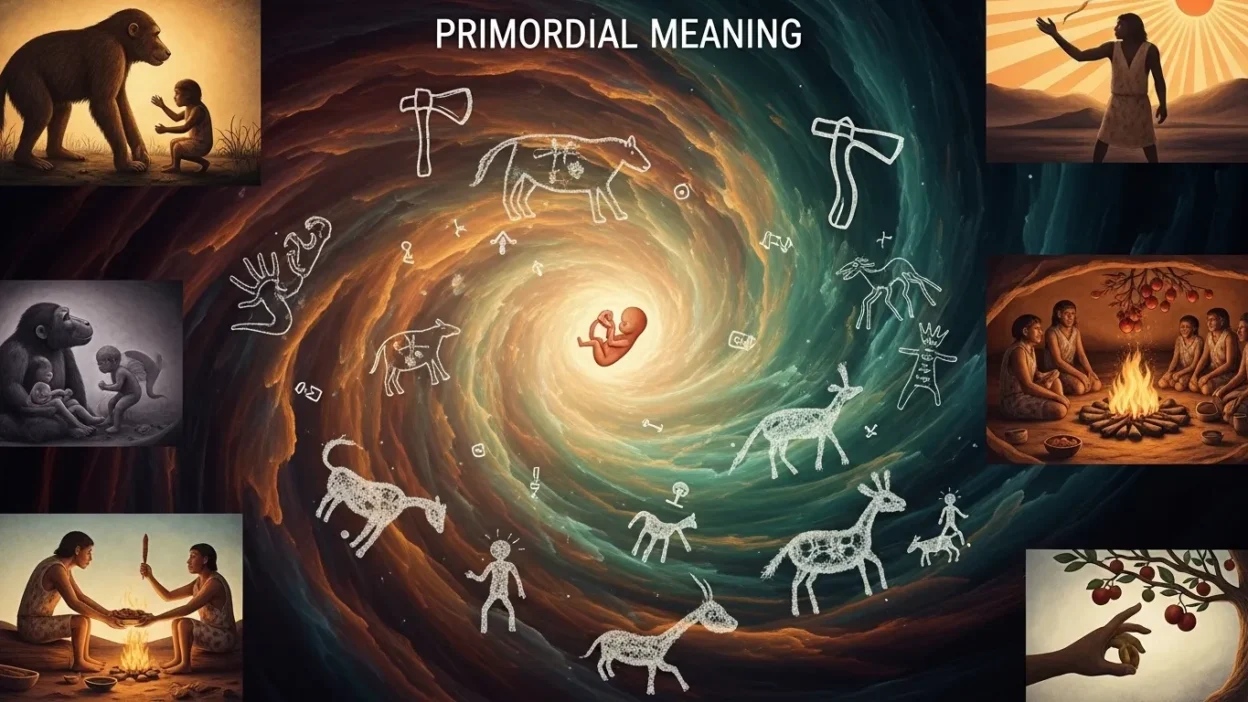
Language is full of fascinating words that carry rich history and deep significance, and “primordial” is one such word. Often used in literature, science, and philosophy, this term refers to something that exists from the very beginning or has the most basic, original form.
Understanding the primordial meaning not only enhances your vocabulary but also helps you grasp complex concepts in various fields.
Whether you are reading about the primordial universe, exploring philosophical ideas, or encountering the word in everyday conversation, knowing its definition, origin, and correct usage can make your communication more precise and engaging.
In this article, we will explore what primordial means, its origin, how to pronounce it, and provide examples, synonyms, and antonyms.
By the end, you will have a clear understanding of the term and be able to use it confidently in both written and spoken English.
What Does Primordial Mean?
The word primordial refers to something that exists from the very beginning, often describing the earliest or most fundamental form of anything. In simple terms, it means original, ancient, or first in existence. For example, when we talk about the primordial universe, we are referring to the universe as it existed at its earliest stage, before stars, planets, and life had formed. Similarly, in everyday language, primordial can describe ideas, instincts, or emotions that are basic and fundamental to human nature.
In a dictionary sense, primordial is defined as: “existing at or from the very beginning; primary; original.” This makes it a versatile word that can apply to time, nature, ideas, or even physical matter. For instance, a primordial forest refers to a forest that has remained untouched and in its original state for thousands of years.
The term is not just limited to literal beginnings. In philosophy and literature, primordial often symbolizes fundamental truths or original principles. For example, a philosopher may speak of a primordial state of human consciousness, meaning the most basic form of awareness before cultural or social influences.
Understanding the primordial meaning allows you to recognize its use in science, philosophy, and literature, making your reading and writing more precise. It also helps you appreciate the deep historical and symbolic connotations the word carries.
Primordial Definition in English
The word primordial is an adjective that describes something existing from the very beginning or forming the earliest stage of development. In English, it is often used to emphasize originality, fundamental importance, or ancient origins. According to standard dictionaries, primordial can be defined as: “existing at or from the very beginning; primary; original; basic and fundamental.” This definition highlights its dual role: both temporal, referring to the earliest time, and conceptual, referring to something fundamental or essential.
In everyday English, primordial is used in various contexts. For example, one might say, “The primordial instincts of survival are present in all humans,” indicating that these instincts are basic and inherent. Similarly, in science, you might hear about a primordial star or primordial soup, referring to the earliest stages of stars or life on Earth.
Primordial is also commonly found in literature and philosophical writing, where it often conveys a sense of timelessness or foundational significance. Phrases like “primordial chaos” or “primordial essence” reflect concepts that predate structured order or civilization.
Understanding the primordial definition in English allows learners and readers to grasp not only the literal meaning but also the symbolic and metaphorical uses of the word. It is a versatile term that bridges science, philosophy, and everyday conversation, making it a valuable addition to anyone’s vocabulary.
Pronunciation of Primordial
Understanding the pronunciation of primordial is important for using the word correctly in both speaking and listening. The word is pronounced as /praɪˈmɔːrdiəl/ in phonetic English. Breaking it down, it has four syllables: pri-mor-di-al. Emphasize the second syllable, so it sounds like “pri-MOR-di-al”. Correct pronunciation ensures clarity, especially when discussing scientific, philosophical, or literary topics where the term often appears.
For non-native speakers, the “pri” is pronounced like the word “pry”, while “mor” rhymes with “more”. The “di” is pronounced softly like “dee”, and the final “al” is a light “uhl”. Putting it together slowly helps: pri-MOR-dee-uhl. With practice, the pronunciation becomes smooth and natural.
There are also a few common mispronunciations to watch out for, such as saying “prim-or-ih-dial” or stressing the wrong syllable. These can make the word sound awkward or unclear. Listening to native speakers, online dictionaries, or pronunciation guides can help reinforce the correct way to say it.
Learning the pronunciation of primordial not only improves your speech but also increases confidence when reading academic texts or discussing concepts like the primordial universe or primordial instincts. By practicing regularly, you can use this word correctly in both conversation and writing, making your English more precise and expressive.
Origin and Etymology of Primordial
The word primordial has a rich linguistic history that traces back to Latin roots, reflecting its deep connection to beginnings and origins. It comes from the Latin word “primordialis”, which itself is derived from “primus”, meaning first, and “ordiri”, meaning to begin or to set in order. Essentially, primordial literally means “first in order” or “existing at the very beginning”.
This etymology highlights why the word is often used to describe things that are fundamental, original, or ancient. Over time, the word migrated into Middle French as “primordial” and eventually entered the English language in the 15th century, maintaining the sense of something primary or original.
Historically, primordial was used in philosophical and theological texts to describe the original state of existence or creation, long before science or modern cosmology existed. For example, thinkers used it to refer to the primordial nature of the universe or the first cause of all things.
In modern English, the term has broadened to include not only philosophical ideas but also scientific and everyday contexts, such as the primordial universe, primordial elements, or even primordial instincts in humans. Knowing the origin and etymology of primordial adds depth to your understanding of the word, helping you appreciate both its literal and metaphorical uses.
Understanding its Latin roots also helps learners remember the meaning: anything primordial is inherently first, original, and fundamental, making it a powerful term in English vocabulary.
Different Contexts of Primordial Meaning
The word primordial is versatile, appearing in a variety of contexts, including science, philosophy, and literature. Understanding these contexts helps readers grasp its nuanced meanings and see how it applies beyond everyday language.
In science, primordial often refers to the earliest stages of the universe, life, or natural phenomena. For example, scientists speak of the primordial universe, meaning the universe in its original form immediately after the Big Bang. Similarly, the primordial soup refers to the mixture of molecules that may have given rise to the first forms of life on Earth. In these contexts, primordial emphasizes originality and fundamental beginnings.
In philosophy, primordial is used to describe basic principles or original states of existence. Philosophers might discuss the primordial nature of consciousness or a primordial state of being, referring to concepts that exist before human experience, culture, or society. Here, the word highlights foundational truths and timeless ideas.
In literature, primordial often conveys a sense of ancient or elemental forces. Writers may describe primordial chaos, primordial landscapes, or primordial emotions to evoke something raw, powerful, and timeless. The term adds depth, connecting human experience to a broader, often universal context.
By exploring the different contexts of primordial, readers can see why the word is more than just a synonym for “ancient.” It represents originality, fundamentality, and the earliest essence of whatever it describes, whether it’s the universe, ideas, or human instincts.
Examples of Primordial in Sentences
Using the word primordial in sentences helps you understand its meaning and apply it correctly in different contexts. Here are several examples across everyday, academic, and literary uses.
Everyday Examples:
- “The child’s primordial curiosity about the world drives them to explore everything.”
- “Even in modern society, humans retain some primordial instincts like fear of danger and the desire for companionship.”
These examples show how primordial can describe basic, inherent traits or behaviors in people or living beings.
Academic Examples:
- “The study of the primordial universe provides insights into the origins of galaxies and stars.”
- “Scientists are investigating the primordial soup, which may have led to the formation of life on Earth.”
In academic contexts, primordial emphasizes the earliest or original stages of phenomena, whether in science, history, or cosmology.
Literary Examples:
- “The poet described the forest as a primordial landscape, untouched by time or human hands.”
- “The novel explores the primordial chaos that existed before the world was formed.”
In literature, primordial often evokes a sense of timelessness, raw power, or original forces, adding depth and imagery to writing.
By looking at these examples, it’s clear that primordial is a versatile word. It can describe original states, fundamental truths, or natural instincts, making it useful in both formal and creative writing. Practicing its usage in sentences will help you internalize the meaning and use it confidently in speech and writing.
Synonyms of Primordial
Understanding the synonyms of primordial can help you use the word more flexibly and enrich your vocabulary. While primordial emphasizes originality and earliest existence, several words share similar meanings but may vary slightly in context.
1. Primeval – This word often refers to something ancient and existing from the earliest times. For example, a primeval forest is a forest that has remained untouched for thousands of years.
2. Ancient – A more general term, ancient describes anything very old or belonging to the distant past. For instance, ancient civilizations or ancient traditions.
3. Original – While less specific to time, original highlights the first form or initial version of something. For example, “The original manuscript was handwritten centuries ago.”
4. Primitivs – This synonym emphasizes simplicity or early development. It is often used in anthropology or historical contexts, such as “primitivs tools”.
5. Earliest – This word directly points to the first in order or time, such as “the earliest records of human history.”
While these words are related, each carries slight differences in nuance. Primeval and ancient focus more on age, original on the first version, primitivs on simplicity or early stage, and earliest on chronological order.
Using these synonyms interchangeably with primordial depends on the context. For example, in science, primordial universe is more precise than ancient universe, while in literature, primordial chaos might evoke a more symbolic meaning than primeval chaos.
By learning these synonyms, you can express ideas more precisely and make your writing richer and more varied.
Antonyms of Primordial
While understanding synonyms helps expand vocabulary, knowing the antonyms of primordial is equally important to use the word accurately and in contrast. Since primordial refers to something original, earliest, or fundamental, its antonyms generally describe things that are recent, modern, or new.
1. Modern – Modern refers to something relating to the present or recent times, often in contrast to ancient or original forms. For example, “Modern technology has replaced many primordial tools used in ancient societies.”
2. Recent – This word emphasizes newness or occurrence in the near past, unlike primordial, which indicates the earliest beginnings. For instance, “Recent studies focus on changes in human behavior rather than primordial instincts.”
3. Contemporary – Often used to describe something existing in the same time as the present, it highlights the present era rather than the origin. For example, “Contemporary architecture differs greatly from the primordial structures of early civilizations.”
4. New – A simple antonym that denotes something recently created or introduced, opposite to the first or original state implied by primordial. For example, “The new artificial ecosystem contrasts with the primordial forests untouched by humans.”
Using antonyms effectively allows writers to highlight contrasts. For example, discussing the primordial universe versus modern cosmology or primordial instincts versus learned behaviors helps clarify meaning and adds depth to descriptions.
By understanding the antonyms of primordial, you can communicate ideas about time, development, and evolution more precisely, making your writing or speech both nuanced and accurate.
Related Words and Forms of Primordial
The word primordial not only functions as an adjective but also has several related forms that expand its usage in English. Understanding these forms helps you use the word more flexibly in writing and speech.
1. Primordially (Adverb) – This form describes the manner in which something exists from the beginning or fundamentally. For example: “Human instincts are primordially rooted in survival.” It emphasizes that the action or quality is tied to the original or earliest state.
2. Primordiality (Noun) – This noun form refers to the quality or state of being primordial. For example: “The primordiality of the universe is a subject studied in cosmology.” It is often used in academic or philosophical discussions to convey abstract concepts.
3. Primordialism (Concept in Social Science and Politics) – Primordialism is a term used in sociology and political science to describe the idea that ethnic and cultural identities are deeply rooted and inherent, often dating back to the earliest times. For example: “Primordialism suggests that loyalty to one’s community is based on innate bonds.”
These related forms allow for more precise expression, depending on whether you are describing an action, a state, or a theoretical concept. While primordial is widely used to describe things that are ancient or fundamental, its variations help you convey nuanced ideas in different contexts.
Using primordially, primordiality, or primordialism can make your writing more academic, descriptive, or analytical, providing depth beyond the basic adjective. Understanding these forms ensures that you can discuss primordial concepts across science, literature, philosophy, and social studies with confidence.
Difference Between Primordial and Similar Words
Understanding the difference between primordial and similar words helps ensure precise usage in both writing and speech. While several words overlap in meaning with primordial, each carries subtle distinctions in context and nuance.
1. Primordial vs Primeval
Both words refer to ancient or earliest times, but primeval often emphasizes age or ancient history, particularly in nature. For example: “A primeval forest has existed for thousands of years,” whereas “primordial instincts drive human survival” emphasizes fundamental and original qualities, not just age.
2. Primordial vs Primitivs
Primitivs highlights early development or simplicity, often implying a lack of sophistication. For instance, “Primitiv tools were made of stone”. In contrast, primordial focuses on origin and basic essence, without implying simplicity. “Primordial forces shaped the universe” shows fundamental beginnings rather than simplicity.
3. Primordial vs Ancient
Ancient generally refers to anything very old, such as “ancient civilizations”. Primordial, however, specifically points to the first or original form, like “the primordial universe”. Ancient is descriptive of time, whereas primordial often conveys both time and fundamental significance.
4. Primordial vs Original
Original refers to the first version of something, like a manuscript or idea. Primordial goes deeper, often connecting to earliest beginnings or foundational existence. For example, “Original art inspired later works,” versus “Primordial chaos existed before the creation of the world.”
By knowing these differences, you can choose the right word for context, whether discussing nature, history, literature, or science. This precision enriches your writing and ensures clarity, particularly in academic or literary works.
Common Phrases and Expressions with Primordial
The word primordial often appears in various phrases and expressions, especially in science, literature, and philosophical writing. Understanding these common usages helps readers see how the word conveys originality, fundamental essence, or ancient beginnings.
1. Primordial Universe – This phrase refers to the earliest stage of the universe, immediately following the Big Bang. For example: “Cosmologists study the primordial universe to understand the formation of galaxies and stars.”
2. Primordial Soup – Used in biology, this expression describes the mixture of organic molecules that may have led to the first life forms on Earth. Example: “The primordial soup theory explains how life might have originated billions of years ago.”
3. Primordial Chaos – Often used in literature or philosophy, this phrase symbolizes a state of disorder before creation or order. For instance: “The myth describes primordial chaos before the world was formed.”
4. Primordial Forces – This term refers to basic natural or cosmic forces that shaped the early universe or existence. Example: “Primordial forces of nature continue to influence the Earth’s climate.”
5. Primordial Instincts – In psychology or everyday use, it describes basic human instincts present from birth, such as survival or the need for connection. Example: “Primordial instincts guide humans even in complex societies.”
By recognizing these common phrases, readers can better understand how primordial functions in different contexts. These expressions often emphasize originality, fundamental importance, or earliest existence, making the word both versatile and impactful in writing and conversation.
Why the Word Primordial Is Important
The word primordial holds significant importance because it conveys concepts of origin, foundation, and the earliest state of existence. Understanding and using this word allows writers, speakers, and learners to describe ideas, phenomena, and instincts with precision and depth.
In science, primordial is crucial for discussing the earliest stages of the universe, life, or natural elements. Terms like primordial universe or primordial soup help scientists communicate complex ideas about the origin of matter and life in a concise and accurate way. Without this word, describing such fundamental beginnings would require lengthy explanations.
In philosophy, primordial emphasizes the original or foundational aspects of existence. Philosophers use it to discuss concepts such as the primordial state of consciousness or fundamental truths that precede culture and social constructs. It allows deep exploration of ideas about life, human nature, and the universe.
In literature and writing, primordial is important because it evokes timelessness, raw power, and original forces. Describing a setting as a primordial forest or a situation as primordial chaos adds vivid imagery and symbolic meaning.
Additionally, knowing the word primordial enhances vocabulary and communication skills. It allows learners to express abstract, scientific, or philosophical concepts accurately, making writing and speech more sophisticated.
Overall, the word is not only a linguistic tool but also a bridge across disciplines, connecting science, literature, and philosophy. Understanding primordial ensures that readers and writers can discuss the earliest, most fundamental aspects of the world effectively.
Tips for Using Primordial Correctly
Using the word primordial correctly can make your writing and speech more precise, expressive, and sophisticated. Since it refers to original, fundamental, or earliest states, applying it in the right context is key.
1. Use Primordial for Beginnings or Origins
The word is most effective when describing something that exists from the very beginning. For example: “Scientists study the primordial universe to understand the origins of matter.” Avoid using it for ordinary or recent things, as that would be incorrect.
2. Apply It in Scientific, Philosophical, or Literary Contexts
Primordial is commonly used in science (primordial soup, primordial elements), philosophy (primordial consciousness, primordial truths), and literature (primordial chaos, primordial forests). Using it in these contexts makes your writing sound accurate and thoughtful.
3. Pair with Abstract or Fundamental Concepts
The word works well with ideas, forces, or instincts that are basic or elemental. For example, “Primordial instincts drive human survival” conveys a deeper meaning than simply saying “basic instincts.”
4. Avoid Overuse
Primordial is a strong and precise word, so overusing it can make your writing sound repetitive or forced. Reserve it for instances where you truly mean original, fundamental, or earliest.
5. Combine with Supporting Words
Using adjectives or nouns like chaos, universe, instincts, or forces can clarify the meaning. For example: “Primordial forces shaped the Earth in its earliest days.”
By following these tips, you can confidently incorporate primordial into your vocabulary, enhancing both academic and creative writing while conveying depth and precision.
(FAQ)
Understanding the word primordial often raises several common questions. Here are answers to the most frequently asked ones, which help clarify its meaning and usage.
1. What is the simple meaning of primordial?
Primordial means existing from the very beginning or being fundamental and original. It can describe objects, ideas, forces, or instincts that are earliest or most basic in nature.
2. How do you use primordial in a sentence?
You can use it to describe both literal and abstract concepts. Examples include:
- “The primordial universe existed before stars and planets formed.”
- “Humans have primordial instincts that guide survival.”
3. What is primordial in science?
In scientific contexts, primordial often refers to the earliest stages of the universe, life, or natural phenomena. Terms like primordial soup or primordial star describe the first forms of life or cosmic matter.
4. Is primordial the same as ancient?
Not exactly. While both relate to age, ancient refers to something very old, whereas primordial emphasizes originality and the earliest existence, often with a sense of fundamental importance.
5. How do you pronounce primordial?
It is pronounced /praɪˈmɔːrdiəl/, with the emphasis on the second syllable: pri-MOR-di-al.
6. What is the origin of the word primordial?
Primordial comes from Latin “primordialis”, derived from “primus” (first) and “ordiri” (to begin). It entered English in the 15th century, keeping the sense of original or primary.
Answering these FAQs helps learners and readers fully grasp the meaning, pronunciation, and application of primordial in various contexts, from everyday speech to scientific and philosophical writing.
Conclusion:
The word primordial is a powerful term that conveys the idea of originality, fundamental existence, and the earliest stages of life, the universe, or concepts.
Understanding its meaning, pronunciation, origin, and usage not only enriches your vocabulary but also allows you to express complex ideas with precision and depth.
Primordial is widely used across multiple fields. In science, it describes the earliest forms of matter, life, or cosmic phenomena, such as the primordial universe or primordial soup.
In philosophy, it highlights fundamental truths and original states of consciousness, offering a framework for exploring existence and human nature. In literature, it evokes ancient, elemental forces or timeless imagery, adding power and symbolism to writing.
By learning the synonyms and antonyms of primordial, along with its related forms like primordially and primordiality, you can use the word effectively in both academic and creative contexts.
Understanding common phrases, such as primordial chaos or primordial instincts, further enhances comprehension and usage.
Incorporating primordial into your vocabulary allows you to describe beginnings, fundamentals, and essential qualities with clarity and sophistication.
Whether you are writing, speaking, or reading, grasping this word enriches your communication and allows you to connect ideas across science, literature, and philosophy.
Ultimately, primordial is more than just a word it is a concept that bridges history, nature, and human understanding, enabling you to articulate the most fundamental aspects of the world and existence itself.

Welcome to TextFlirtz.com, your ultimate destination for flirty, fun, and clever text messages! Whether you’re looking to break the ice, charm your crush, or keep the sparks alive in your relationship, we’ve got a treasure trove of pick-up lines, flirty texts, and witty messages that make flirting effortless and exciting. Dive in, explore, and let your words do the magic—because at TextFlirtz.com, every message is a chance to flirt smarter, not harder.