
Understanding the word “preempted” can be surprisingly tricky, especially since it is used in multiple contexts from everyday conversations to legal and business settings.
Many people encounter it in news reports, TV schedules, or legal documents, and often wonder, “What exactly does it mean?” At its core, preempted refers to taking action in advance to prevent, replace, or supersede something.
However, the nuances vary depending on the situation: a TV program might be preempted by breaking news, a law can preempt a local regulation, or a business strategy may preempt a competitor’s move.
Knowing how to use the word correctly not only improves your vocabulary but also helps you communicate more precisely in writing and conversation.
In this article, we will explore the meaning of preempted, its origins, different contexts, examples in sentences, synonyms, antonyms, common mistakes, and tips for proper usage.
What Does “Preempted” Mean?
The word “preempted” is the past tense of the verb “preempt,” which generally means to take action ahead of something else in order to prevent it or gain an advantage. In simple terms, if something is preempted, it is replaced, interrupted, or addressed before it happens. The meaning, however, can change slightly depending on the context in which it is used.
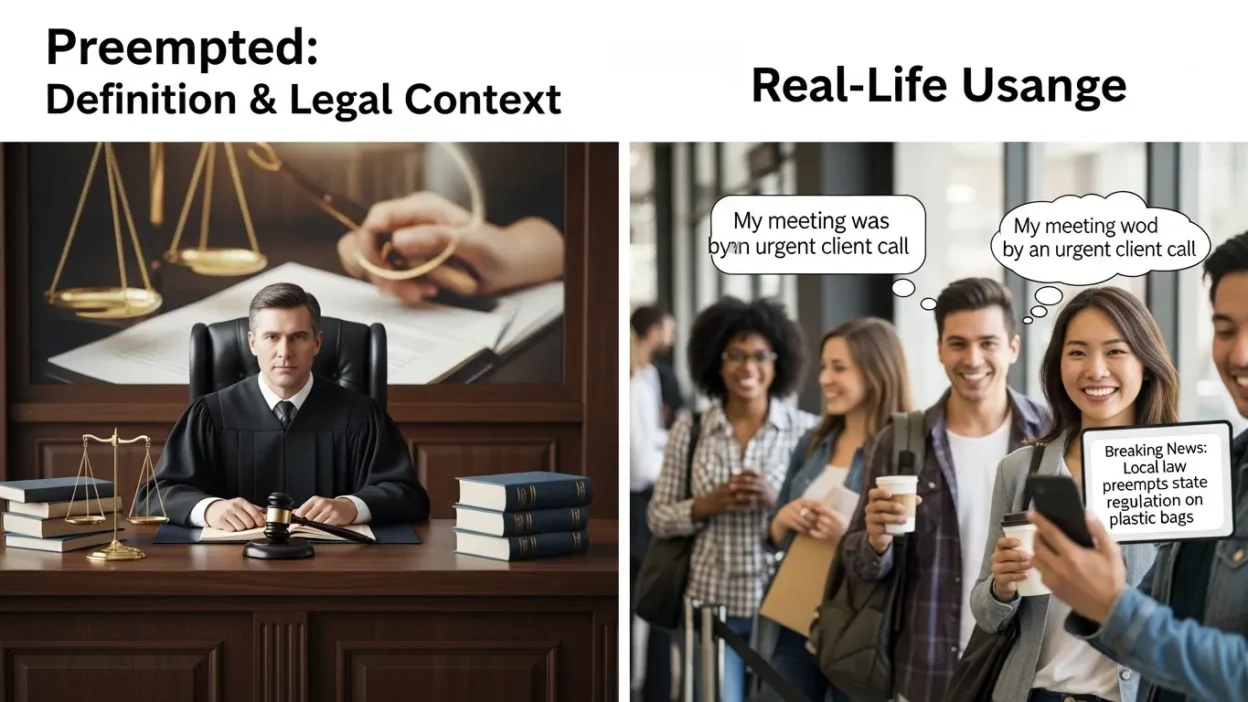
In everyday conversation, preempted often refers to situations where plans or events are disrupted or replaced by something more urgent. For example: “Our meeting was preempted by an unexpected announcement from management.” Here, the meeting did not happen as planned because something else took its place.
In legal or political contexts, preempted has a more formal meaning. It often describes how higher authority or federal law can override or take precedence over local laws. For instance: “Federal regulations preempt state law on this matter,” meaning the federal law takes priority and local rules cannot contradict it.
In media or broadcasting, the term is used when a scheduled program is replaced or interrupted by breaking news or special events. For example: “Tonight’s episode was preempted by a live sports broadcast.”
Understanding these nuances is essential because using preempted incorrectly can lead to confusion. It is not simply the same as “stopped” or “prevented” it implies that an action was strategically or automatically taken before something else occurred.
Origin and Etymology of “Preempted”
The word “preempted” comes from the verb “preempt,” which has its roots in the Latin word “praeemere,” meaning “to buy beforehand” or “to take before someone else.” This Latin term combines “prae” (before) and “emere” (to buy or take), highlighting the idea of acting in advance to secure something or prevent another from doing so. Over time, the meaning expanded beyond literal buying to include any action taken proactively to prevent, replace, or supersede something.
In English, preempt was first used in the 16th century, initially in legal and property contexts, where it described the act of purchasing or claiming land before others could. By the 19th century, its usage broadened to include general preventative actions, strategies, and interventions, as well as in military and political contexts.
The past tense form, preempted, therefore carries the historical sense of acting first to gain an advantage or prevent an undesired outcome. This etymology helps explain why the word often implies both timing and strategy it’s not merely stopping something, but doing so proactively or preemptively.
Today, preempted is widely used in multiple areas: legal, business, media, and everyday conversation. Understanding its historical origins clarifies why the word suggests taking deliberate, often strategic action before something else occurs. Knowing this background can also help learners of English use the word more accurately and confidently.
Different Meanings of “Preempted” by Context
The word “preempted” can take on different meanings depending on the context, which is why understanding its usage in various situations is essential.
1. Everyday Meaning
In daily conversation, preempted usually refers to plans, events, or actions being replaced or interrupted by something considered more urgent. For example: “Our team meeting was preempted by a fire drill.” In this case, the original event didn’t occur because something else required attention first. This usage emphasizes timing and priority.
2. Legal Meaning
In legal contexts, preempted carries a formal definition. It often refers to a higher authority’s law or regulation overriding a lower one. For instance: “Federal law preempts state legislation on environmental standards.” Here, preemption indicates that the federal law takes precedence, and the state law cannot conflict with it. This meaning is crucial in government, policy, and legal discussions.
3. Business and Strategic Meaning
In business or strategy, preempted describes proactive actions to gain a competitive advantage. For example: “The company preempted its competitor by launching a new product early.” This usage highlights foresight and strategic timing rather than simple prevention.
4. Media and Broadcasting Meaning
In television, radio, or online media, preempted refers to a scheduled program being replaced or delayed by another event. Example: “Tonight’s show was preempted by live breaking news.” This emphasizes rescheduling or replacement due to priority content.
By examining these contexts, readers can see that preempted is not a one-size-fits-all word. Its precise meaning depends on timing, authority, strategy, or priority, making it versatile yet nuanced.
How to Use “Preempted” in a Sentence
Using “preempted” correctly in a sentence requires understanding its verb forms and the context in which it is applied. As the past tense of “preempt,” it describes an action that has already occurred to prevent, replace, or take priority over something else.
Verb Forms
- Preempt – base form: “They preempt action to avoid conflict.”
- Preempted – past tense: “The meeting was preempted by an urgent announcement.”
- Preempting – present participle/continuous: “She is preempting potential problems by preparing in advance.”
Examples in Everyday Use
- “Our lunch plans were preempted by a sudden change in schedule.”
- “The game was preempted due to heavy rain.”
Examples in Legal or Political Context
- “Federal law preempted the local ordinance, ensuring uniform standards across states.”
- “The government preempted conflicting state regulations to streamline policy.”
Examples in Business or Strategy
- “The company preempted its competitor by releasing the product early.”
- “By preempting market trends, they secured a major advantage.”
Media and Broadcasting Examples
- “Tonight’s show was preempted by breaking news coverage.”
- “The scheduled program was preempted for a live sports broadcast.”
When using preempted, it is important to remember that it implies deliberate action taken beforehand or to gain priority, rather than merely stopping or canceling something. By practicing with these examples, you can confidently apply the word in various contexts, from casual conversation to professional writing.
Synonyms and Antonyms of “Preempted”
Understanding synonyms and antonyms of “preempted” can help you use the word more precisely and avoid common mistakes. While preempted implies acting ahead of time to replace, prevent, or take priority over something, synonyms may carry slightly different shades of meaning depending on context.
Synonyms
- Prevented – Focuses on stopping something from happening. Example: “The strike prevented the shipment from arriving on time.” Unlike preempted, it doesn’t always imply strategic timing.
- Blocked – Implies creating an obstacle. Example: “New rules blocked the project from proceeding.”
- Forestalled – Emphasizes proactive action to delay or stop something. Example: “They forestalled the crisis by early intervention.”
- Superseded – Highlights replacement or being taken over. Example: “The old software was superseded by a newer version.”
- Replaced – Focuses on substitution. Example: “Her shift was replaced by a coworker.”
Antonyms
- Allowed – Opposite of preempted, meaning something continues or is permitted.
- Permitted – Confirms that an action is authorized or not blocked.
- Continued – Emphasizes that an event or process goes on without interruption.
- Enabled – Suggests facilitation rather than prevention.
While synonyms like prevented or blocked are sometimes used interchangeably with preempted, the key difference is timing and strategy. Preempted usually implies a deliberate action taken ahead of time or as a priority, which makes it more nuanced than general synonyms. Choosing the right word ensures clarity in both writing and speech.
Preempted vs. Similar Words
Many people confuse preempted with similar words such as prevented, interrupted, and replaced. Understanding the subtle differences can help you use each word correctly.
1. Preempted vs. Prevented
While both words involve stopping something from happening, preempted emphasizes taking action beforehand to gain priority or replace something, whereas prevented focuses on stopping something entirely.
- Preempted: “The meeting was preempted by an urgent announcement.” (It was replaced or delayed.)
- Prevented: “The heavy rain prevented the game from taking place.” (It was stopped completely.)
2. Preempted vs. Interrupted
Interrupted implies a temporary halt, often unexpected, while preempted suggests a deliberate or strategic action taken in advance.
- Preempted: “The show was preempted by a special news report.” (Planned replacement.)
- Interrupted: “The lecture was interrupted by a fire alarm.” (Sudden disruption.)
3. Preempted vs. Replaced
Replaced focuses purely on substitution, whereas preempted often includes the element of timing or priority.
- Preempted: “The original broadcast was preempted by breaking news.”
- Replaced: “The old model was replaced by a new one.”
4. Preempted vs. Stopped
Stopped is general and can mean any halt, but preempted implies strategic or preplanned action.
- Preempted: “The policy was preempted to avoid conflicts with federal law.”
- Stopped: “The traffic was stopped by the police.”
By distinguishing preempted from these similar words, you can communicate more precisely and avoid common misunderstandings, whether in conversation, writing, or professional contexts.
Common Mistakes When Using “Preempted”
Even though “preempted” is a versatile and useful word, it is often misused because people confuse it with simpler words like stopped, prevented, or interrupted. Being aware of common mistakes can help you use it correctly.
1. Using “Preempted” as a Simple Synonym for “Stopped”
A common mistake is to say something was preempted when it was merely stopped. For example: “The concert was preempted by rain.” While understandable, the correct phrasing would emphasize that the event was replaced, delayed, or overridden, not just stopped.
2. Confusing Timing and Intent
Preempted implies an action was taken in advance or strategically. Using it for random interruptions is incorrect.
- Incorrect: “The lecture was preempted by a student leaving the room.”
- Correct: “The scheduled lecture was preempted by a fire drill.”
3. Misusing in Tense or Form
Some writers mistakenly use preempted in the wrong tense or structure:
- Incorrect: “They preempting the meeting.”
- Correct: “They are preempting the meeting.”
4. Using It in the Wrong Context
Preempted is formal enough for legal, business, or media contexts. Overusing it in casual settings where simpler words like replaced or stopped would work can sound awkward.
By avoiding these mistakes, you ensure that preempted conveys the intended meaning: a deliberate, timely, or strategic action taken to replace, prevent, or take priority over something else. Proper use of the word improves clarity and professionalism in both writing and speech.
When Should You Use the Word “Preempted”?
Knowing when to use “preempted” is just as important as understanding its meaning. The word is most appropriate in contexts where an action is taken ahead of time, often strategically, to replace, prevent, or take priority over something else.
1. Formal and Professional Contexts
Preempted works well in legal, business, and government communication. For example: “Federal law preempts state legislation in this matter” clearly indicates authority and precedence. In business: “The company preempted its competitor by launching the product early” conveys strategy and foresight. These contexts benefit from the nuance that preempted provides, which simpler words like stopped or replaced cannot fully capture.
2. Media and Broadcasting
The word is commonly used in broadcasting when scheduled programming is replaced by urgent or more important content. Example: “Tonight’s episode was preempted by live coverage of breaking news.” Using preempted here signals that the change was deliberate and necessary, rather than accidental.
3. Everyday Situations
In daily life, preempted can describe interruptions that are proactive or planned. Example: “Our meeting was preempted by a fire drill.” This usage implies the original plan was overridden by something deemed more urgent or important.
Key Tip
Avoid using preempted for casual or random interruptions where no strategy or priority is involved. If something is simply stopped or delayed, words like interrupted, stopped, or replaced may be more natural.
By using preempted in the right situations, you can communicate with precision, clarity, and sophistication, making your language more effective in both professional and casual settings.
Real-World Examples of Preemption
Understanding preempted becomes much easier when you see real-world examples from law, business, media, and politics. These examples illustrate how the word is applied in different contexts.
1. Legal Examples
In legal contexts, preemption occurs when higher authority laws override lower authority laws. For instance: “Federal regulations preempt state laws regarding environmental standards.” Here, the federal law takes priority, preventing conflicting state regulations. Another example: “The court ruled that the state law was preempted by national legislation on healthcare.”
2. Business and Strategic Examples
Companies often act proactively to preempt competitors. Example: “The tech firm preempted its rival by releasing a new smartphone ahead of schedule.” Similarly, marketing strategies can be preemptive: “By launching a promotional campaign early, the brand preempted competitors’ seasonal offers.”
3. Media and Broadcasting Examples
In broadcasting, preemption happens when scheduled programs are replaced by urgent content. Example: “Tonight’s episode was preempted by live coverage of breaking news.” Sports events, political announcements, or emergency alerts frequently preempt regular programming.
4. Political Examples
In politics, leaders sometimes preempt opposition by acting first. Example: “The senator preempted criticism by announcing a new policy initiative before the debate.” This strategic action demonstrates foresight and timing.
These real-world examples show that preempted is versatile, covering formal authority, strategic moves, media scheduling, and daily decision-making. Recognizing these situations helps you understand its nuances and use it correctly in writing and conversation.
Frequently Asked Questions (FAQ) About “Preempted”
Understanding preempted can raise several common questions. Here are the answers to the most frequently asked ones.
1. What does “preempted” mean in simple words?
Preempted means that something was done or acted upon in advance to prevent, replace, or take priority over something else. It often implies a deliberate or strategic action rather than a random interruption.
2. What is the legal meaning of “preempted”?
In law, preempted refers to higher authority laws or regulations overriding lower authority ones. For example, federal law can preempt state law if there’s a conflict, meaning the state law cannot contradict federal regulations.
3. Is “preempted” the same as “prevented”?
Not exactly. While both involve stopping something, preempted emphasizes acting ahead of time or replacing something, whereas prevented focuses on stopping something from happening altogether.
4. How do you use “preempted” in a sentence?
Example sentences:
- “The TV show was preempted by live news coverage.”
- “The company preempted competitors by launching early.”
- “Federal law preempted the state regulation.”
5. What is an example of preempted in everyday life?
A practical example: “Our meeting was preempted by a fire drill,” meaning the meeting didn’t happen as scheduled because something else took priority.
Conclusion:
The word “preempted” is more than just a simple synonym for “stopped” or “replaced.” It carries a nuanced meaning that emphasizes timing, strategy, and priority.
Whether used in everyday conversation, legal contexts, business strategy, or media broadcasting, it conveys that an action was taken deliberately ahead of time to prevent, replace, or take precedence over something else.
Understanding the origins of the word from the Latin “praeemere,” meaning “to buy beforehand” helps clarify why preemption always involves foresight and proactive action.
Real-world examples, such as federal laws preempting state regulations, companies launching products early to beat competitors, or TV programs being preempted by breaking news, show the versatility of the term.
Using preempted correctly not only improves your vocabulary but also enhances clarity in communication. Remember to distinguish it from similar words like prevented, interrupted, or replaced, as each has subtle differences in meaning and context.
Being mindful of proper usage, context, and verb forms ensures your language is precise and professional.
In short, preempted is a powerful word that conveys intentional, timely, and strategic action. By understanding its meanings, applications, and nuances, you can use it confidently in both writing and conversation.
Mastering this word will help you communicate more effectively and demonstrate a higher level of vocabulary sophistication in any context.

Welcome to TextFlirtz.com, your ultimate destination for fun, flirty, and clever pick-up lines that spark conversations and make hearts skip a beat! Whether you’re looking to impress your crush, add some humor to your chats, or just have a playful time texting, we’ve got you covered with lines that are witty, spicy, and unforgettable. Dive in, explore our collections, and start flirting the smart way—because at TextFlirtz.com, words are your best wingman!