
Understanding the term “permissive” is essential for anyone looking to improve their English vocabulary or comprehend behavior, parenting styles, and social attitudes.
At its core, permissive describes a tendency to allow freedom, flexibility, or leniency rather than enforcing strict rules or control. People often encounter this word in everyday conversation, education, psychology, and even legal or workplace contexts.
For instance, a permissive parent may allow children more freedom of choice, while a permissive teacher might avoid strict discipline in the classroom. But being permissive is not inherently positive or negative; its impact depends on the context and balance.
In this article, we will explore the permissive meaning, pronunciation, examples, synonyms, antonyms, and the nuances of permissive behavior in personal, social, and professional settings.
By the end, you’ll have a clear understanding of how to identify, describe, and apply the concept of permissiveness in English communication.
What Does Permissive Mean?
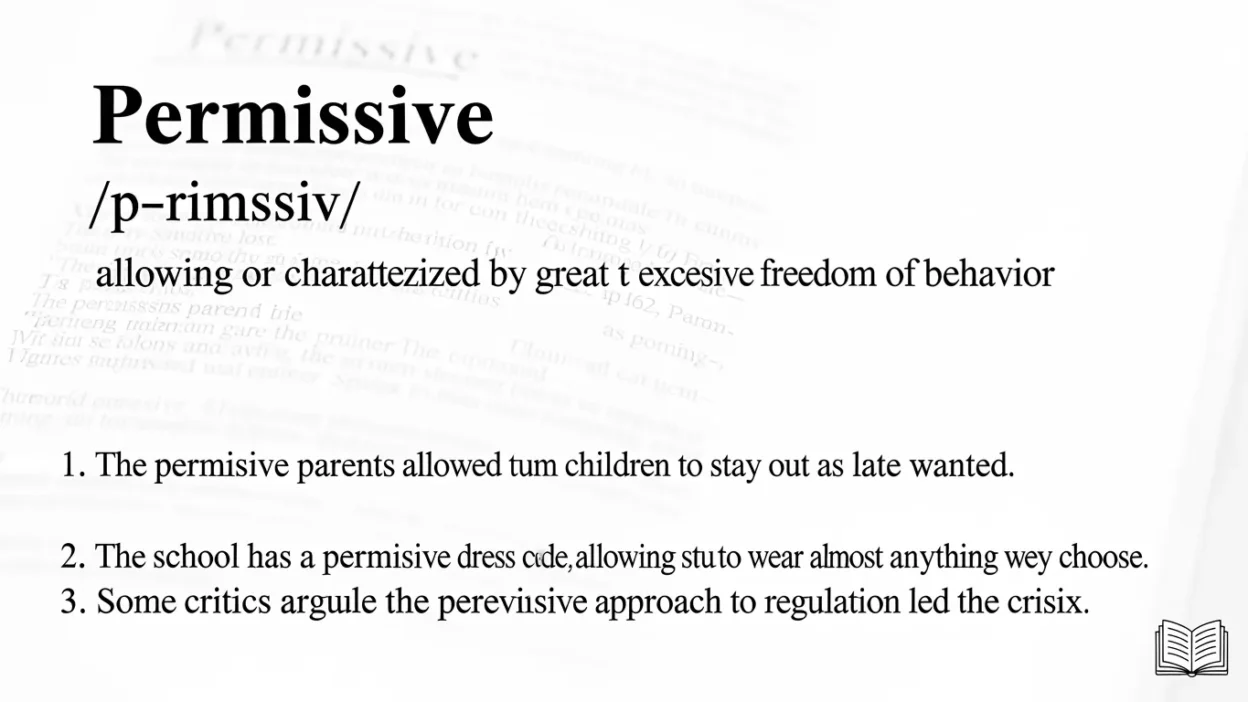
The word permissive is an adjective used to describe someone or something that allows freedom, does not enforce strict rules, or tends to be lenient. In simple terms, if a person, rule, or environment is permissive, it means it permits flexibility and avoids strict control. For example, a permissive teacher might allow students to choose their own project topics instead of assigning them specific tasks.
The meaning of permissive can be applied in various contexts:
- Behavior: A permissive person tends to tolerate different opinions and actions without strict judgment.
- Parenting: Permissive parents give their children more freedom, often prioritizing emotional support over strict discipline.
- Workplace or Society: A permissive environment allows employees or citizens more independence and less rigid rules.
It is important to note that being permissive is not the same as being careless or weak. A permissive attitude is intentional and often aimed at encouraging freedom, creativity, or independence. For instance, permissive parenting can help children develop self-expression, while permissive teaching can foster innovation and critical thinking.
However, extreme permissiveness without boundaries can sometimes lead to confusion, lack of discipline, or difficulty following rules. Therefore, understanding the balance between permissiveness and control is crucial in evaluating whether a permissive approach is beneficial or potentially problematic.
In short, permissive means allowing freedom, being lenient, and avoiding strictness, but its value depends on the situation and context.
Permissive Pronunciation & Word Breakdown
Understanding how to pronounce and break down the word permissive is essential for correct usage in speech and writing. The word is pronounced as /pərˈmɪs.ɪv/, and it consists of three syllables: per‑mis‑sive. The stress is on the second syllable, “mis,” which means it sounds like per-MISS-ive when spoken clearly.
Breaking the word down can help learners remember its meaning:
- Per suggests “through” or “allowing” in the root sense.
- Miss relates to the idea of sending or permitting (from Latin mittere, meaning “to send”).
- -ive a common adjective suffix indicating a quality or tendency.
Together, the word conveys the idea of someone or something that allows, permits, or tolerates rather than restricts.
Using permissive correctly in speech is simple if you remember these tips:
- Emphasize the second syllable: per‑MISS‑ive.
- Keep your tone neutral; it is a descriptive word, not inherently positive or negative.
- Pair it with nouns like attitude, behavior, parent, environment, or rules to make meaningful sentences, for example: “She has a permissive attitude toward her students.”
Knowing the pronunciation and structure of permissive ensures that you can confidently recognize, say, and use the word in conversation, writing, and learning environments. Mastery of pronunciation also helps ESL learners sound natural and articulate when discussing freedom, leniency, or flexible rules.
Permissive Part of Speech & Usage
The word permissive is primarily used as an adjective, which means it is used to describe a noun by showing a characteristic, quality, or tendency. It describes someone or something that allows flexibility, freedom, or leniency, rather than enforcing strict rules. For example:
- “The teacher has a permissive approach to classroom rules.”
- “He grew up in a permissive household where he could make his own choices.”
How to Use Permissive
- With People:
When describing individuals, “permissive” highlights their attitude or personality.
- “A permissive parent often avoids strict rules.”
- “She is quite permissive when it comes to deadlines.”
- “A permissive parent often avoids strict rules.”
- With Rules or Environments:
“Permissive” can describe situations, rules, or environments that allow freedom or flexibility.
- “The company has a permissive policy on work-from-home schedules.”
- “The school adopted a more permissive curriculum to encourage creativity.”
- “The company has a permissive policy on work-from-home schedules.”
- In Comparison:
“Permissive” is often compared to words like strict or authoritarian, emphasizing the contrast between leniency and rigidity.
Tips for Correct Usage
- Always use permissive as an adjective, never as a verb or noun.
- Pair it with nouns like behavior, attitude, parent, rules, environment, or society.
- Avoid confusing it with casual words like “careless” or “lazy”; permissiveness is intentional and situational.
Understanding the part of speech and proper usage ensures that “permissive” communicates the right meaning, whether you are writing about parenting, teaching, leadership, or social behavior.
Permissive Meaning in Simple Words
In simple words, permissive means allowing people to do what they want without strict rules or control. It describes a person, environment, or attitude that is lenient, tolerant, and flexible. For example, if a parent lets a child choose their own bedtime or snacks without strict limits, that parent is considered permissive.
The idea of being permissive can appear in many situations:
- At Home: A permissive household allows children to make decisions about their daily routine, playtime, and personal choices. This can encourage creativity and independence.
- At School: A permissive teacher may let students decide how to complete their projects or participate in classroom discussions freely.
- At Work: A permissive manager might give employees flexibility in work schedules or project methods, trusting them to make their own decisions.
It’s important to understand that being permissive does not mean careless or irresponsible. Instead, it is an intentional approach to allow freedom while still providing guidance when necessary.
For instance, saying “He has a permissive attitude toward rules” means he tends to allow flexibility instead of enforcing strict limits. Similarly, “permissive parenting” refers to a style where parents provide warmth and freedom rather than strict discipline.
In short, permissive is all about freedom and leniency, but its effectiveness depends on balance. Too much permissiveness without boundaries can cause confusion, while the right amount can foster confidence, independence, and creativity.
Permissive Examples in Sentences
Understanding permissive becomes easier when we look at real-life examples. The word can be used to describe people, rules, environments, or behaviors where freedom and leniency are allowed. Here are several examples to illustrate:
- Family:
- “Her parents are very permissive, letting her stay out late with friends.”
- “Growing up in a permissive household, he learned to make his own choices early.”
- School or Education:
- “The teacher adopted a permissive approach to homework, allowing students to decide their topics.”
- “A permissive classroom encourages creativity and independent thinking.”
- Workplace:
- “The manager has a permissive policy regarding office hours, giving employees flexibility to work from home.”
- “In a permissive environment, employees feel trusted and motivated to perform better.”
- Personality or Behavior:
- “She is naturally permissive, never judging others for their choices.”
- “His permissive attitude made him popular among colleagues who needed freedom in their work.”
- Social Situations:
- “The festival had a permissive atmosphere, allowing attendees to express themselves freely.”
Using examples like these helps you see how permissive applies in different contexts. It can describe people, rules, attitudes, or environments that favor freedom, flexibility, and leniency rather than strict control.
In all these cases, the key idea is the balance between allowing freedom and maintaining necessary boundaries, which makes the word both descriptive and practical in everyday English.
Permissive Person Meaning
A permissive person is someone who tends to be lenient, flexible, and tolerant rather than strict or controlling. Such individuals often allow others to make their own choices and avoid imposing rigid rules or harsh discipline. Being permissive does not mean being careless or irresponsible; it reflects a conscious choice to provide freedom while guiding when necessary.
Key Traits of a Permissive Person:
- Lenient: They rarely enforce strict rules and prefer a softer approach in guiding behavior.
- Tolerant: They accept different opinions, lifestyles, and actions without judgment.
- Flexible: They adapt easily to changing situations and allow others to make decisions.
- Encouraging Independence: They trust others to handle responsibilities on their own.
- Patient: They give space for learning from mistakes rather than punishing immediately.
Examples in Daily Life:
- A permissive parent may let a child choose their bedtime or extracurricular activities.
- A permissive teacher allows students to explore creative methods to complete a project.
- A permissive manager lets employees set their own work schedules.
Advantages of a Permissive Person:
- Promotes creativity and self-expression
- Builds trust and confidence in others
- Encourages personal responsibility
Possible Challenges:
- Excessive permissiveness may lead to a lack of discipline
- Boundaries may become unclear for those under their guidance
In short, a permissive person is someone who favors freedom and flexibility in interactions, relationships, and decision-making. Understanding this personality type helps in recognizing behavior patterns in families, schools, workplaces, and social settings.
Permissive Parenting Meaning
Permissive parenting is a style in which parents are lenient, flexible, and supportive, allowing children more freedom and autonomy while avoiding strict rules or harsh discipline. This style focuses on nurturing a child’s emotional growth and self-expression rather than enforcing rigid control.
Key Characteristics of Permissive Parenting:
- High Responsiveness: Parents are warm, caring, and attentive to their child’s needs.
- Low Demands: Rules and expectations are minimal; children often make their own decisions.
- Freedom of Choice: Children are encouraged to explore, decide, and learn independently.
- Avoidance of Punishment: Discipline is rare, with emphasis on guidance and explanation instead.
Examples:
- Letting children choose their bedtime or daily schedule.
- Allowing unlimited screen time or play choices without strict limits.
- Avoiding strict consequences for mistakes, focusing instead on discussion.
Advantages of Permissive Parenting:
- Encourages creativity and self-expression
- Builds strong emotional bonds between parent and child
- Develops independence and confidence
Disadvantages:
- Children may struggle with boundaries and self-discipline
- Potential for behavioral problems if limits are too vague
- May face challenges in structured environments like schools
Permissive parenting is not inherently negative; its effectiveness depends on balancing freedom with guidance. When applied thoughtfully, it can nurture confidence, responsibility, and individuality in children. Understanding the meaning of permissive parenting helps parents, educators, and caregivers evaluate when leniency supports development and when firmer boundaries may be necessary.
Permissive Attitude Meaning
A permissive attitude refers to a mindset or approach in which a person tends to allow freedom, flexibility, or leniency instead of enforcing strict rules or rigid control. This attitude can appear in personal behavior, social interactions, workplace management, or everyday decision-making.
Key Features of a Permissive Attitude:
- Tolerance: Accepting different opinions, choices, and actions without judgment.
- Flexibility: Adapting easily to varying situations and allowing others to make decisions.
- Non-restrictiveness: Avoiding strict rules or regulations that limit behavior.
- Supportive Approach: Encouraging independence and creativity instead of enforcing compliance.
Examples in Daily Life:
- Workplace: A manager with a permissive attitude may let employees choose how to complete their tasks or set their own deadlines.
- Social Situations: A friend with a permissive attitude may respect your decisions even if they differ from their own.
- Family: A parent with a permissive attitude allows children to express themselves freely, deciding how to handle homework or chores.
Positive and Negative Aspects:
- Positive: Promotes creativity, trust, and independence. People feel valued and empowered.
- Negative: Excessive permissiveness may lead to unclear boundaries, poor discipline, or dependency issues in certain contexts.
In essence, a permissive attitude reflects a balance between freedom and guidance. It is highly valued in situations where innovation, independence, and emotional well-being are important. However, understanding when to apply limits ensures that permissiveness remains constructive rather than chaotic.
Permissive Synonyms
Understanding synonyms of the word permissive helps expand vocabulary and allows you to use the term more accurately in different contexts. While “permissive” describes leniency, tolerance, or flexibility, its synonyms emphasize similar qualities with subtle differences.
Common Synonyms of Permissive:
- Lenient Indicates a person or rule that is not strict and allows some freedom.
- Example: “The teacher was lenient with late submissions.”
- Example: “The teacher was lenient with late submissions.”
- Tolerant Refers to accepting differing opinions, beliefs, or behaviors without criticism.
- Example: “She is tolerant of people from all cultures.”
- Example: “She is tolerant of people from all cultures.”
- Flexible Suggests adaptability and willingness to change rules or plans.
- Example: “The company has a flexible work schedule.”
- Example: “The company has a flexible work schedule.”
- Easygoing Describes someone relaxed and unconcerned with enforcing strict rules.
- Example: “He has an easygoing personality that makes him approachable.”
- Example: “He has an easygoing personality that makes him approachable.”
- Liberal Often used in social or policy contexts to mean permissive or open-minded.
- Example: “The school adopted a liberal dress code policy.”
- Example: “The school adopted a liberal dress code policy.”
- Indulgent Suggests giving in to others’ desires, often with warmth or care.
- Example: “The indulgent parent let the child choose any dessert.”
- Example: “The indulgent parent let the child choose any dessert.”
Using Synonyms Effectively
While all these words relate to permissiveness, the context determines the best choice. For instance, “lenient” is often used in rules or discipline, “tolerant” for beliefs and behavior, and “indulgent” in parenting or personal care situations. Choosing the right synonym ensures clarity and precision in communication.
Knowing these alternatives makes your writing and speech richer and helps convey subtle differences in meaning, while keeping the core idea of freedom and leniency intact.
Permissive Antonyms
To fully understand the meaning of permissive, it’s helpful to look at its antonyms words that convey the opposite concept. While permissive emphasizes freedom, leniency, and flexibility, its antonyms represent strictness, control, and rigidity. Knowing these opposites helps in choosing the right word in writing and speech.
Common Antonyms of Permissive:
- Strict Enforces rules firmly without leniency.
- Example: “The school has a strict policy on attendance.”
- Example: “The school has a strict policy on attendance.”
- Authoritarian Focused on control, often demanding obedience without question.
- Example: “The manager’s authoritarian style left little room for employee input.”
- Example: “The manager’s authoritarian style left little room for employee input.”
- Rigid Inflexible, unwilling to adapt or allow exceptions.
- Example: “His rigid approach to deadlines caused frustration among team members.”
- Example: “His rigid approach to deadlines caused frustration among team members.”
- Controlling Trying to dictate or manage every action.
- Example: “A controlling parent may limit a child’s independence.”
- Example: “A controlling parent may limit a child’s independence.”
- Harsh Severe or strict, sometimes lacking warmth or understanding.
- Example: “The punishment was harsh compared to the mistake.”
- Example: “The punishment was harsh compared to the mistake.”
Using Antonyms in Context
Antonyms are useful when comparing behaviors, rules, or attitudes. For instance, contrasting permissive and strict parenting styles highlights the difference between leniency and control. Similarly, describing a workplace as permissive versus authoritarian helps convey the culture of freedom versus regulation.
By understanding the antonyms of permissive, you can communicate more clearly, highlight contrasts, and emphasize the level of control or flexibility in any situation.
Permissive vs Strict
Understanding the difference between permissive and strict is essential because these words describe opposite approaches to rules, discipline, and behavior. While permissive emphasizes leniency and freedom, strict focuses on enforcing rules, boundaries, and control.
Key Differences:
| Feature | Permissive | Strict |
| Rules | Flexible, minimal enforcement | Fixed, clearly enforced |
| Freedom | Encourages independence | Limits choices and freedom |
| Discipline | Rare, focused on guidance | Frequent, focused on compliance |
| Behavior Impact | Promotes creativity and self-expression | Promotes order and responsibility |
| Emotional Tone | Supportive, tolerant | Authoritative, sometimes harsh |
Examples in Context:
- Parenting:
- Permissive: “The parent allowed the child to choose bedtime and play activities.”
- Strict: “The parent enforced a fixed bedtime and limited screen time.”
- Permissive: “The parent allowed the child to choose bedtime and play activities.”
- Education:
- Permissive: “The teacher let students select their own project topics.”
- Strict: “The teacher required all students to follow a specific project format.”
- Permissive: “The teacher let students select their own project topics.”
- Workplace:
- Permissive: “Employees can decide when to submit reports as long as deadlines are met.”
- Strict: “Reports must be submitted at a fixed time every day.”
- Permissive: “Employees can decide when to submit reports as long as deadlines are met.”
Summary
The contrast between permissive and strict lies in freedom versus control. Both approaches have advantages and disadvantages depending on the context. Understanding this difference helps in parenting, teaching, leadership, and daily interactions. While permissiveness encourages creativity and independence, strictness ensures discipline and order.
Permissive vs Lenient
While the words permissive and lenient are often used interchangeably, they have subtle differences in meaning and usage. Both describe a tendency to allow freedom or flexibility, but the context and degree of tolerance differ.
Key Differences:
- Scope of Flexibility:
- Permissive often refers to an overall attitude, environment, or style that allows freedom and choice.
- Lenient usually refers to a specific rule, punishment, or situation, emphasizing mercy or mildness.
- Permissive often refers to an overall attitude, environment, or style that allows freedom and choice.
- Intent:
- Permissive implies an intentional approach of freedom and flexibility, often based on trust or encouragement.
- Lenient focuses more on reducing severity, often to avoid harsh consequences.
- Permissive implies an intentional approach of freedom and flexibility, often based on trust or encouragement.
- Examples in Context:
- Parenting:
- Permissive: “A permissive parent lets children decide their daily routine.”
- Lenient: “A lenient parent forgives minor misbehavior without punishment.”
- Permissive: “A permissive parent lets children decide their daily routine.”
- Workplace:
- Permissive: “The manager created a permissive environment where employees could experiment with new ideas.”
- Lenient: “The manager was lenient with employees who missed a deadline once.”
- Permissive: “The manager created a permissive environment where employees could experiment with new ideas.”
- Education:
- Permissive: “A permissive teacher allows students to explore creative methods for assignments.”
- Lenient: “A lenient teacher gives extra time to students who submit late.”
- Permissive: “A permissive teacher allows students to explore creative methods for assignments.”
Summary
In short, permissive is broader, describing a general approach of freedom and flexibility, while lenient is narrower, focusing on mildness or mercy in specific situations. Understanding this distinction helps you choose the right word based on context, whether describing personality, rules, or behavior.
Permissive Parenting vs Authoritarian Parenting
Permissive parenting and authoritarian parenting represent opposite approaches to raising children, and understanding their differences can help parents, educators, and caregivers adopt the most effective strategies.
Key Differences:
| Feature | Permissive Parenting | Authoritarian Parenting |
| Rules | Few rules, flexible | Many strict rules, non-negotiable |
| Discipline | Rare, gentle guidance | Frequent, strict punishment |
| Freedom | High freedom for the child | Limited freedom, strict control |
| Emotional Tone | Warm, supportive | Cold or rigid, focused on obedience |
| Decision Making | Child chooses frequently | Parent decides everything |
| Outcome | Encourages independence and creativity | Encourages obedience and structure |
Examples:
- Permissive: A parent allows their child to decide their bedtime, school activities, and hobbies.
- Authoritarian: A parent enforces a strict bedtime, mandatory study hours, and controlled activities.
Advantages and Disadvantages:
Permissive Parenting:
- Advantages: Builds confidence, encourages creativity, and strengthens parent-child trust.
- Disadvantages: Children may struggle with boundaries and discipline.
Authoritarian Parenting:
- Advantages: Promotes order, discipline, and respect for rules.
- Disadvantages: May suppress creativity, independence, and self-expression.
Summary
Permissive parenting emphasizes freedom and emotional support, while authoritarian parenting emphasizes strict rules and obedience. Both styles can have benefits and drawbacks depending on context. Often, a balanced approach that combines warmth with appropriate boundaries is most effective in raising well-adjusted children.
Is Permissive Positive or Negative?
The question of whether being permissive is positive or negative depends largely on context, balance, and application. Permissiveness is neither inherently good nor bad it reflects a choice to allow freedom, flexibility, and leniency instead of strict control.
Positive Aspects of Permissiveness:
- Encourages Creativity: In permissive environments, individuals are free to experiment, explore, and innovate.
- Builds Independence: Children, students, or employees can make decisions and learn responsibility.
- Fosters Trust: People feel respected and empowered, which strengthens relationships.
- Promotes Emotional Well-Being: A permissive approach can reduce stress and fear of failure.
Negative Aspects of Permissiveness:
- Lack of Boundaries: Without rules, individuals may struggle to understand limits.
- Potential Behavioral Problems: Excessive freedom can lead to irresponsibility or confusion.
- Difficulty in Structured Environments: Children or employees used to permissive settings may face challenges in school or workplace environments that require discipline.
Situational Analysis:
- Parenting: Permissive parenting can encourage creativity and independence but may require more guidance in structured settings like schools.
- Workplace: A permissive management style can boost morale but may reduce efficiency if boundaries are unclear.
- Social Behavior: Being permissive toward others’ choices promotes tolerance, but extreme permissiveness may enable poor judgment or exploitation.
Summary
Permissiveness is positive when balanced with guidance and boundaries, and negative when excessive or lacking structure. The key lies in knowing when to allow freedom and when to enforce limits to achieve beneficial outcomes in personal, professional, and social contexts.
Permissive in Education and Classroom Settings
In education, a permissive approach refers to a teaching style or classroom environment where students are given freedom, flexibility, and independence rather than being strictly controlled. This style emphasizes creativity, self-expression, and student autonomy, often at the expense of rigid rules or traditional discipline.
Key Features of Permissive Education:
- Flexible Rules: Students may choose how to complete assignments or participate in projects.
- Encouraging Creativity: Teachers allow exploration of ideas and problem-solving methods.
- Student Autonomy: Learners have a say in decision-making, such as project topics or classroom activities.
- Supportive Guidance: Discipline is minimal, focusing on advice and encouragement rather than punishment.
Examples in the Classroom:
- A teacher lets students select their own research topics or presentation formats.
- Group projects are self-managed, with students deciding roles and deadlines.
- Students are encouraged to question ideas and contribute freely to discussions.
Advantages of a Permissive Classroom:
- Fosters critical thinking and innovation
- Encourages independent learning and responsibility
- Improves engagement and motivation
Challenges and Limitations:
- Students may struggle with structure or deadlines in more formal settings.
- Lack of boundaries can lead to inconsistent behavior or confusion.
- Some learners may need more guidance to stay on track.
Summary
A permissive classroom promotes freedom, creativity, and confidence. When balanced with guidance, it nurtures independent, motivated learners. However, without structure, students may face challenges adapting to environments that require discipline and rules.
Permissive in the Workplace
In the workplace, a permissive environment refers to a setting where employees enjoy freedom, flexibility, and minimal restrictions in how they complete tasks or make decisions. Managers or leaders in permissive workplaces emphasize trust, autonomy, and creativity rather than strict rules or micromanagement.
Key Features of a Permissive Workplace:
- Flexible Policies: Employees may set their own schedules, choose methods for completing work, or have input on deadlines.
- Encouragement of Innovation: Workers are allowed to experiment and propose new ideas without fear of failure.
- Trust-Based Leadership: Leaders rely on employee judgment rather than enforcing rigid procedures.
- Supportive Culture: Mistakes are treated as learning opportunities, not punishable offenses.
Examples:
- A manager allows staff to work remotely or adjust hours according to personal needs.
- Employees can decide how to approach a project without strict guidelines.
- Brainstorming sessions encourage free-thinking and unconventional solutions.
Advantages of a Permissive Workplace:
- Boosts creativity and innovation
- Increases employee morale and engagement
- Develops problem-solving and decision-making skills
Potential Challenges:
- Lack of structure may lead to missed deadlines or inefficiency
- Employees who prefer clear rules may feel uncertain or stressed
- Excessive freedom without accountability can reduce productivity
Summary
A permissive workplace promotes freedom, trust, and innovation, helping employees grow and thrive. However, maintaining a balance with clear expectations ensures that flexibility does not lead to chaos or confusion, making the environment both productive and supportive.
Permissive Society Meaning
A permissive society is a social or cultural environment that encourages freedom, tolerance, and flexibility in personal choices, behavior, and lifestyle. In such societies, strict rules, taboos, and rigid moral codes are often relaxed, allowing individuals to express themselves more freely.
Key Features of a Permissive Society:
- Social Tolerance: People are generally accepting of different beliefs, lifestyles, and opinions.
- Flexible Norms: Rules regarding dress, behavior, or relationships may be more relaxed.
- Freedom of Expression: Individuals can openly express ideas, emotions, and creativity without severe judgment.
- Low Social Control: There is less pressure to conform strictly to traditional or conservative standards.
Examples:
- In some modern urban societies, people may have more freedom in fashion choices, relationships, and lifestyle preferences.
- Policies supporting freedom of speech, gender equality, or alternative lifestyles reflect a permissive social environment.
- Artistic communities often thrive in permissive societies because creativity is encouraged without harsh censorship.
Advantages of a Permissive Society:
- Encourages diversity and innovation
- Promotes personal freedom and individual rights
- Reduces social stress related to rigid rules or expectations
Challenges and Criticism:
- Some argue that extreme permissiveness may weaken traditional values
- Lack of clear boundaries can sometimes lead to moral confusion
- Individuals may struggle with self-discipline in highly permissive settings
Summary
A permissive society emphasizes freedom, tolerance, and flexibility, supporting individuality and innovation. While it fosters openness and creativity, maintaining a balance between freedom and responsibility is essential to ensure social harmony and ethical standards.
Real-Life Examples of Permissive Behavior
Permissive behavior can be observed in everyday life, from families and schools to workplaces and social environments. It generally involves allowing freedom, being lenient, and avoiding strict control, while still maintaining some guidance when needed.
Examples in Parenting:
- A parent lets their child decide what to wear, what activities to do after school, or what bedtime to follow.
- Mistakes are addressed through discussion rather than punishment, promoting independence and confidence.
Examples in Education:
- A teacher allows students to choose project topics or methods of presentation.
- Classrooms encourage open discussion, creative thinking, and self-directed learning instead of strict enforcement of rules.
Examples in the Workplace:
- Managers allow employees to set their own work hours or decide the methods to complete tasks.
- Employees are encouraged to innovate and take ownership of projects without micromanagement.
Examples in Social Life:
- A friend accepts and supports your choices, even if they differ from their own preferences.
- Communities that encourage cultural diversity, freedom of speech, or alternative lifestyles reflect permissive behavior on a societal level.
Benefits of Permissive Behavior:
- Encourages creativity and innovation
- Builds trust and stronger relationships
- Promotes independence and problem-solving skills
Possible Challenges:
- Excessive freedom without boundaries can cause confusion
- Some individuals may struggle with structure or discipline
Summary
Permissive behavior, when balanced, can foster growth, confidence, and creativity across various aspects of life. Recognizing these examples helps understand how permissiveness works in real-world situations and when it can be applied effectively.
Common Mistakes Using Permissive
While being permissive can encourage freedom, creativity, and independence, misusing or overusing permissiveness can lead to problems in parenting, education, and social or professional settings. Recognizing common mistakes helps maintain a healthy balance between freedom and guidance.
1. Excessive Leniency
One common mistake is giving too much freedom without any rules. For example, parents who allow unlimited screen time or skip setting bedtimes may inadvertently hinder a child’s sense of discipline and responsibility.
2. Lack of Boundaries
Permissiveness without boundaries can confuse children, students, or employees about expectations. In classrooms or workplaces, people may struggle with deadlines or rules if limits are unclear.
3. Confusing Permissiveness with Weakness
Some individuals mistakenly equate permissive behavior with being weak or indecisive. True permissiveness is intentional and balanced, not careless or lazy.
4. Ignoring Consequences
Allowing complete freedom without guidance can lead to repeated mistakes. For instance, a permissive teacher who never corrects errors may inadvertently discourage learning accountability.
5. Applying Permissiveness in the Wrong Context
Being overly permissive in situations that require structure like exams, safety rules, or legal matters can lead to negative outcomes.
Tips to Avoid These Mistakes:
- Set clear boundaries even when allowing freedom.
- Balance leniency with guidance and accountability.
- Apply permissiveness selectively, depending on context.
- Teach responsibility alongside freedom.
Summary
Being permissive is most effective when freedom is paired with clear boundaries and guidance. Avoiding these common mistakes ensures that permissive behavior fosters independence, creativity, and confidence rather than confusion or irresponsibility.
When to Use Permissive
Knowing when to apply a permissive approach is key to making it effective. Permissiveness works best in situations where freedom, creativity, and independence are more beneficial than strict control.
1. In Parenting
A permissive approach can be useful when encouraging self-expression and decision-making in children. For example, allowing children to choose hobbies, organize their schedules, or participate in family discussions can build confidence and problem-solving skills. However, boundaries for safety and responsibility should still be in place.
2. In Education
Teachers may adopt a permissive style when fostering creativity and critical thinking. Giving students the freedom to select project topics, collaborate on ideas, or explore unique solutions helps develop innovation and independence. At the same time, clear learning objectives and deadlines should be maintained.
3. In the Workplace
A permissive approach can boost employee morale and productivity in environments that require innovation and flexible problem-solving. Managers may allow employees to decide how to accomplish tasks or set their own schedules. This works best when team members are responsible and self-motivated.
4. In Social Situations
Permissiveness is effective in fostering tolerance and inclusivity. Allowing diverse opinions, lifestyles, and cultural practices promotes respect and harmony in communities.
Guidelines for Effective Use
- Combine permissiveness with guidance and accountability.
- Assess the situation: some tasks or contexts require structure rather than freedom.
- Adjust your level of leniency based on experience, responsibility, and maturity.
Summary
Using permissiveness thoughtfully allows people to grow, learn, and thrive while maintaining necessary boundaries. When applied in the right context, it promotes independence, creativity, and positive relationships.
Psychological Perspective of Permissiveness
From a psychological perspective, permissiveness plays a significant role in shaping behavior, personality, and emotional development. Psychologists study permissive tendencies in parenting, education, and social interactions to understand their effects on learning, self-esteem, and interpersonal relationships.
Effects on Children and Adolescents
- Independence and Confidence: Children raised in permissive environments often develop strong decision-making skills and a sense of autonomy.
- Creativity and Exploration: Freedom encourages experimentation and problem-solving, fostering creative thinking.
- Potential Challenges: Without clear boundaries, some children may struggle with self-discipline, responsibility, or understanding limits.
Permissive Personality Traits
Adults with permissive tendencies often demonstrate:
- Tolerance toward others’ behaviors
- Flexibility in problem-solving
- Patience and understanding in social interactions
- A supportive approach rather than controlling behavior
Benefits and Risks
- Benefits: Permissiveness promotes emotional security, self-expression, and trust in relationships.
- Risks: Excessive permissiveness can lead to dependency, lack of accountability, or difficulty following rules in structured settings such as schools or workplaces.
Application in Therapy and Counseling
Therapists may encourage a balanced permissive approach to boost confidence and reduce anxiety. For example, allowing clients to explore solutions and express emotions freely can foster personal growth while maintaining professional guidance.
Summary
Psychologically, permissiveness is a tool that balances freedom and guidance. Its effectiveness depends on how well boundaries are integrated with flexibility. When applied thoughtfully, it supports healthy development, creativity, and emotional well-being in both children and adults.
Permissive Collocations and Common Word Combinations
Understanding collocations words that naturally go together can help you use permissive more accurately in English. Collocations are essential because they make speech and writing sound natural, clear, and contextually appropriate.
Common Collocations with Permissive
- Permissive Attitude Describes a mindset that allows freedom and flexibility.
- Example: “She has a permissive attitude toward her students’ creative projects.”
- Example: “She has a permissive attitude toward her students’ creative projects.”
- Permissive Parenting Refers to a parenting style characterized by leniency and minimal rules.
- Example: “Permissive parenting can encourage independence but requires guidance.”
- Example: “Permissive parenting can encourage independence but requires guidance.”
- Permissive Environment An environment that allows freedom, flexibility, or leniency.
- Example: “The office maintained a permissive environment to encourage innovation.”
- Example: “The office maintained a permissive environment to encourage innovation.”
- Permissive Rules Rules that are flexible or not strictly enforced.
- Example: “The club has permissive rules regarding membership participation.”
- Example: “The club has permissive rules regarding membership participation.”
- Permissive Society A culture or society that emphasizes tolerance and freedom.
- Example: “A permissive society often embraces diverse lifestyles and opinions.”
- Example: “A permissive society often embraces diverse lifestyles and opinions.”
Why Collocations Matter
Using collocations like these makes your language more fluent and precise. Instead of just saying “She is permissive,” you can say “She has a permissive attitude,” which conveys more specific meaning. Collocations help readers and listeners understand context and avoid ambiguity.
Summary
By learning common collocations of permissive, you can describe behavior, environments, and attitudes more accurately. They enhance clarity in writing, speaking, and comprehension, making your use of the word both natural and effective.
Permissive in Law and Policy
In legal and policy contexts, the term permissive refers to rules, laws, or regulations that allow certain actions or behaviors rather than prohibiting them. Permissive laws provide flexibility, choice, and freedom within a legal framework, contrasting with restrictive or prohibitive legislation.
Key Features of Permissive Laws:
- Freedom Within Limits: Individuals are allowed to act in ways that are legally acceptable without heavy restrictions.
- Optional Compliance: Permissive rules often provide guidelines rather than enforce mandatory actions.
- Encouragement of Autonomy: People can make decisions without strict interference from authorities.
Examples in Real Life:
- Permissive Zoning Laws: Some cities allow flexible use of land, letting property owners develop residential, commercial, or mixed-use spaces with minimal restrictions.
- Permissive Workplace Policies: Laws may permit flexible working hours, telecommuting, or remote work without mandating strict schedules.
- Permissive Voting Laws: Certain jurisdictions allow optional procedures, like early voting or mail-in ballots, giving citizens greater choice in participation.
Advantages of Permissive Policies:
- Encourage innovation and flexibility
- Promote personal responsibility and decision-making
- Reduce bureaucratic obstacles and rigid enforcement
Challenges of Permissive Laws:
- Excessive flexibility may lead to misuse or loopholes
- Individuals may struggle to interpret boundaries without clear guidance
- Enforcement can be inconsistent if rules are too vague
Summary
In law and policy, permissive measures provide freedom and flexibility while maintaining a framework for safety and order. They encourage autonomy, choice, and innovation, but must be balanced with clarity and accountability to avoid confusion or misuse.
Permissive Parenting vs Authoritative Parenting
Permissive parenting and authoritative parenting are both common styles that shape children’s development, but they differ significantly in discipline, rules, and guidance. Understanding the differences can help parents choose approaches that best support growth and responsibility.
Key Differences:
| Feature | Permissive Parenting | Authoritative Parenting |
| Rules and Expectations | Few rules, highly flexible | Clear rules, but reasonable and explained |
| Discipline | Rare, gentle guidance | Consistent, fair, and supportive |
| Freedom | High freedom for the child | Balanced freedom with boundaries |
| Parental Warmth | Very high, nurturing | High warmth with guidance |
| Decision Making | Child decides frequently | Parent guides decisions but allows input |
| Outcome | Encourages independence but may lack discipline | Encourages independence with responsibility |
Examples:
- Permissive: A parent allows a child to choose bedtime and homework schedules, rarely enforcing limits.
- Authoritative: A parent sets a structured bedtime and homework routine but explains reasons, listens to the child’s input, and adjusts when necessary.
Advantages and Disadvantages:
Permissive Parenting: Encourages creativity and self-expression but can lead to unclear boundaries and difficulty following rules.
Authoritative Parenting: Promotes discipline, responsibility, and emotional security while allowing flexibility and personal growth.
Summary
Permissive parenting emphasizes freedom and leniency, whereas authoritative parenting balances rules with warmth and guidance. Understanding the distinction allows parents to choose a style that fosters healthy development, independence, and responsible behavior in children.
Frequently Asked Questions About Permissive
Many people have questions about the word permissive and its usage. This section addresses common queries to clarify its meaning, application, and nuances.
1. What does permissive mean?
Permissive describes someone, an environment, or a behavior that allows freedom, flexibility, or leniency instead of enforcing strict rules. It can be applied to parenting, teaching, workplaces, and social settings.
2. Is permissive positive or negative?
Permissiveness is neither inherently good nor bad. It is positive when balanced with guidance, boundaries, and accountability, fostering creativity, independence, and trust. Excessive permissiveness without limits may cause confusion or lack of discipline.
3. How is permissive different from lenient?
While both words involve flexibility, permissive usually describes an overall approach, attitude, or environment, whereas lenient refers to specific situations, rules, or punishments being mild or merciful.
4. What is permissive parenting?
Permissive parenting is a style where parents are warm, supportive, and lenient, allowing children freedom of choice while providing minimal rules or discipline. It encourages independence but may require boundaries for structure.
5. Can permissive behavior be applied in the workplace?
Yes. A permissive workplace allows employees flexibility in completing tasks, making decisions, and expressing creativity. It works best when combined with accountability and responsibility.
6. What are common mistakes when being permissive?
Common mistakes include giving too much freedom, ignoring boundaries, confusing permissiveness with weakness, and applying it in situations that require structure.
Summary
Understanding these FAQs helps clarify the meaning, application, and impact of permissiveness across different contexts, ensuring it is used effectively and appropriately.
Conclusion:
The term permissive describes a tendency to allow freedom, flexibility, or leniency rather than enforcing strict rules or control.
Understanding its meaning, application, and nuances is essential for effective communication in parenting, education, workplaces, and social settings.
Key Points to Remember
- Definition: Permissive refers to being lenient, tolerant, and flexible in behavior, rules, or attitudes. It can describe people, environments, or societies.
- Contexts of Use: It appears in parenting styles, teaching approaches, workplace culture, and societal norms. Permissiveness encourages creativity, independence, and trust.
- Synonyms and Antonyms: Words like lenient, tolerant, flexible, or indulgent are similar, while opposites include strict, rigid, authoritarian, or controlling.
- Parenting Styles: Permissive parenting emphasizes freedom and emotional support, while authoritative parenting balances rules with warmth. Understanding the difference helps guide children effectively.
- Pros and Cons: Permissiveness can foster innovation, confidence, and emotional well-being but may lead to confusion, lack of discipline, or boundary issues if overapplied.
- Effective Use: Apply permissiveness thoughtfully in the right situations, pairing freedom with guidance and accountability to achieve positive outcomes.
Final Thoughts
Permissiveness is a powerful tool when balanced correctly. Whether in raising children, managing teams, or interacting socially, it can nurture independence, creativity, and trust. The key is understanding when to allow freedom, when to set boundaries, and how to adapt based on context. By mastering the concept of permissive behavior, attitude, and environments, individuals can communicate more effectively, foster positive relationships, and promote growth in themselves and others.
In essence, being permissive wisely is not about laxity; it is about intentional flexibility with responsibility, making it an important aspect of modern life and interpersonal interactions.