
Geometry is all around us, from the shapes of windows and books to the structures we see in engineering and architecture. One of the most important and versatile shapes in geometry is the parallelogram. But what exactly is a parallelogram?
Simply put, a parallelogram is a four-sided figure (quadrilateral) where opposite sides are parallel and equal in length, and opposite angles are equal. Understanding the meaning of a parallelogram is essential for solving various problems in mathematics, from calculating areas and perimeters to understanding vectors and forces in physics.
In this comprehensive guide, we will explore the definition of a parallelogram, its key properties, formulas, types, and even real-life examples.
Whether you are a student trying to grasp geometry basics or someone curious about practical applications, this article will provide a clear and complete understanding of the parallelogram.
What Is a Parallelogram?
A parallelogram is one of the fundamental shapes in geometry. It is a quadrilateral, which means it has four sides. What makes a parallelogram special is that both pairs of opposite sides are parallel. This parallelism gives the shape unique properties that distinguish it from other quadrilaterals like trapeziums or kites. In simple words, if you imagine a rectangle or a rhombus, both of these are actually special types of parallelograms because they satisfy this parallel-side rule.
Key Features of a Parallelogram
- Opposite Sides Are Equal and Parallel – This is the defining feature. For example, in a parallelogram ABCD, side AB is parallel and equal to side CD, and side AD is parallel and equal to side BC.
- Opposite Angles Are Equal – Angles across from each other have the same measurement.
- Diagonals Bisect Each Other – The two diagonals divide each other into equal halves.
- Consecutive Angles Are Supplementary – Any two angles next to each other add up to 180°.
Simple Example
Imagine a leaning rectangular window. The opposite sides remain parallel even though the shape tilts, making it a parallelogram.
Understanding the basic meaning of a parallelogram is essential because it helps solve area, perimeter, and angle problems in geometry. As we move forward, we will explore its properties, formulas, types, and real-life applications, giving you a complete understanding of this versatile shape.
Properties of a Parallelogram
A parallelogram has several unique properties that make it one of the most important shapes in geometry. Understanding these properties not only helps in solving mathematical problems but also explains why parallelograms appear so often in real-life structures.
1. Opposite Sides Are Equal and Parallel
In any parallelogram, both pairs of opposite sides are equal in length and run parallel to each other. For instance, if side AB is equal to side CD, and side AD equals side BC, this ensures the shape maintains its parallel structure.
2. Opposite Angles Are Equal
The angles that face each other across the shape are always equal. For example, if ∠A = 70°, then ∠C will also be 70°, and similarly, ∠B = ∠D.
3. Consecutive Angles Are Supplementary
Any two angles that are next to each other add up to 180°. So, if ∠A = 70°, then ∠B = 110°. This property helps in calculating missing angles easily.
4. Diagonals Bisect Each Other
The two diagonals of a parallelogram cut each other exactly in half. This property is useful when dividing the shape into two congruent triangles for area or coordinate geometry calculations.
5. Special Cases
Some parallelograms, like rectangles, rhombuses, and squares, have additional properties. For example, a rectangle has right angles, and a rhombus has equal diagonals intersecting at right angles.
Understanding these properties is crucial before moving on to formulas, types, and applications, as they form the foundation for solving geometry problems involving parallelograms.
Formulas of a Parallelogram
Understanding the formulas of a parallelogram is essential for calculating its area, perimeter, and diagonal lengths. These formulas are widely used in geometry, algebra, and real-life applications.
1. Area of a Parallelogram
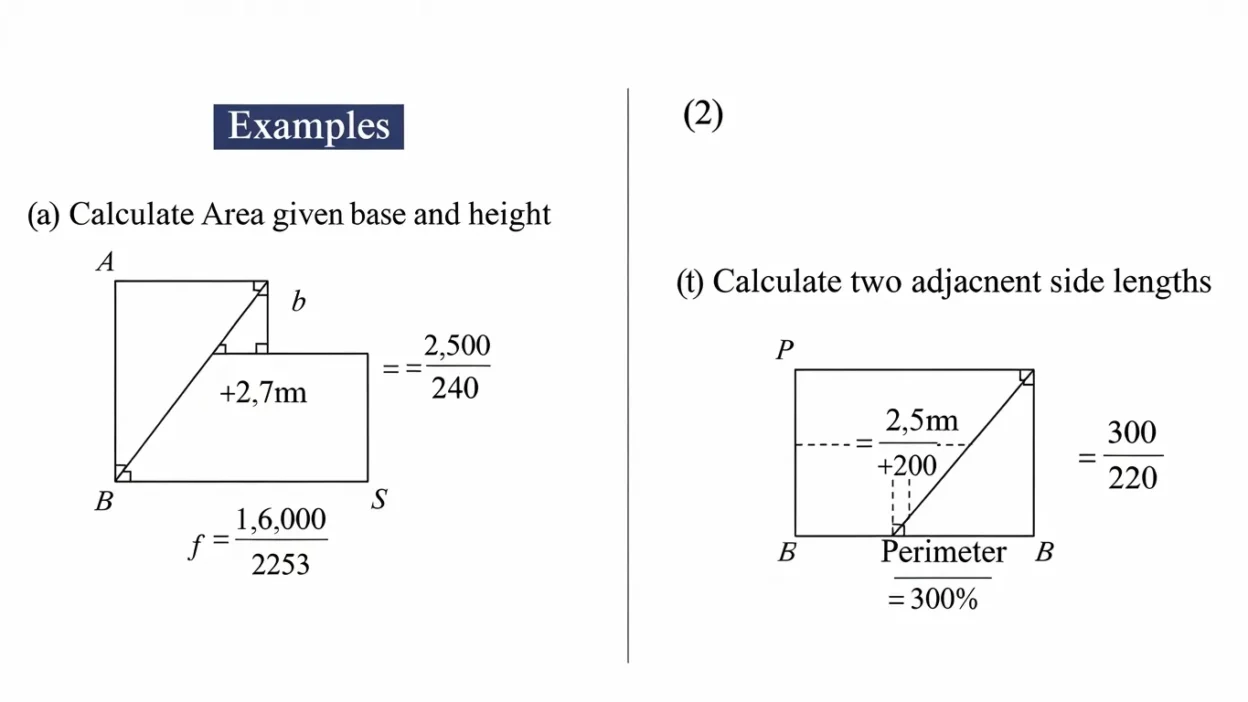
The most common formula for the area is:
Area=Base×Height(A=b×h)\text{Area} = \text{Base} \times \text{Height} \quad (A = b \times h)Area=Base×Height(A=b×h)
- Base (b) – any side of the parallelogram can be considered as the base.
- Height (h) – the perpendicular distance from the chosen base to the opposite side.
Example: If a parallelogram has a base of 8 cm and height of 5 cm:
Area=8×5=40 cm²\text{Area} = 8 \times 5 = 40 \text{ cm²}Area=8×5=40 cm²
2. Perimeter of a Parallelogram
The perimeter is the total distance around the shape:
Perimeter=2×(Length + Width)(P=2(a+b))\text{Perimeter} = 2 \times (\text{Length + Width}) \quad (P = 2(a + b))Perimeter=2×(Length + Width)(P=2(a+b))
- a – one pair of opposite sides
- b – other pair of opposite sides
Example: If sides are 7 cm and 5 cm:
P=2×(7+5)=24 cmP = 2 \times (7 + 5) = 24 \text{ cm}P=2×(7+5)=24 cm
3. Diagonals of a Parallelogram
While diagonals in a general parallelogram are not equal, they bisect each other. In coordinate geometry, their lengths can be calculated using the distance formula.
Knowing these formulas allows students to solve geometry problems quickly and accurately. In the next section, we will explore different types of parallelograms, including rectangles, rhombuses, and squares, which have their own special formulas and properties.
Types of Parallelograms
While all parallelograms share the basic properties of opposite sides being parallel and equal, there are special types that have additional unique characteristics. Understanding these types helps in recognizing and solving different geometry problems more easily.
1. Rectangle
A rectangle is a parallelogram in which all angles are 90°.
- Opposite sides are equal and parallel.
- Diagonals are equal in length.
- Common examples include doors, windows, and screens.
2. Rhombus
A rhombus is a parallelogram with all sides equal.
- Opposite angles are equal.
- Diagonals bisect each other at right angles (90°).
- Often seen in diamond shapes, tiles, or jewelry patterns.
3. Square
A square is a combination of a rectangle and a rhombus.
- All sides are equal.
- All angles are 90°.
- Diagonals are equal and perpendicular.
- Squares are common in floor tiles, chessboards, and art designs.
4. Oblique Parallelogram
An oblique parallelogram is the general form that does not have right angles or equal sides.
- Only the basic parallelogram properties apply.
- Seen in slanted shapes like leaning walls, ramps, or irregular tables.
Each type of parallelogram follows the core properties, but knowing these distinctions allows for easier calculation of area, perimeter, and angles. Recognizing these types in real-life objects also improves visual understanding and geometry skills.
Real-Life Examples of Parallelograms
Parallelograms are not just abstract shapes in textbooks—they appear all around us in daily life. Recognizing them helps understand geometry practically and see how math shapes our world.
1. Architecture and Construction
Many buildings and bridges use parallelogram shapes for stability and design. For example, roof trusses, floor patterns, and support beams often form parallelograms because their parallel sides distribute weight evenly.
2. Furniture and Objects
Common objects like tables, books, and picture frames often have parallelogram shapes. Even a leaning or slanted table can be considered an oblique parallelogram if the sides remain parallel.
3. Tiles and Flooring
Floor tiles and wall tiles are frequently designed in parallelogram patterns, especially in herringbone or diamond layouts. These designs are both aesthetically appealing and geometrically efficient.
4. Graphic Design and Art
Artists and designers use parallelograms in logos, patterns, and illustrations. The shape provides a sense of balance and symmetry, making designs visually appealing.
5. Engineering and Physics
In physics, the parallelogram law of vectors uses parallelograms to calculate resultant forces. Mechanical structures also use the shape for levers and linkages because of its stable properties.
These examples show that the meaning of a parallelogram extends beyond classrooms—it is practical, versatile, and visually significant. Understanding its properties allows us to identify and utilize it in everyday life, from design to engineering to art.
Difference Between Parallelogram and Other Quadrilaterals
A parallelogram is a special type of quadrilateral, but it differs from other four-sided shapes in several ways. Understanding these differences is important for solving geometry problems correctly.
1. Parallelogram vs Rectangle
- Both have opposite sides parallel and equal.
- Rectangle: all angles are 90°.
- Parallelogram: angles are not necessarily 90°.
- Diagonals: equal in rectangles, may be unequal in general parallelograms.
2. Parallelogram vs Rhombus
- Rhombus: all four sides are equal.
- Parallelogram: opposite sides equal, but not necessarily all sides.
- Diagonals: bisect at right angles in rhombus, but not always in parallelogram.
3. Parallelogram vs Square
- Square: all sides equal + all angles 90°.
- Parallelogram: only opposite sides are equal; angles can vary.
- Every square is a parallelogram, but not every parallelogram is a square.
4. Parallelogram vs Trapezium (Trapezoid)
- Trapezium: only one pair of sides is parallel.
- Parallelogram: both pairs of opposite sides are parallel.
Comparison Table
| Shape | Opposite Sides | All Sides Equal | Angles | Diagonals |
| Parallelogram | Yes | No | No | Bisect |
| Rectangle | Yes | No | Yes | Equal |
| Rhombus | Yes | Yes | No | Perpendicular |
| Square | Yes | Yes | Yes | Equal & Perpendicular |
| Trapezium | One pair | No | No | Varies |
This comparison clarifies the unique properties of parallelograms and helps distinguish them from other quadrilaterals in both theory and real-world applications.
Applications of Parallelograms in Mathematics and Physics
Parallelograms are more than just geometric shapes—they play a significant role in both mathematics and physics, helping us solve practical problems efficiently.
1. Vector Addition
In physics and mathematics, the parallelogram law of vectors is a common application. When two vectors originate from the same point, a parallelogram can be drawn using the vectors as adjacent sides. The diagonal of the parallelogram represents the resultant vector. This principle is widely used in mechanics and engineering to calculate forces and velocities.
2. Area Calculations in Geometry
The formula for the area of a parallelogram (Area = Base × Height) is foundational for solving geometry problems. It is especially useful when calculating land plots, architectural spaces, and floor areas.
3. Physics Force Diagrams
Engineers and physicists often use parallelogram diagrams to analyze forces acting at an angle. By representing forces as vectors forming a parallelogram, one can determine the resultant force, torque, or equilibrium conditions.
4. Engineering and Structural Design
Parallelogram shapes are used in mechanical linkages, bridges, and trusses because their parallel sides provide stability. The predictable geometry ensures that structures can bear evenly distributed loads.
5. Coordinate Geometry
In coordinate geometry, proving that a quadrilateral is a parallelogram allows us to calculate distances, midpoints, and areas using formulas efficiently. This is particularly useful in advanced math problems and computer graphics.
These applications show that understanding the meaning and properties of a parallelogram is not just academic—it is practical and essential in mathematics, engineering, physics, and daily life.
Common Problems and Practice Questions on Parallelograms
Once you understand the meaning and properties of a parallelogram, practicing problems is the best way to strengthen your geometry skills. Here are some common types of questions students encounter.
1. Finding Missing Angles
Problem: In a parallelogram ABCD, ∠A = 70°. Find ∠B, ∠C, and ∠D.
Solution:
- Opposite angles are equal: ∠C = ∠A = 70°, ∠D = ∠B.
- Consecutive angles are supplementary: ∠A + ∠B = 180° → ∠B = 110°.
- ∠D = ∠B = 110°.
2. Calculating Area
Problem: A parallelogram has a base of 10 cm and height of 6 cm. Find its area.
Solution:
Area=Base×Height=10×6=60 cm²\text{Area} = \text{Base} \times \text{Height} = 10 \times 6 = 60 \text{ cm²}Area=Base×Height=10×6=60 cm²
3. Finding Perimeter
Problem: A parallelogram has sides 8 cm and 5 cm. Find its perimeter.
Solution:
Perimeter=2(a+b)=2(8+5)=26 cm\text{Perimeter} = 2(a+b) = 2(8+5) = 26 \text{ cm}Perimeter=2(a+b)=2(8+5)=26 cm
4. Using Diagonals
Problem: In a parallelogram, diagonals bisect each other. If one half of a diagonal is 4 cm, find the full length.
Solution: Full length = 4 × 2 = 8 cm.
Tips for Practice
- Always check if opposite sides are equal and parallel.
- Use the properties of angles and diagonals to solve missing values.
- Draw a diagram to visualize problems—it makes solving easier.
Regular practice with these types of problems helps you master parallelogram properties, formulas, and applications, building a strong foundation for advanced geometry topics.
Common Mistakes Students Make with Parallelograms
Even though parallelograms are simple in concept, students often make mistakes when solving related problems. Being aware of these errors can help improve accuracy and confidence in geometry.
1. Confusing Height with Side Length
Many students incorrectly use the slanted side of a parallelogram as the height when calculating the area. The height must always be perpendicular to the base, not along the side.
Tip: Draw a perpendicular line from the base to the opposite side to correctly identify the height.
2. Assuming Diagonals Are Equal
Unlike rectangles and squares, diagonals of a general parallelogram are not equal. Mistakenly assuming this can lead to incorrect calculations, especially in coordinate geometry problems.
3. Forgetting Consecutive Angles Are Supplementary
Some students assume all angles are equal or only use opposite angles. Remember, in a parallelogram, consecutive angles add up to 180°. This is essential for solving angle-related problems.
4. Misidentifying Special Parallelograms
Rectangles, rhombuses, and squares are all types of parallelograms. Students sometimes mix up formulas by not recognizing the shape correctly. For instance, using a rectangle’s diagonal formula for a general parallelogram can lead to errors.
5. Not Drawing a Diagram
Skipping diagrams is a common mistake. Drawing a clear figure helps visualize properties, sides, angles, and diagonals, reducing calculation errors.
Key Advice: Always identify the type of parallelogram, check which properties apply, and carefully distinguish between sides, height, and diagonals. Practicing these habits will minimize mistakes and make solving parallelogram problems faster and more accurate.
FAQs About Parallelograms
Understanding the meaning and properties of a parallelogram often raises some common questions among students. Here are the most frequently asked ones:
1. What is a simple definition of a parallelogram?
A parallelogram is a four-sided figure (quadrilateral) in which both pairs of opposite sides are parallel. Its opposite sides are equal, opposite angles are equal, and diagonals bisect each other.
2. Are all rectangles parallelograms?
Yes, every rectangle is a parallelogram because it has opposite sides parallel and equal. However, not all parallelograms are rectangles because parallelograms don’t always have 90° angles.
3. Are all parallelograms rectangles?
No. Only parallelograms with all right angles are rectangles. Other types, like rhombuses or oblique parallelograms, do not have 90° angles.
4. What makes a shape not a parallelogram?
If a quadrilateral does not have both pairs of opposite sides parallel, it cannot be a parallelogram. For example, a trapezium has only one pair of parallel sides, so it is not a parallelogram.
5. How do I calculate the area of a parallelogram?
Use the formula:
Area=Base×Height(A=b×h)\text{Area} = \text{Base} \times \text{Height} \quad (A = b \times h)Area=Base×Height(A=b×h)
Remember, the height must be perpendicular to the base, not the slanted side.
6. Where do we see parallelograms in real life?
Parallelograms appear in floor tiles, windows, books, bridges, mechanical linkages, and vector diagrams in physics. They are both practical and visually appealing.
By understanding these FAQs, students can avoid common mistakes and gain a clearer grasp of parallelogram properties, formulas, and applications.
Conclusion:
The parallelogram is a fundamental geometric shape that plays an important role in both mathematics and real-life applications. At its core, a parallelogram is a quadrilateral with both pairs of opposite sides parallel and equal, opposite angles equal, and diagonals that bisect each other.
Understanding its meaning and properties lays the foundation for solving a wide variety of geometry problems, from calculating areas and perimeters to analyzing angles and diagonals.
We have also explored the different types of parallelograms, including rectangles, rhombuses, squares, and oblique parallelograms. Each type follows the basic properties but adds unique characteristics, such as right angles in rectangles or equal sides in rhombuses. Recognizing these distinctions is crucial for applying the correct formulas and theorems.
Parallelograms are more than theoretical shapes. They appear in architecture, furniture design, floor tiling, graphic design, and engineering structures. In physics, the parallelogram law of vectors uses this shape to calculate resultant forces. These practical applications demonstrate how a clear understanding of parallelograms can help in problem-solving and everyday life.
Finally, by practicing problems and being aware of common mistakes, students can master parallelogram concepts and improve their confidence in geometry. From formulas and properties to real-life examples, knowing the essentials of parallelograms equips learners with valuable skills that extend beyond the classroom.
In summary, the parallelogram is a versatile and essential shape in mathematics, engineering, and design. Grasping its properties and applications opens the door to better geometric understanding and practical problem-solving.

Welcome to TextFlirtz.com, your ultimate destination for flirty, fun, and clever text messages! Whether you’re looking to break the ice, charm your crush, or keep the sparks alive in your relationship, we’ve got a treasure trove of pick-up lines, flirty texts, and witty messages that make flirting effortless and exciting. Dive in, explore, and let your words do the magic—because at TextFlirtz.com, every message is a chance to flirt smarter, not harder.