
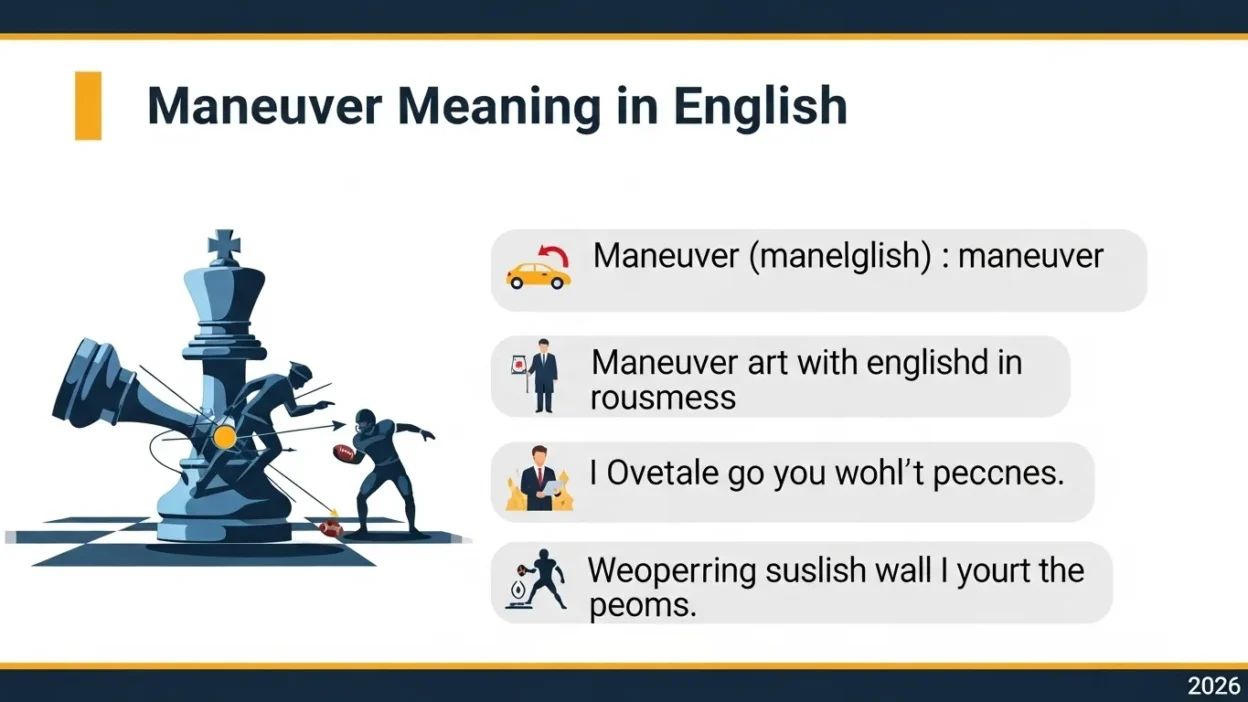
When you hear the word maneuver, it may sound like a complicated term, but its meaning is actually simple and useful in daily English. The word maneuver refers to a skillful or careful movement or action that is done to achieve a specific goal.
People often use this word when talking about driving, military operations, sports moves, or even smart business strategies. For example, a driver may perform a parking maneuver, while a company may make a clever maneuver to stay ahead of competitors.
Understanding the maneuver meaning is important because it is commonly used in news, formal writing, and everyday conversations. It can be used as both a noun and a verb, depending on the sentence.
In this article, you will learn the exact meaning of maneuver, its pronunciation, synonyms, real-life examples, and how to use it correctly in different contexts.
Maneuver Meaning in English
The word maneuver is versatile and can be used as both a noun and a verb, depending on the context. As a noun, a maneuver refers to a careful or skillful movement or action that is planned to achieve a particular purpose. For instance, a pilot might perform a complicated maneuver during a flight, or a driver might execute a precise maneuver to park a car in a tight spot. In everyday life, maneuver can also refer to a tactical action someone takes to solve a problem or gain an advantage, such as a smart business maneuver or a clever political maneuver.
When used as a verb, to maneuver means to move or guide something carefully and skillfully. For example, you can say, “He maneuvered the boat through the narrow canal,” or “The manager maneuvered the team to complete the project on time.” In both cases, the emphasis is on control, skill, and strategy.
The word maneuver is not limited to physical movements. It is widely used in abstract situations as well, such as making strategic decisions in business, politics, or even sports. Understanding how to use maneuver correctly can make your English sound more precise and professional, whether you are writing, speaking, or reading.
Next, we will look at how to pronounce maneuver correctly and the subtle differences between American and British English spellings.
Maneuver Pronunciation and Spelling
Pronouncing and spelling maneuver correctly is important, especially for English learners, because it appears often in formal writing and conversation. In American English, the word is spelled “maneuver” and pronounced as /məˈnuːvər/. You can break it down phonetically as “muh-NOO-ver”, with the emphasis on the second syllable. For example: “The pilot performed a daring maneuver during the airshow.”
In British English, the spelling changes slightly to “manoeuvre”, but the pronunciation is very similar: /məˈnuːvə/. The only difference is the extra letters “-oe-” in the middle, which is a traditional British spelling. Many learners get confused between the two spellings, but remember: the meaning remains exactly the same, whether you use American or British English.
Here are a few pronunciation tips to make it easier:
- Focus on the middle syllable: “noo”. It’s the most important part of the word.
- Don’t stress the first syllable too much; it’s soft: “muh”.
- The ending can sound like “-ver” (US) or “-və” (UK), depending on which version you are using.
Correct pronunciation and spelling are essential when using the word in exams, presentations, or professional writing. It not only shows that you understand the word but also helps others read and understand your sentences correctly.
Next, we will explore the different contexts where maneuver is used, such as driving, military, business, and sports.
Maneuver Meaning in Different Contexts
The word maneuver is widely used in different contexts, and its meaning can slightly change depending on the situation.
1. Maneuver in Driving
In driving, a maneuver refers to a skillful movement of a vehicle to achieve a specific task. Common examples include parallel parking, reversing, making a three-point turn, or performing a U-turn. Driving tests often require demonstrating these maneuvers to show control and precision. For instance: “The student carefully maneuvered the car into the tight parking space.”
2. Maneuver in the Military
In military terms, a maneuver is a planned movement or tactical action carried out to gain a strategic advantage. Soldiers, tanks, or aircraft may perform maneuvers to outsmart the enemy or secure a position. Example: “The army executed a complex maneuver to flank the opposing forces.” Here, maneuver emphasizes planning, precision, and strategy.
3. Maneuver in Business
In business, maneuver often refers to a clever or strategic action taken to improve outcomes or achieve goals. This could include corporate decisions, negotiations, or market strategies. Example: “The company maneuvered quickly to capture market share before its competitors.”
4. Maneuver in Sports
In sports, a maneuver refers to a skillful move or tactic to gain an advantage over opponents. Athletes may use defensive or offensive maneuvers in games like football, basketball, or martial arts. Example: “The boxer executed a quick maneuver to dodge his opponent’s punch.”
Understanding these different contexts helps learners use the word accurately in both formal and informal situations. It shows that maneuver isn’t just about physical movement it can also describe strategic thinking and skillful action in life, work, and sports.
Maneuver Meaning in Urdu and Hindi + Synonyms
Understanding the maneuver meaning in different languages can help learners grasp its usage more easily.
Maneuver Meaning in Urdu
In Urdu, maneuver can be translated as:
- چال (Chaal) a move or step
- حکمتِ عملی (Hikmat-e-Amli) a strategic or tactical action
- چالاکی سے حرکت (Chalaki Se Harkat) moving skillfully or carefully
Example sentences in Urdu context:
- “ڈرائیور نے گاڑی کو پارک کرنے کے لیے ایک مشکل چال کی۔”
- “کاروباری ٹیم نے مارکیٹ میں آگے بڑھنے کے لیے ایک ہوشیار حکمتِ عملی اپنائی۔”
Maneuver Meaning in Hindi
In Hindi, maneuver can be translated as:
- चाल (Chaal) move or action
- रणनीति (Ranniti) strategy
- सावधानीपूर्वक कार्य (Saavdhani Poorvak Karya) careful or skillful action
Example sentences in Hindi context:
- “पायलट ने विमान को सुरक्षित लैंडिंग के लिए एक कठिन चाल की।”
- “कंपनी ने प्रतियोगियों से आगे निकलने के लिए एक स्मार्ट रणनीति अपनाई।”
Synonyms of Maneuver
Knowing synonyms helps expand your vocabulary and use the word more naturally. Some common synonyms include:
- Tactic a planned action to achieve a goal
- Strategy overall plan or approach
- Move an action or step
- Operation a coordinated action
- Plan a prepared course of action
- Action something done intentionally
Using these synonyms in sentences can help you avoid repetition while keeping your writing or speech smooth and professional.
Maneuver vs Manoeuvre and Common Mistakes
One of the most common confusions with the word maneuver is its spelling and usage. The difference is simple:
Maneuver (American English)
In American English, the word is spelled maneuver. It is used in all contexts driving, military, business, and sports. Example:
- “The driver skillfully performed a parking maneuver.”
Manoeuvre (British English)
In British English, the word is spelled manoeuvre, but the pronunciation and meaning are almost identical. Example:
- “The army executed a complex manoeuvre to secure the hill.”
Despite the spelling difference, both words are interchangeable in meaning, and the choice depends on your audience or the English variant you are using.
Common Mistakes People Make
- Spelling Confusion Using “maneuvre” or “manuver” incorrectly. Remember: US = maneuver, UK = manoeuvre.
- Wrong Pronunciation Mispronouncing the middle syllable as “man” instead of “noo”. Correct pronunciation: muh-NOO-ver (US) / muh-NOO-vuh (UK).
- Using in the Wrong Context Some people use maneuver only for driving, but it also applies to military, business, sports, or medical contexts.
- Confusing with Manipulate While both involve skill, manipulate has a negative connotation, whereas maneuver can be neutral or positive.
- Grammar Errors Forgetting that maneuver can be both a noun and a verb. Example:
- Noun: “The pilot performed a difficult maneuver.”
- Verb: “The pilot maneuvered the plane carefully.”
- Noun: “The pilot performed a difficult maneuver.”
By understanding these differences and mistakes, learners can use maneuver confidently and accurately in any situation.
Maneuver in Sentences and Common Phrases
Using maneuver correctly in sentences is essential to make your English sound natural and precise. Here are some examples across different contexts:
Sentence Examples
- Driving: “The driver carefully maneuvered the car into the narrow parking space.”
- Military: “The troops executed a clever maneuver to outflank the enemy.”
- Business: “The company maneuvered quickly to gain a competitive advantage.”
- Sports: “The footballer maneuvered past three defenders to score a goal.”
- Aviation: “The pilot maneuvered the plane during the storm to ensure a safe landing.”
- Daily Life: “She maneuvered her way through the crowded market.”
- Medical: “The doctor performed a Heimlich maneuver to save the choking patient.”
Common Phrases and Collocations with Maneuver
- Evasive maneuver a move to avoid danger or attack. Example: “The driver took an evasive maneuver to avoid the collision.”
- Tactical maneuver a planned action for advantage. Example: “The general planned a tactical maneuver to capture the hill.”
- Political maneuver a strategic action in politics. Example: “The politician’s clever maneuver won him many supporters.”
- Maneuver around to skillfully deal with a problem. Example: “She maneuvered around the obstacles to reach her goal.”
- Maneuver into position to carefully get into the correct spot. Example: “The crane maneuvered into position to lift the heavy container.”
Learning these phrases and examples helps you use maneuver naturally in both spoken and written English. They show the flexibility of the word in different contexts, from physical movement to strategic actions.
Types of Maneuvers and Positive vs Negative Usage
The word maneuver can describe many types of actions, both physical and strategic, depending on the situation. Understanding these types helps you use the word accurately.
1. Physical Maneuvers
These involve skillful movement of a person or object. Examples include:
- Driving maneuvers: parallel parking, U-turns, lane changes
- Sports maneuvers: dodging, feints, or strategic plays in football or basketball
- Aviation maneuvers: emergency turns, aerial stunts, or precise landings
2. Strategic Maneuvers
These refer to planned actions designed to gain an advantage. Examples include:
- Military maneuvers: flanking, ambushing, or troop movements
- Business maneuvers: corporate decisions, negotiations, or marketing strategies
- Political maneuvers: policy adjustments or clever tactics to influence outcomes
3. Emergency or Special Maneuvers
These are careful, often urgent actions to solve a critical situation. Examples:
- Medical maneuvers: Heimlich maneuver, Epley maneuver
- Safety maneuvers: avoiding a car accident, or emergency plane maneuvers
Positive vs Negative Usage
- Positive: Maneuvers can highlight skill, intelligence, or cleverness. Example: “The manager maneuvered the team efficiently to meet the deadline.”
- Neutral: Maneuver can simply mean movement or action. Example: “He maneuvered the furniture into place.”
- Negative: Sometimes, it implies manipulation or cunning tactics. Example: “The politician maneuvered to undermine his opponent.”
By recognizing these types and connotations, you can use maneuver appropriately in writing and conversation, ensuring clarity and precision.
Word Origin of Maneuver
The word maneuver comes from the French word “manœuvre”, which originally meant a work done by hand or a skilled movement. Over time, it entered the English language in the 16th century, and its meaning evolved to include careful or skillful actions in both physical and strategic contexts. The spelling “maneuver” is used in American English, while British English retains the original “manoeuvre”. Understanding its origin helps learners appreciate its usage in military, driving, business, and daily contexts.
FAQs About Maneuver
1. What is the meaning of maneuver?
- A maneuver is a careful or skillful movement or action to achieve a goal.
2. Is maneuver a noun or verb?
- It can be both. Noun: “The driver performed a difficult maneuver.” Verb: “He maneuvered the car into the garage.”
3. What is an evasive maneuver?
- A move made to avoid danger or escape a threat, often used in driving or military contexts.
4. What is the difference between maneuver and manoeuvre?
- Meaning is the same; spelling depends on English variant. US = maneuver, UK = manoeuvre.
5. Can maneuver be negative?
- Yes, it can imply manipulation or cunning actions, but it is often neutral or positive.
Conclusion
The word maneuver is a versatile and useful term in English. From driving and sports to business and military strategies, it describes skillful, careful, or strategic actions.
By understanding its meaning, pronunciation, synonyms, and usage, you can confidently incorporate it into your speaking and writing. Next time you need to describe a clever move or action, remember the power of a well-planned maneuver!

Welcome to TextFlirtz.com, your ultimate destination for flirty, fun, and clever text messages! Whether you’re looking to break the ice, charm your crush, or keep the sparks alive in your relationship, we’ve got a treasure trove of pick-up lines, flirty texts, and witty messages that make flirting effortless and exciting. Dive in, explore, and let your words do the magic—because at TextFlirtz.com, every message is a chance to flirt smarter, not harder.