

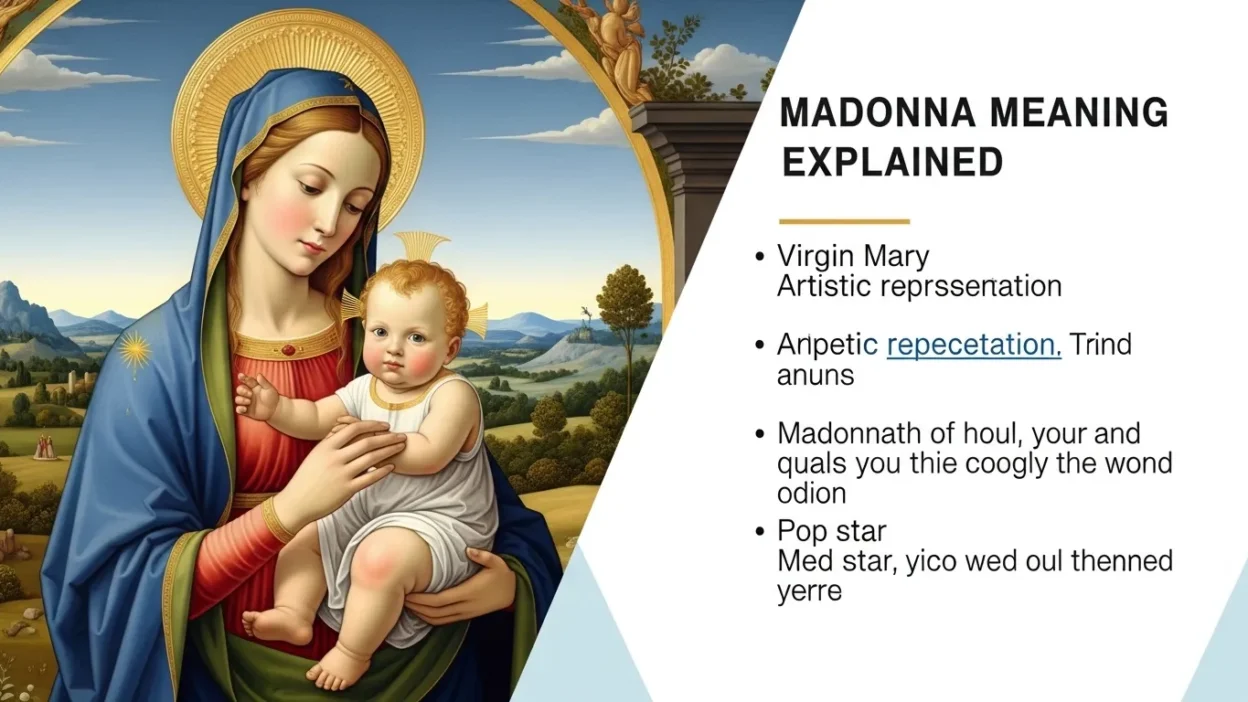
The word “Madonna” is one of those terms that carries layers of meaning, spanning centuries and cultures. To some, it evokes images of the Virgin Mary, the revered figure in Christianity celebrated for her purity, compassion, and motherly devotion.
In the world of art, Madonna has inspired countless masterpieces, symbolizing divine femininity and spiritual grace.
To others, the term immediately brings to mind the iconic pop singer Madonna, a global cultural phenomenon whose music, fashion, and persona have left an indelible mark on modern society.
Understanding the meaning of Madonna, therefore, requires exploring both its religious and cultural significance, its historical roots, and how it has evolved in language and society.
In this article, we will dive into the origins, symbolism, and contemporary relevance of Madonna, providing a comprehensive guide that illuminates why this name has remained powerful and influential for generations.
What Does Madonna Mean?
The term “Madonna” originates from the Italian phrase “ma donna”, which translates to “my lady”. Historically, it was used as a respectful form of address for women of high status or reverence. Over time, the word became closely associated with the Virgin Mary, the mother of Jesus Christ, and adopted as a title highlighting her purity, compassion, and divine role in Christian theology. In religious contexts, Madonna symbolizes motherhood, grace, and spiritual guidance, appearing frequently in prayers, hymns, and sacred art.
Beyond its religious significance, Madonna has taken on new meanings in contemporary culture. For many, the name conjures images of the pop icon Madonna, whose career has spanned decades and reshaped music, fashion, and social expression. In this context, Madonna represents empowerment, individuality, and cultural influence, showing how a single name can carry both spiritual reverence and modern celebrity weight.
Interestingly, the meaning of Madonna can vary depending on context. In art and religion, it conveys divinity and sanctity, while in modern pop culture, it reflects boldness, creativity, and breaking societal norms. This dual significance makes the term fascinating and versatile, bridging historical traditions with contemporary interpretations. Understanding both dimensions allows us to fully appreciate the richness and depth behind the word “Madonna.”
Historical and Religious Background of Madonna
The name Madonna has deep roots in religious history, primarily tied to Christianity. It is most commonly associated with the Virgin Mary, the mother of Jesus Christ, who holds a central role in Christian belief as a symbol of purity, compassion, and maternal care. The term “Madonna” began to be widely used in Italy during the Middle Ages, reflecting reverence for Mary as “my lady”, a figure worthy of devotion and honor.
Throughout history, Madonna has been a central subject in religious art. During the Renaissance, artists such as Michelangelo, Raphael, and Leonardo da Vinci created iconic paintings of Madonna, often depicted holding the infant Jesus. These artworks were not merely aesthetic; they conveyed deep spiritual symbolism, portraying Mary as the ideal mother and a bridge between humanity and divinity. Her image represented grace, virtue, and the protective power of maternal love.
In addition to her artistic significance, Madonna played a role in European religious culture and festivals, where churches and communities celebrated her virtues through rituals, prayers, and public observances. The reverence for Madonna also spread beyond Italy to other parts of Europe, becoming a universal symbol of spiritual devotion. Understanding this historical and religious context allows us to see why the name Madonna carries such weight not just as a person, but as a timeless emblem of faith, inspiration, and divine femininity.
Madonna in Pop Culture
While the term Madonna has centuries of religious significance, it has also become synonymous with one of the most influential figures in modern pop culture: Madonna the singer. Born Madonna Louise Ciccone, she rose to global fame in the 1980s, transforming the music industry with her bold style, provocative performances, and genre-defying songs. Today, when many people hear “Madonna,” the first image that comes to mind is often that of the pop icon rather than the Virgin Mary, highlighting the name’s cultural evolution.
Madonna’s impact extends beyond music. She became a fashion trendsetter, pushing boundaries with her stage costumes and personal style, inspiring generations of artists and fans. Her influence also shaped societal conversations about female empowerment, sexuality, and individuality, challenging norms and encouraging self-expression. In this sense, the name Madonna now carries a symbolic meaning in modern culture: it represents boldness, independence, and creativity.
Interestingly, the coexistence of religious and pop culture interpretations of Madonna creates a unique duality. While religious Madonna symbolizes purity and devotion, pop culture Madonna embodies rebellion and innovation. This dual significance demonstrates how a single name can bridge centuries of meaning, resonating with both spiritual and contemporary audiences. Understanding Madonna in pop culture highlights the flexibility of language and symbolism, showing that words and names can evolve to carry new and unexpected significance over time.
Etymology and Linguistic Meaning of Madonna
The word “Madonna” has a fascinating linguistic history that traces back to Italian roots. It originates from the phrase “ma donna”, which literally translates to “my lady”. This form of address was traditionally used to show respect and honor toward women of high social standing, particularly in medieval Italy. Over time, it became closely associated with the Virgin Mary, reflecting her elevated spiritual status as the mother of Jesus Christ.
In Latin, the word domina (meaning “lady” or “mistress”) influenced the development of Madonna, further emphasizing authority, dignity, and reverence. This connection between language and respect highlights how the term evolved from a general honorific to a title of profound religious significance. In European languages, Madonna became the standard way to refer to Mary in both religious texts and artistic depictions.
The linguistic journey of Madonna also reflects cultural adaptation. While in Italy it maintained strong religious connotations, the term spread to other countries through literature, art, and religious practice. Today, Madonna carries dual linguistic meanings: one spiritual and one secular. In the modern context, it is also recognized as the name of the pop icon, giving the term a new dimension in English and other languages.
Understanding the etymology of Madonna enriches our appreciation of the word, showing how language can evolve while preserving echoes of its historical and cultural origins. From Italian honorific to global cultural symbol, the term continues to bridge history, religion, and contemporary society.
Symbolism of Madonna
The term Madonna carries rich symbolism, spanning both religious and cultural contexts. In Christian tradition, Madonna primarily represents the Virgin Mary, symbolizing purity, compassion, and maternal care. Artists and theologians have portrayed her as an idealized figure of virtue, offering spiritual guidance and protection to humanity. In religious art, she is often depicted holding the infant Jesus, signifying motherhood, nurturing, and divine love. The image of Madonna serves as a visual reminder of faith, devotion, and the connection between humanity and the divine.
Beyond religion, Madonna also carries symbolism in art and culture. In Renaissance and Baroque paintings, her serene expression, posture, and attire were carefully chosen to convey grace, dignity, and sacred beauty. The recurring presence of Madonna in art highlights her role as an enduring icon of spiritual inspiration and moral ideals.
In modern pop culture, the symbolism of Madonna transforms. The name now evokes empowerment, creativity, and bold self-expression, largely due to the influence of the singer Madonna. She represents independence, challenging societal norms, and redefining femininity, showing that the same name can embody both sanctity and audacious individuality.
This duality—spiritual reverence versus cultural influence—illustrates why Madonna remains a powerful symbol. Whether in churches, museums, or concert halls, the name carries layers of meaning, connecting past and present, faith and culture, tradition and modernity. It is a testament to the enduring resonance of both the figure and the word itself.
Common Misconceptions About Madonna
The name Madonna is often misunderstood due to its dual significance in religion and pop culture. One common misconception is that references to Madonna always relate to the pop singer. While she is an influential cultural figure, the term historically and primarily refers to the Virgin Mary, revered for her spiritual purity, maternal devotion, and role in Christianity. Confusing these two meanings can obscure the rich religious and historical context that has shaped the name over centuries.
Another misconception arises in art and literature. Some people assume that all depictions of Madonna represent the singer or contemporary culture, whereas many Renaissance and Baroque paintings featuring Madonna portray religious symbolism, with careful attention to spiritual themes such as grace, compassion, and divine motherhood. Misinterpreting these images can lead to a superficial understanding of their cultural and historical significance.
Additionally, the linguistic roots of Madonna are sometimes overlooked. People may think of it solely as a proper name without recognizing that it originally meant “my lady” in Italian, a respectful title for women of status. This misunderstanding diminishes the depth of its etymology and its evolution over time.
By clarifying these misconceptions, readers can better appreciate the dual dimensions of Madonna—both as a sacred religious figure and a modern cultural icon. Understanding the historical, artistic, and linguistic roots alongside contemporary interpretations allows for a more complete and meaningful perspective on the name and its enduring significance.
Madonna in Modern Context
The significance of Madonna extends beyond history and religion into the modern world, where the term resonates in multiple cultural contexts. In contemporary media, Madonna is most often associated with the global pop icon, whose influence has shaped music, fashion, and societal norms for decades. Her career has not only revolutionized the entertainment industry but has also redefined the way the public perceives female empowerment and individuality. The name Madonna, in this context, symbolizes boldness, creativity, and resilience.
Madonna’s impact also reaches into literature, film, and popular discourse. Writers, critics, and artists frequently reference her as an emblem of cultural transformation, highlighting how she challenges conventions and inspires new forms of artistic expression. In a broader sense, the name Madonna has become a cultural shorthand for innovation and boundary-pushing personality, demonstrating how historical names can evolve to carry contemporary significance.
Simultaneously, Madonna retains her spiritual relevance. Churches, religious art, and devotional practices continue to honor the Virgin Mary, ensuring that the sacred meaning of Madonna remains alive. This coexistence of religious reverence and pop culture influence illustrates the term’s unique versatility, bridging tradition and modernity.
Understanding Madonna in today’s context underscores how a single word can hold multiple layers of meaning, reflecting both centuries of religious devotion and decades of cultural evolution. It is a testament to the enduring power of language, symbolism, and identity, showing that Madonna remains relevant across time, geography, and societal spheres.
FAQs About Madonna
1. What does Madonna mean in religion?
In religious contexts, Madonna refers to the Virgin Mary, mother of Jesus Christ. It symbolizes purity, compassion, motherhood, and divine guidance, and is widely depicted in Christian art, prayers, and cultural traditions.
2. Who is Madonna in pop culture?
Madonna is also the name of the globally famous pop singer Madonna Louise Ciccone, whose career spans decades. She is recognized for her influence on music, fashion, and social movements, and her name has come to symbolize empowerment, individuality, and creativity in modern culture.
3. What is the origin of the name Madonna?
The word originates from the Italian phrase “ma donna”, meaning “my lady”, and Latin domina, meaning “lady” or “mistress.” It started as a respectful title and became closely associated with the Virgin Mary.
4. Why is Madonna important historically?
Historically, Madonna (the Virgin Mary) has been a central figure in Christianity, inspiring devotion, art, and cultural traditions. In art history, she is a recurring subject in Renaissance and Baroque paintings, symbolizing grace, virtue, and maternal love.
5. Can Madonna have different meanings?
Yes. Depending on context, Madonna can refer to a religious figure, a historical symbol, or a modern pop icon. Its meaning ranges from spiritual devotion to cultural influence, making it a multi-layered and versatile term.
6. How is Madonna portrayed in art vs. modern media?
In art, Madonna embodies divinity and purity, while in modern media, she represents rebellion, creativity, and empowerment. This duality illustrates how a single name can bridge centuries of tradition and contemporary culture.
Conclusion:
The term Madonna carries a rich tapestry of meanings, spanning centuries, cultures, and contexts. Historically, it has been deeply rooted in religion, most prominently representing the Virgin Mary, a figure of purity, compassion, and divine motherhood.
From Renaissance paintings to devotional practices, Madonna has inspired countless artists and believers, making her a timeless symbol of spiritual grace and maternal care. Understanding this dimension reveals the profound cultural and historical significance embedded in the name.
At the same time, Madonna has evolved into a modern cultural icon. The singer Madonna has redefined entertainment, fashion, and social expression, transforming the term into a symbol of empowerment, creativity, and individuality.
This juxtaposition of sacred and secular meanings demonstrates the versatility of the word and its ability to resonate across different generations and audiences.
Moreover, the etymology of Madonna from the Italian “ma donna” and Latin domina reminds us that names can carry layers of respect, authority, and influence. Whether in religious art, literature, or pop culture, Madonna continues to embody ideals that inspire, challenge, and captivate. By exploring both the spiritual and contemporary contexts, readers gain a comprehensive understanding of why this name remains powerful and relevant.
Ultimately, Madonna is more than a name; it is a symbol of enduring significance, bridging the gap between tradition and modernity, faith and culture, history and contemporary identity. Its meaning is multifaceted, reflecting humanity’s evolving relationship with language, art, and expression.

Welcome to TextFlirtz.com, your ultimate destination for fun, flirty, and clever pick-up lines that spark conversations and make hearts skip a beat! Whether you’re looking to impress your crush, add some humor to your chats, or just have a playful time texting, we’ve got you covered with lines that are witty, spicy, and unforgettable. Dive in, explore our collections, and start flirting the smart way—because at TextFlirtz.com, words are your best wingman!