
English learners often encounter the phrase “how come” in conversations, movies, and TV shows, but its meaning and usage can sometimes be confusing.
Simply put, “how come” means “why” and is used to ask for an explanation. Unlike the word “why,” which follows standard question grammar, “how come” has a slightly different structure and is more informal, making it perfect for casual conversations but less suitable for academic or formal writing.
In this guide, we will break down everything you need to know about how come from its definition and grammar rules to examples in daily life and common mistakes to avoid.
By the end of this article, you’ll understand the subtle differences between how come and why, know how to use it correctly in various situations, and gain confidence in incorporating this phrase naturally into your spoken English.
What Does “How Come” Mean?
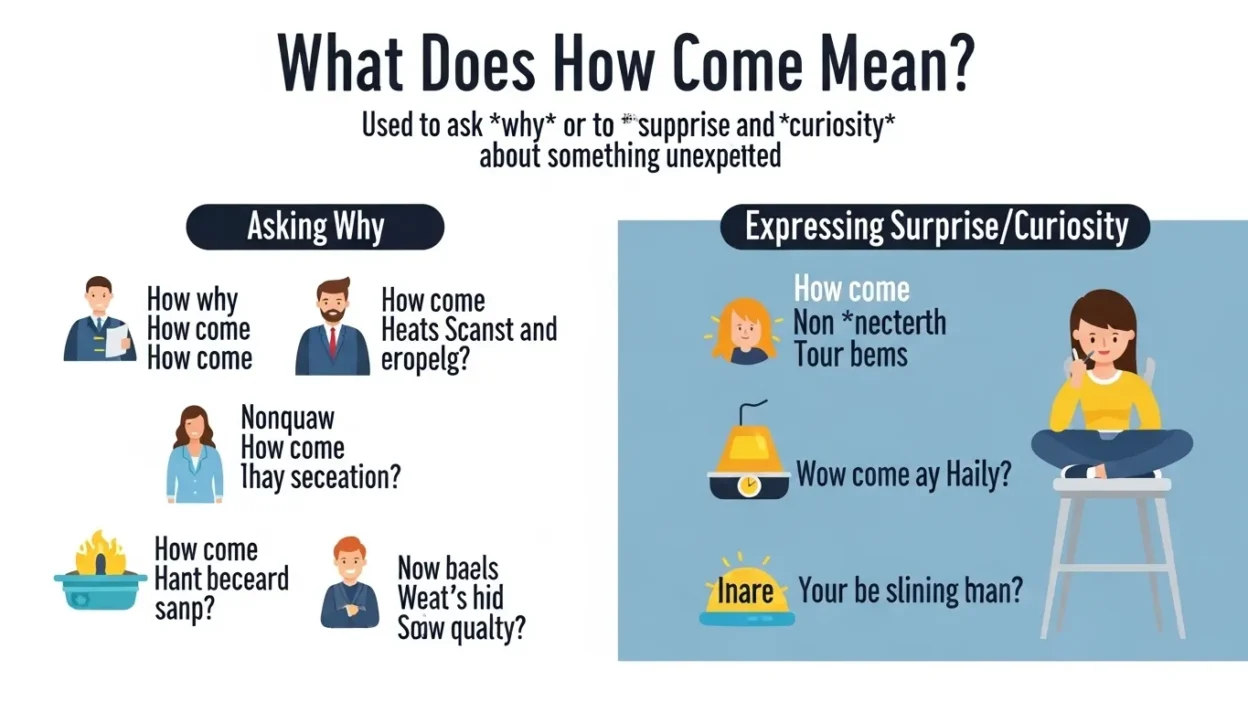
The phrase “how come” is an informal way of asking “why”. It is commonly used in spoken English when you want to know the reason for something. While it functions similarly to “why,” it carries a slightly more casual, conversational tone. For example, if you hear someone say, “How come you’re late?” they are simply asking, “Why are you late?”
Unlike “why,” “how come” does not require auxiliary verbs or subject-verb inversion. In standard questions with “why,” the verb comes before the subject:
- Why are you late? ✅
With “how come,” the sentence structure is straightforward: - How come you’re late? ✅
This simplicity makes “how come” very popular in everyday conversation, especially among friends, family, and peers. It often expresses curiosity, surprise, or mild confusion. For example:
- How come she didn’t attend the party?
- How come they left so early?
- How come you didn’t tell me about this?
It’s important to remember that “how come” is informal, so it’s best avoided in academic writing, formal emails, or professional reports. Instead, “why” is more appropriate in formal contexts.
By understanding its meaning and structure, you can start using “how come” naturally in your daily conversations, making your English sound more fluent and native-like.
Grammar Rules for Using “How Come”
One of the key aspects of using “how come” correctly is understanding its grammar. Unlike “why,” which follows the standard question structure with subject-verb inversion, “how come” uses a simpler format. In other words, you do not invert the subject and verb after “how come.”
Example:
- Why are you tired? ✅ (inversion with “are”)
- How come you are tired? ✅ (no inversion)
- How come are you tired? ❌ (incorrect)
The general structure for “how come” questions is:
How come + subject + verb
This structure works in all tenses:
- Present simple: How come you don’t like coffee?
- Present continuous: How come she is crying?
- Past simple: How come they left early yesterday?
- Future: How come you will miss the meeting tomorrow?
Another important point is that “how come” is always used for questions, not statements. You can’t say “I wonder how come” in formal writing; instead, you’d rephrase with “why.”
Finally, remember that “how come” is informal and typically used in conversations rather than academic or professional contexts. It’s excellent for showing curiosity or mild surprise but should be avoided in essays, reports, or formal correspondence.
By following these grammar rules, you can ask questions naturally and confidently using “how come”, making your English sound more fluent and conversational.
How Come vs Why: Key Differences
Although “how come” and “why” both ask for reasons, they differ in grammar, tone, and usage. Understanding these differences helps you use them correctly in conversation and writing.
1️⃣ Grammar Differences
- Why requires subject-verb inversion:
- Why are you upset? ✅
- Why are you upset? ✅
- How come does not use inversion:
- How come you are upset? ✅
- How come you are upset? ✅
- Avoid mixing the two structures:
- How come are you upset? ❌
- How come are you upset? ❌
2️⃣ Tone and Formality
- Why is neutral and fits both formal and informal contexts.
- How come is casual and conversational, often used among friends, family, or peers.
- Example:
- Formal: Why didn’t you submit the report on time?
- Informal: How come you didn’t submit the report on time?
- Formal: Why didn’t you submit the report on time?
3️⃣ Situational Use
- Why can ask for explanations in serious, formal, or academic contexts.
- How come often expresses mild surprise or curiosity in everyday conversations.
- Example:
- Why is the sky blue? (neutral, informative)
- How come you’re home so early? (casual, conversational)
- Why is the sky blue? (neutral, informative)
4️⃣ Quick Comparison Table
| Aspect | Why | How Come |
| Grammar | Subject-verb inversion | No inversion |
| Formality | Formal & informal | Informal |
| Tone | Neutral | Curious/surprised |
| Usage Context | Any | Casual conversation |
By keeping these differences in mind, you can choose “how come” or “why” appropriately, improving both your grammar and your natural conversational tone.
Real-Life Examples of “How Come” in Conversation
One of the best ways to understand “how come” is by seeing it in real-life situations. This phrase is widely used in daily conversations to ask for explanations or express mild surprise.
1️⃣ Friendly Conversations
Among friends, “how come” is natural and casual.
- Example 1: How come you didn’t come to the party last night?
- Example 2: How come you’re so quiet today?
2️⃣ Family Situations
Family members often use “how come” to check on each other’s actions or feelings.
- Example 1: How come you didn’t finish your homework?
- Example 2: How come you’re up so late?
3️⃣ Workplace Informal Chat
Even in a professional setting, “how come” can be used in informal conversations among colleagues.
- Example 1: How come the meeting ended earlier than expected?
- Example 2: How come you didn’t join the team lunch?
4️⃣ Texting and Online Chat
In messages or chats, “how come” makes your tone friendly and curious:
- Example 1: How come you didn’t reply to my message?
- Example 2: How come you’re online so late?
These examples show that “how come” is versatile for casual, everyday interactions. It is perfect for expressing curiosity, mild surprise, or concern without sounding too formal or rigid.
By practicing with these real-life examples, you’ll get more comfortable using “how come” naturally, making your English sound fluent and native-like.
Common Mistakes with “How Come” and How to Avoid Them
While “how come” is simple to use, many learners make common mistakes that can make sentences sound unnatural. Understanding these errors will help you use the phrase confidently.
1️⃣ Incorrect Word Order
A frequent mistake is using subject-verb inversion, like in standard “why” questions.
- ❌ How come are you late?
- ✅ How come you are late?
Remember: after “how come,” the subject comes first, followed by the verb.
2️⃣ Mixing Formal Writing with “How Come”
Another mistake is using “how come” in formal writing, such as essays, reports, or emails.
- ❌ How come the results are delayed? (formal context)
- ✅ Why are the results delayed? (formal alternative)
3️⃣ Using “How Come” in Statements
Some learners try to make statements with “how come,” which is incorrect.
- ❌ I wonder how come she is late.
- ✅ I wonder why she is late.
4️⃣ Forgetting Contractions in Spoken English
In casual conversation, native speakers often use contractions. Not using them can make your speech sound stiff.
- Formal-sounding: How come you are not attending?
- Natural: How come you’re not attending? ✅
5️⃣ Overusing the Phrase
Using “how come” in every question can sound repetitive. Mix it with “why” or other question phrases to sound more natural.
By avoiding these mistakes, you can make your “how come” sentences sound correct and natural, helping you communicate more effectively in everyday English.
Tips for Practicing and Using “How Come” in Daily Conversation
Using “how come” naturally takes a little practice, but with consistent effort, you can make it a regular part of your spoken English. Here are some practical tips:
1️⃣ Listen and Observe
Pay attention to how native speakers use “how come” in movies, TV shows, podcasts, or everyday conversations. Notice the tone, contractions, and situations in which it appears. For example:
- “How come you’re so quiet today?”
- “How come they didn’t join us?”
2️⃣ Start with Simple Sentences
Begin by practicing short, everyday sentences. Use familiar topics like family, friends, or school:
- How come you didn’t eat breakfast?
- How come you’re late to class?
3️⃣ Use Contractions
In spoken English, contractions sound natural and fluent:
- How come you’re tired? ✅
- How come you are tired? (acceptable, but more formal)
4️⃣ Mix with “Why” for Variety
Avoid overusing “how come” in every question. Alternate with “why” to keep your speech balanced:
- How come you didn’t call me?
- Why did you miss the meeting?
5️⃣ Practice in Conversation
Try asking “how come” questions with friends or language partners. Role-playing common situations can help you internalize the structure.
By following these tips, you’ll gain confidence and start using “how come” naturally in casual conversations. With enough practice, it will feel as effortless as using “why,” while giving your speech a more native and friendly tone.
How Come in Different Tenses and Situations
One of the advantages of “how come” is that it can be used in a variety of tenses, making it versatile for everyday conversation. Understanding how to use it in different situations helps you sound more fluent and natural.
1️⃣ Present Simple
Used to ask about current situations or habits:
- How come you don’t eat vegetables?
- How come she is always late to class?
2️⃣ Present Continuous
Used for actions happening right now:
- How come you are sitting here alone?
- How come he is not answering his phone?
3️⃣ Past Simple
Used for events that already happened:
- How come they left early yesterday?
- How come you didn’t finish your homework?
4️⃣ Present Perfect
Used for past actions with relevance to the present:
- How come you have never tried sushi?
- How come she has missed so many meetings this week?
5️⃣ Future / Modal Forms
Used for future events or possibilities:
- How come you will not attend the party tomorrow?
- How come we can’t meet on Friday?
6️⃣ Situational Usage
- Surprise/Curiosity: How come you didn’t know about the news?
- Concern: How come the kids are still awake?
- Casual Inquiry: How come we haven’t met before?
By practicing how come across tenses and situations, you’ll be able to ask questions naturally in any context, whether you’re curious, surprised, or just making casual conversation.
Synonyms and Similar Expressions to “How Come”
While “how come” is a common and natural way to ask for reasons, English offers several other phrases and expressions that can convey a similar meaning. Using these alternatives can help you sound more varied and fluent in conversation.
1️⃣ Why
The most straightforward alternative, suitable for formal and informal contexts.
- How come you didn’t call me? → Why didn’t you call me?
2️⃣ What for / For what reason
These expressions are slightly more formal and can replace “how come” in certain contexts.
- How come you’re late? → For what reason are you late?
3️⃣ How is it that
A more formal or literary alternative, often used in writing or thoughtful speech.
- How come she left early? → How is it that she left early?
4️⃣ How did it happen that
Useful for emphasizing the process or explanation of an event.
- How come the project failed? → How did it happen that the project failed?
5️⃣ Other Casual Alternatives
- Why is it that…
- How come it is that… (less common, but conversational)
Tips for Using Synonyms
- Use “why” in formal writing and professional contexts.
- Use “how come” in casual, friendly conversations.
- Use “how is it that” or “for what reason” when you want to sound slightly more formal or thoughtful.
By mixing “how come” with these alternatives, your English will sound natural, flexible, and context-appropriate, making your conversations more engaging and dynamic.
Frequently Asked Questions (FAQs) about “How Come”
Many English learners have questions about “how come”. This FAQ section addresses the most common doubts to help you use it confidently.
1️⃣ Is “How Come” the Same as “Why”?
Yes, “how come” essentially means the same as “why”, but it is informal and used mainly in spoken English. While “why” works in all contexts, “how come” is best for casual conversations.
2️⃣ Can “How Come” Be Used in Formal Writing?
No, it is generally not suitable for formal writing like essays, reports, or business emails. Use “why” or alternatives like “for what reason” instead.
3️⃣ Is “How Come” Grammatically Correct?
Yes, it is grammatically correct in informal speech. The main rule to remember is no subject-verb inversion after “how come.”
- Correct: How come you’re late?
- Incorrect: How come are you late?
4️⃣ Do Native Speakers Use “How Come” Often?
Yes, native speakers frequently use “how come” in casual conversation to express curiosity, mild surprise, or concern.
5️⃣ Can “How Come” Be Used in Questions About the Past or Future?
Absolutely. “How come” works in all tenses:
- Past: How come they left early yesterday?
- Future: How come you won’t attend the meeting tomorrow?
By understanding these FAQs, you can use “how come” naturally and avoid common mistakes, making your English sound fluent and native-like.
Conclusion:
The phrase “how come” is a simple yet powerful way to ask why in everyday English. While it shares the same meaning as “why,” it is informal, conversational, and does not use subject-verb inversion, which makes it distinct in structure and tone.
From casual chats with friends to family conversations and informal workplace interactions, “how come” helps express curiosity, mild surprise, or concern in a friendly way.
By understanding its grammar rules, recognizing common mistakes, and practicing with real-life examples, you can confidently incorporate “how come” into your speech. Remember to use it in casual contexts and avoid it in formal writing, where “why” or other alternatives are more appropriate.
Mixing “how come” with synonyms like “why,” “for what reason,” or “how is it that” adds variety and richness to your English, making your communication sound natural and fluent. Regular practice through conversation, role-playing, or even texting will help internalize its correct usage.
In short, mastering “how come” not only improves your grammar but also makes your spoken English more native-like, friendly, and expressive, helping you ask questions in a natural and engaging way.

Welcome to TextFlirtz.com, your ultimate destination for fun, flirty, and clever pick-up lines that spark conversations and make hearts skip a beat! Whether you’re looking to impress your crush, add some humor to your chats, or just have a playful time texting, we’ve got you covered with lines that are witty, spicy, and unforgettable. Dive in, explore our collections, and start flirting the smart way—because at TextFlirtz.com, words are your best wingman!