
Have you ever heard someone say, “That’s hogwash!” and wondered what it really means? The word hogwash is commonly used in English to describe statements, ideas, or claims that are completely untrue, ridiculous, or nonsensical.
Despite its casual tone, it has a rich history that traces back to farm life, where it literally referred to leftover food fed to pigs. Today, the term has evolved into a popular way to dismiss nonsense in conversations, articles, or even debates.
If you are a student learning English, a writer looking to enrich your vocabulary, or simply curious about quirky expressions, understanding hogwash can make your language more colorful and expressive.
In this article, we will explore the meaning, pronunciation, origin, synonyms, and usage examples of hogwash, helping you grasp the word fully and use it confidently in everyday English.
What Does Hogwash Mean?
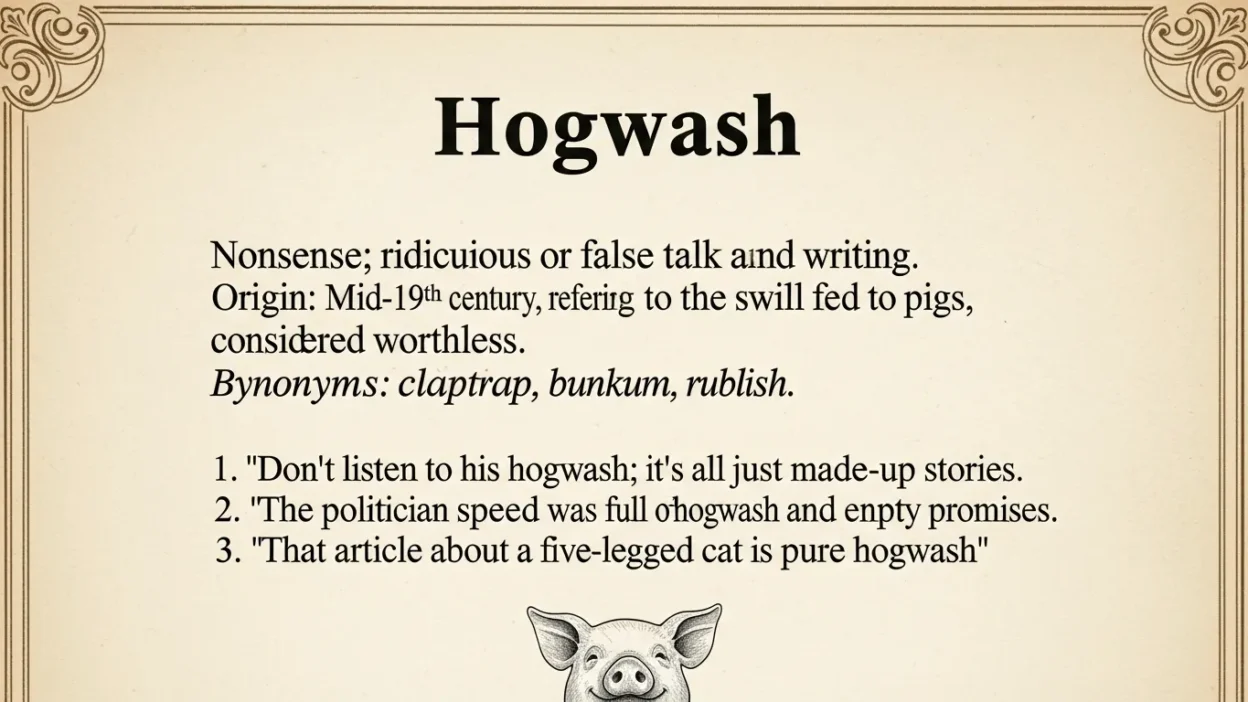
The word hogwash is primarily used in English to describe something that is nonsense, foolish talk, or completely untrue. When someone says, “That’s hogwash!” they are expressing disbelief or dismissing an idea as ridiculous. In simple terms, if a statement makes no sense or seems obviously false, it can be called hogwash.
Dictionary definitions provide a clear understanding:
- Oxford English Dictionary: “Nonsense; worthless or absurd ideas.”
- Merriam-Webster: “Words or ideas that are foolish, false, or absurd.”
- Cambridge Dictionary: “Statements that are untrue or silly.”
While hogwash is often used in informal conversations, it carries a slightly humorous or dismissive tone, making it milder than words like lies or falsehoods. For example, if someone claims they can become rich overnight without effort, a common response could be: “That’s complete hogwash!”
Hogwash is also used in written English, especially in articles, opinion pieces, or dialogues, to highlight the absurdity of a statement. However, it is rarely used in formal or academic writing because of its casual tone.
In short, hogwash is a colorful way to reject false claims, exaggerations, or silly ideas. By understanding its meaning, you can confidently use it to express doubt, humor, or disbelief in everyday English.
Pronunciation of Hogwash
Understanding the pronunciation of hogwash is important to use the word confidently in conversation. The word is pronounced slightly differently depending on whether you are using British English or American English.
Phonetic spelling:
- UK English: /ˈhɒɡ.wɒʃ/
- US English: /ˈhɑːɡ.wɑːʃ/
Breaking it down into syllables makes it easier to pronounce:
- Hog – sounds like the animal hog, rhymes with “log.”
- Wash – sounds like the word wash, rhymes with “posh.”
When you say the word, emphasize the first syllable: HOG-wash. This stress pattern helps it sound natural in conversation.
Common pronunciation mistakes include:
- Mispronouncing the first syllable as “hug” instead of “hog.”
- Softening the “w” in wash, making it sound like HOG-ash.
- Over-pronouncing the second syllable in British English, which can make the word sound unnatural.
A simple tip to remember: think of the original meaning of hogwash—leftover food for pigs. Imagine saying it to a pig, and the correct sound will come naturally.
By practicing the syllables slowly and gradually speeding up, you can confidently use hogwash in conversations or presentations. Proper pronunciation ensures your listener immediately understands that you are dismissing nonsense in a light, humorous way.
What Does “That’s Hogwash” Mean?
The phrase “That’s hogwash” is one of the most common ways people use the word in everyday English. When someone says this, they are expressing that a statement, claim, or idea is completely false, ridiculous, or nonsensical. It is a casual, often slightly humorous way to dismiss something without being harsh.
For example, imagine a friend claims, “I can run a marathon without any training!” A typical response could be: “That’s hogwash!” Here, the speaker signals disbelief and politely points out that the claim is unrealistic.
Meaning in context:
- Dismiss nonsense: “All those rumors about the celebrity are hogwash.”
- Reject false claims: “The idea that money grows on trees is hogwash.”
- Express humor or sarcasm: “You think you can eat pizza every day and still lose weight? Hogwash!”
The phrase can be used in both spoken and written English. It is popular in informal conversations, blogs, opinion pieces, and casual articles. However, it is rarely appropriate in formal writing, business emails, or academic papers.
Overall, saying “that’s hogwash” is a playful but firm way to call out ideas that are clearly untrue or absurd. It allows speakers to convey disbelief or criticism while keeping the tone light and engaging.
Origin and History of the Word Hogwash
The word hogwash has a surprisingly interesting origin. Originally, it referred to liquid or semi-liquid food given to pigs, often leftover scraps from kitchens or farms. In this literal sense, “hogwash” was something of little value—essentially waste food for animals. This meaning dates back to the 15th and 16th centuries in English-speaking regions, particularly in farming communities.
Over time, the term evolved into a figurative meaning. Just as hogwash was considered worthless food, ideas, claims, or statements that were false, ridiculous, or meaningless began to be labeled as hogwash. By the 19th century, the figurative use of the word was well-established in both British and American English. Writers and speakers started using it to dismiss nonsense in conversation, often with a touch of humor.
The evolution of the word reflects how language adapts everyday objects into expressive metaphors. Comparing nonsense to pig food creates a vivid image: just as no one would eat leftover scraps meant for pigs, no rational person should take ridiculous claims seriously.
Interestingly, the word has maintained its casual, informal tone throughout history. It has never been considered vulgar or offensive, which is why it is still popular in everyday conversation, media, and literature.
Understanding the origin and history of hogwash helps learners appreciate why it conveys both disbelief and light-hearted humor. It also makes the word more memorable, connecting its current usage with its farmyard roots.
Hogwash in a Sentence
Using hogwash in sentences helps you understand its meaning and tone in real-life contexts. The word is most often used to dismiss false claims, absurd ideas, or nonsense, usually in informal conversation.
Simple Examples
- “The rumor that he won the lottery twice in one week is complete hogwash.”
- “She said the new diet guarantees instant weight loss, but that’s hogwash.”
Everyday Conversation Examples
- Friend 1: “I heard that aliens built the pyramids.”
- Friend 2: “Oh, that’s total hogwash!”
- Colleague: “Our boss is going to give everyone a raise of 50% next month.”
- You: “Hogwash! That’ll never happen.”
Writing or Articles Examples
- In a blog post: “Claims that drinking lemon water cures all diseases are pure hogwash.”
- In opinion pieces: “The politician dismissed the media reports as hogwash.”
Humorous or Casual Examples
- “You think you can beat me at chess after one lesson? Hogwash!”
- “He said he ran five miles before breakfast. Hogwash, more like one mile at most!”
Key Tips for Using Hogwash in a Sentence:
- Place it at the start, middle, or end of a sentence depending on emphasis.
- Often paired with phrases like complete hogwash or total hogwash to strengthen the meaning.
- Works best in informal conversations, social media posts, blogs, and dialogues, rather than formal writing.
By practicing these examples, you can confidently use hogwash to express disbelief, humor, or criticism in everyday English.
Is Hogwash Formal or Informal?
The word hogwash is considered informal in English. It is commonly used in casual conversations, blogs, social media posts, and informal articles to express disbelief or to dismiss nonsense. Its tone is playful, humorous, and sometimes mildly sarcastic, which makes it ideal for friendly interactions or lighthearted criticism.
Informal Usage Examples:
- “You think you can finish this project in one day? That’s hogwash!”
- “All those rumors about the celebrity are pure hogwash.”
Because of its informal nature, hogwash is rarely suitable for formal writing, such as academic papers, official reports, or professional emails. Using it in such contexts can make your writing appear too casual or even unprofessional. In formal contexts, it’s better to replace hogwash with more neutral words like nonsense, falsehoods, or inaccurate claims.
Semi-formal usage:
In some semi-formal settings, such as opinion pieces, editorials, or speeches aimed at engaging the audience, hogwash can still be effective. For example, a newspaper columnist might write: “The claims made by the company are hogwash and should not be taken seriously.” In this case, the word adds personality and emphasizes skepticism without being offensive.
Summary:
- Tone: Informal, slightly humorous or dismissive
- Appropriate contexts: Casual conversations, blogs, dialogues, social media, opinion pieces
- Avoid in: Academic writing, business reports, professional emails
Understanding the formality of hogwash ensures you use it in the right situations, making your speech or writing engaging while avoiding awkward or inappropriate usage.
Synonyms of Hogwash
Understanding synonyms of hogwash can help you vary your language and choose the best word for different contexts. Hogwash refers to nonsense, foolish ideas, or untrue statements, and there are many words with similar meanings in English.
Common Synonyms
- Nonsense – The most neutral and widely used synonym. Example: “That theory is nonsense.”
- Rubbish – More common in British English. Example: “His excuse was complete rubbish.”
- Baloney – Informal and casual, often humorous. Example: “The claim he can run 10 miles without training is baloney.”
- Bunk – Slangy and casual. Example: “Those conspiracy theories are bunk.”
- Claptrap – Slightly old-fashioned but still understood. Example: “Politicians often talk claptrap to impress voters.”
Stronger or More Colorful Alternatives
- Drivel – Implies long-winded or meaningless talk. Example: “Stop spouting that drivel.”
- Garbage – Informal, conveys strong disapproval. Example: “That article is pure garbage.”
- Trash – Similar to garbage, casual and dismissive. Example: “Most of his advice is trash.”
Polite Alternatives
If you need a softer or more professional tone, you can use:
- Falsehood – Neutral and factual.
- Inaccuracy – Appropriate for written or professional contexts.
- Misconception – Focuses on a mistaken belief rather than ridicule.
By knowing these synonyms, you can adapt your choice of words depending on the tone, audience, and context, whether in casual conversation, writing, or semi-formal communication. Using the right synonym can make your language more precise, expressive, and engaging.
Antonyms of Hogwash
While hogwash refers to nonsense, foolish talk, or false ideas, its antonyms are words that express truth, accuracy, and reliability. Understanding antonyms helps learners contrast meanings and use the word more precisely in context.
Common Antonyms
- Truth – The most straightforward opposite. Example: “Her explanation was the truth, not hogwash.”
- Fact – Refers to something proven or verifiable. Example: “The report contains only facts, no hogwash.”
- Reality – Highlights what is actually happening. Example: “It’s time to face reality instead of believing hogwash.”
- Accuracy – Focuses on correctness or precision. Example: “Check the data for accuracy, not hogwash.”
- Validity – Used in logical or formal contexts. Example: “The argument’s validity is unquestionable; it’s not hogwash.”
Usage Tips
Antonyms of hogwash are usually used in formal writing, academic work, or professional contexts, where clarity and correctness are important. For example, you might contrast hogwash with facts when writing an article, giving a clear distinction between nonsense and verified information.
Why Knowing Antonyms Helps
Using antonyms allows you to:
- Highlight contrast – Show the difference between false claims and verified truths.
- Improve writing variety – Avoid repeating the same word and make content more engaging.
- Enhance comprehension – Learners understand the meaning of hogwash more deeply when they see what it is not.
By pairing hogwash with its antonyms in conversation or writing, you can clearly express disbelief in nonsense while emphasizing truth or accuracy.
Similar Words and Expressions
There are several words and expressions similar to hogwash that English speakers use to describe nonsense, foolish ideas, or false claims. Knowing these can help you vary your language and understand subtle differences in tone or context.
Common Similar Words
- Nonsense – Neutral, widely used, and easily understood. Example: “What he said is pure nonsense.”
- Baloney – Informal and slightly humorous. Example: “The claim that he can run a marathon without training is baloney.”
- Rubbish – More common in British English, casual in tone. Example: “That excuse is complete rubbish.”
- Bunk – Slang, informal, often used in American English. Example: “Those conspiracy theories are bunk.”
- Claptrap – Slightly old-fashioned, formal or literary tone. Example: “Politicians sometimes use claptrap to impress voters.”
Common Expressions
- “Load of rubbish” – British informal, emphasizes disbelief. Example: “That story is a load of rubbish.”
- “Talking nonsense” – Simple and neutral. Example: “Stop talking nonsense and get to the point.”
- “That’s a bunch of baloney” – Informal, humorous. Example: “You think pigs can fly? That’s a bunch of baloney.”
- “Complete drivel” – Emphasizes silly or meaningless talk. Example: “The article is full of complete drivel.”
How to Use Similar Words
While these words and expressions share the general meaning of hogwash, they differ in formality, humor, and regional usage. Choosing the right word depends on whether you want to be playful, serious, casual, or slightly sarcastic.
By familiarizing yourself with these alternatives, you can express disbelief or criticism more naturally in different conversations or writings.
Idioms and Phrases Related to Hogwash
In English, there are several idioms and phrases related to hogwash that convey nonsense, falsehood, or ridiculous ideas. These expressions often add color, humor, or emphasis to your speech or writing.
Common Idioms and Phrases
- “Load of rubbish” – British English, informal, used to call something untrue or ridiculous.
Example: “The idea that money grows on trees is a load of rubbish.” - “Full of nonsense” – Simple and neutral, emphasizes that something is meaningless or foolish.
Example: “That explanation is full of nonsense.” - “Talking through your hat” – Informal idiom, implies someone is speaking without knowledge.
Example: “He doesn’t know anything about the topic; he’s just talking through his hat.” - “A bunch of baloney” – Informal and slightly humorous, common in American English.
Example: “You think you can win the lottery without buying a ticket? That’s a bunch of baloney.” - “Complete drivel” – Stronger, emphasizes absurd or meaningless speech.
Example: “Most of that article is complete drivel.” - “Nothing but hot air” – Informal, indicates exaggerated or empty claims.
Example: “The politician promised great changes, but it’s all nothing but hot air.”
How to Use These Phrases
These idioms are most effective in conversations, blogs, opinion pieces, or humorous writing. They allow speakers to dismiss ideas, exaggerations, or false statements in a lively and memorable way.
By learning these idioms alongside hogwash, you can make your English more expressive, natural, and entertaining, while accurately conveying disbelief or skepticism.
When Should You Use the Word Hogwash?
Knowing when to use hogwash is essential to ensure your language is both effective and appropriate. Hogwash is an informal, slightly humorous word used to dismiss false, ridiculous, or exaggerated statements. It works best in casual conversations, blogs, social media posts, and informal writing.
Situations to Use Hogwash
- Rejecting False Claims
When someone presents information that is obviously untrue, hogwash is a playful way to express disbelief.
Example: “The rumor that he can become a millionaire overnight is pure hogwash.” - Expressing Disbelief
You can use it to show skepticism about an idea or story.
Example: “You think aliens built the pyramids? Hogwash!” - Adding Humor or Sarcasm
Hogwash can also lighten criticism or make a statement more entertaining.
Example: “You think I’ll believe that you ran five miles before breakfast? Hogwash!” - Casual Debates or Arguments
During informal debates, hogwash allows you to dismiss arguments without sounding too harsh or confrontational.
Example: “Your plan to finish the project in one day is hogwash.”
Situations to Avoid Hogwash
- Formal writing, such as academic papers, reports, or business communications.
- Professional or serious conversations where casual language is inappropriate.
By understanding when and where to use hogwash, you can confidently express disbelief, humor, or criticism while keeping your tone appropriate. Using it strategically adds color, personality, and emphasis to your English without offending anyone.
Is Hogwash Offensive?
One common question about the word hogwash is whether it is offensive. The good news is that hogwash is not considered a rude or vulgar word. It is a mild, informal term used to dismiss nonsense, exaggerations, or false claims, often in a humorous or playful way.
Tone and Usage
Hogwash carries a lightly dismissive tone rather than aggression. When someone says, “That’s hogwash!” they are expressing disbelief or skepticism, not insulting the person directly. This makes it safe to use in casual conversations, blogs, social media posts, and informal writing.
Examples of Non-Offensive Use
- Friend 1: “I can finish all my homework in five minutes.”
- Friend 2: “Hogwash! That’s impossible.”
- Columnist: “Claims that this diet guarantees instant weight loss are pure hogwash.”
When It Might Feel Slightly Harsh
While hogwash is generally safe, it can sound dismissive if overused or said sharply. For example, telling someone their idea is hogwash in a serious or professional meeting might come across as condescending. In such situations, it is better to use neutral alternatives like falsehood, inaccuracy, or untrue statement.
Summary
- Not vulgar or offensive
- Informal and playful
- Used to express disbelief, humor, or skepticism
- Avoid in formal or highly sensitive situations
Understanding the tone of hogwash ensures you can use it confidently without offending anyone while still clearly rejecting nonsense or false claims.
Hogwash in Pop Culture and Media
The word hogwash has made its mark not only in everyday speech but also in pop culture, literature, and media. Writers, journalists, and filmmakers often use it to dismiss absurd ideas or inject humor into dialogue. Its informal, slightly playful tone makes it perfect for entertaining audiences while expressing skepticism.
Movies and Television
In films and TV shows, characters frequently use hogwash to react to exaggerated claims or ridiculous situations. For example, a detective might say, “All that supernatural nonsense is hogwash!” when dismissing a wild theory. The word is often chosen because it sounds more vivid and memorable than simply saying “nonsense.”
Books and Literature
Authors use hogwash in both fiction and nonfiction to add personality to characters or critique ideas. In humorous novels or satirical essays, a character calling something “hogwash” signals playful disbelief without offending the audience.
Journalism and Opinion Pieces
Columnists and writers sometimes use hogwash to challenge unverified claims or conspiracy theories. For example, “The rumors circulating on social media are pure hogwash” highlights skepticism in an engaging, conversational tone.
Political Speeches
Even politicians occasionally use hogwash to dismiss opposing arguments in a way that sounds approachable rather than harsh. It allows speakers to reject ideas while maintaining a friendly or informal tone.
Overall, hogwash in pop culture and media demonstrates how language evolves from literal meanings—originally leftover food for pigs—to expressive, memorable ways of signaling disbelief, humor, or criticism. Its continued popularity highlights the word’s versatility and charm in modern English.
Differences Between Hogwash and Similar Words
While hogwash is commonly used to describe nonsense, there are several similar words in English, such as nonsense, baloney, rubbish, bunk, and claptrap. Understanding the differences in tone, formality, and regional use helps you choose the most appropriate word in conversation or writing.
Hogwash vs Nonsense
- Nonsense is neutral and widely understood. It can be used in both formal and informal contexts.
- Hogwash is informal, slightly humorous, and best suited for casual speech.
Example: “That explanation is nonsense” vs “That explanation is hogwash.”
Hogwash vs Baloney
- Baloney is informal and humorous, often used in American English.
- Both words dismiss false claims, but hogwash can sound slightly more old-fashioned or playful.
Example: “His claim is baloney” vs “His claim is hogwash.”
Hogwash vs Rubbish
- Rubbish is more common in British English and informal contexts.
- Hogwash and rubbish convey a similar meaning, but rubbish is widely used in everyday UK conversations.
Example: “That story is rubbish” vs “That story is hogwash.”
Hogwash vs Bunk / Claptrap
- Bunk is American slang, informal, casual.
- Claptrap has a literary or slightly old-fashioned tone.
- Hogwash is more playful and versatile in conversation than claptrap.
By recognizing these subtle differences, you can choose the right word to match tone, audience, and region. This ensures your English is precise, expressive, and culturally appropriate, whether in casual speech or written communication.
Common Mistakes When Using Hogwash
While hogwash is a fun and expressive word, English learners and even native speakers sometimes make mistakes when using it. Being aware of these common pitfalls can help you use the word confidently and appropriately.
1. Using Hogwash in Formal Writing
Hogwash is an informal word, so it is generally inappropriate in academic papers, business reports, or professional emails. Using it in such contexts can make your writing appear casual or unprofessional. Instead, consider neutral alternatives like nonsense, falsehood, or inaccuracy.
Incorrect: “The experiment results are hogwash.”
Correct: “The experiment results are inaccurate.”
2. Overusing Hogwash
Using hogwash too frequently in conversation or writing can weaken its impact. It’s most effective when used sparingly to dismiss something clearly false or ridiculous.
3. Mispronunciation
Some speakers mispronounce hogwash, saying “hugwash” or “hog-ash.” The correct pronunciation is HOG-wash, with the stress on the first syllable. Mispronouncing it can confuse listeners or make your speech sound unnatural.
4. Using It in Sensitive Situations
Hogwash can sound dismissive if used aggressively, particularly in sensitive discussions. Avoid saying it when someone shares personal beliefs or experiences.
5. Confusing Meaning
Hogwash refers specifically to nonsense or foolish ideas, not just anything you dislike. Avoid using it to criticize something simply because you disagree with it.
By avoiding these common mistakes, you can use hogwash effectively to express disbelief, humor, or skepticism in a way that is clear, natural, and socially appropriate.
Quick Summary of Hogwash Meaning
The word hogwash is an informal English term used to describe nonsense, foolish talk, or statements that are clearly untrue. It is commonly employed in everyday conversations, blogs, social media, and informal writing to express disbelief, skepticism, or mild humor.
Key Points to Remember
- Definition: Hogwash refers to ideas, claims, or statements that are ridiculous, absurd, or false.
Example: “The claim that you can become rich overnight is hogwash.” - Origin: Originally, hogwash referred to liquid food or scraps fed to pigs. Over time, it evolved into a figurative term for worthless or silly ideas.
- Pronunciation: HOG-wash, with emphasis on the first syllable.
- UK English: /ˈhɒɡ.wɒʃ/
- US English: /ˈhɑːɡ.wɑːʃ/
- Tone and Formality: Informal, playful, and mildly dismissive. Suitable for casual conversations but generally avoided in formal writing.
- Synonyms and Related Words: Nonsense, baloney, rubbish, bunk, claptrap, drivel. Choosing the right synonym depends on region, tone, and audience.
- Usage Tips:
- Place at the start, middle, or end of a sentence.
- Use sparingly for impact.
- Avoid sensitive or highly formal situations.
Final Thought
Hogwash is a versatile, expressive word that allows speakers and writers to dismiss false claims with humor and clarity. Knowing its meaning, origin, synonyms, and proper usage can enhance your spoken and written English, making it more colorful and engaging.
Frequently Asked Questions (FAQ) About Hogwash Meaning
Many learners and readers have questions about the word hogwash, its meaning, and its usage. Here are some of the most common questions answered:
1. What does hogwash mean in English?
Hogwash means nonsense, foolish ideas, or untrue statements. It is used to dismiss absurd or ridiculous claims in a lighthearted, informal way.
2. Is hogwash an insult?
Not really. Hogwash is mildly dismissive, not offensive or vulgar. It targets ideas, claims, or statements rather than a person.
3. Is hogwash slang?
Hogwash is informal, but it is not considered slang. It is widely recognized in English-speaking countries and has a long history in everyday language.
4. What does “that’s hogwash” mean?
The phrase “that’s hogwash” is a common way to say “that’s nonsense” or “I don’t believe that.” It expresses skepticism or disbelief.
Example: “He said he can run 10 miles without training. That’s hogwash!”
5. Can hogwash be used politely?
Yes, it can be used politely if delivered with humor or mild tone. Avoid using it in serious arguments or highly formal situations, as it may sound dismissive.
6. What is the origin of hogwash?
Originally, hogwash referred to food scraps fed to pigs. Over time, it evolved to mean something worthless or ridiculous, much like the literal meaning suggested.
7. What are synonyms for hogwash?
Common synonyms include nonsense, baloney, rubbish, bunk, claptrap, and drivel. Choose the synonym depending on context, tone, and region.
These FAQs provide clarity for anyone encountering hogwash in writing or conversation, making it easier to use confidently and accurately.
Conclusion:
The word hogwash is a lively and expressive term in English that allows speakers and writers to dismiss nonsense, foolish ideas, or untrue statements with humor and clarity.
From its literal origins as food scraps for pigs to its modern figurative meaning, hogwash has evolved into a versatile word that adds color and personality to conversation, blogs, and informal writing.
By understanding its meaning, pronunciation, origin, tone, synonyms, and usage, you can confidently use hogwash in daily English to express skepticism, disbelief, or mild sarcasm. Phrases like “that’s hogwash” make it simple to call out absurd claims while keeping the tone light and approachable.
It is important to remember that hogwash is informal, so it works best in casual conversations, social media, blogs, and opinion pieces, but should be avoided in formal writing or professional settings. Pairing it with synonyms like nonsense, baloney, or rubbish can help you vary your language depending on context and audience.
Ultimately, hogwash is more than just a word it’s a tool for expressing doubt, humor, and critical thinking in everyday English.
Learning to use it correctly will make your speech and writing more engaging, natural, and memorable.