

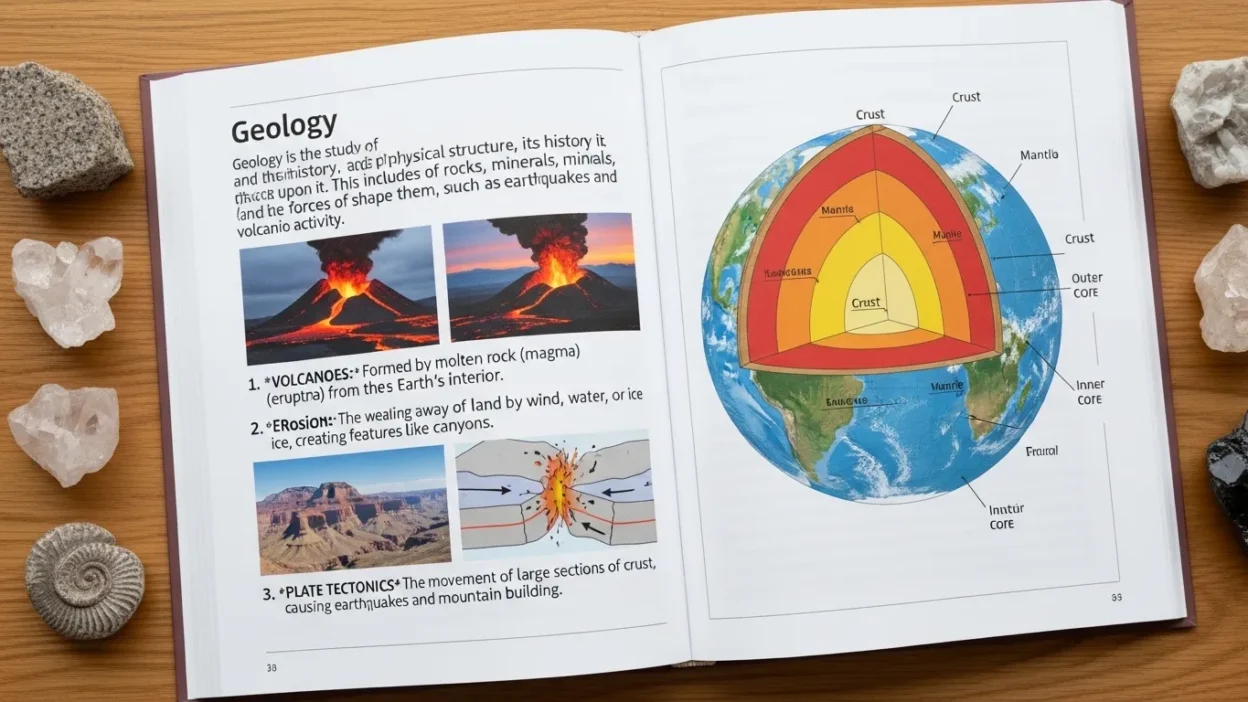
The Earth beneath our feet holds countless stories of its past, from fiery volcanic eruptions to the slow formation of mountains and valleys. Understanding these stories is the focus of geology, a fascinating science that studies the structure, composition, and processes of our planet.
But what exactly does geology mean, and why is it important? In simple terms, geology is the study of the Earth its rocks, minerals, landforms, and the forces that shape them over millions of years.
It helps us uncover the history of life on Earth, locate natural resources like minerals and water, and predict natural disasters such as earthquakes and volcanic eruptions.
From students to curious minds, learning the meaning of geology opens a window into the workings of our planet, showing how past events influence the present and guide the future.
This article will explore geology meaning, its branches, importance, and real-life applications.
Geology Meaning and Definition
At its core, geology is the scientific study of the Earth — its materials, structures, processes, and history. The word “geology” comes from the Greek words “geo” meaning Earth and “logos” meaning study or science, literally translating to “the study of the Earth.” This field of science helps us understand the physical composition of the planet, the natural forces that shape it, and the story recorded in rocks, minerals, and landforms.
Geologists examine the Earth’s layers, including the crust, mantle, and core, to understand phenomena such as earthquakes, volcanic activity, and mountain formation. They study rocks and minerals to reveal the Earth’s history, track the evolution of life through fossils, and even predict natural disasters. By applying scientific methods — including observation, measurement, and experimentation — geology provides a systematic way to explore the planet.
Beyond studying the Earth’s past, geology has practical applications in daily life. It helps locate natural resources such as oil, gas, metals, and groundwater, and guides environmental protection and sustainable land use. Whether in mining, construction, or disaster prevention, the knowledge derived from geology impacts society in countless ways.
In essence, geology is more than rocks and soil — it is the story of our planet, recorded in layers of stone, shaped by time, and studied to understand both the past and the future of the Earth.
What Does Geology Study?
Geology explores the Earth in all its complexity, investigating its materials, processes, and history to understand how our planet works. At its heart, geology studies rocks, minerals, landforms, and the forces that shape them over time.
One of the main focuses of geology is the structure of the Earth. Geologists examine the layers of the planet — the crust, mantle, and core — to understand phenomena such as earthquakes, volcanic eruptions, and the formation of mountains. By studying these layers, scientists can trace the movement of tectonic plates and the processes that continuously reshape the Earth’s surface.
Another key area is rocks and minerals. Rocks are categorized into three types: igneous, sedimentary, and metamorphic, each revealing different aspects of Earth’s history. Minerals, the building blocks of rocks, provide clues about the chemical composition of the planet and its natural resources.
Geology also investigates fossils and ancient life, helping us reconstruct past environments and evolutionary history. By examining sediment layers and fossil records, geologists can determine the age of rocks and understand how life on Earth has changed over millions of years.
Additionally, geology studies geological processes such as erosion, weathering, volcanic activity, and sediment deposition. These processes shape landscapes, influence natural hazards, and affect ecosystems.
In summary, geology is not just about studying stones; it is a comprehensive science that explores Earth’s materials, processes, and history, offering insights that are vital for understanding both natural phenomena and human interactions with the planet.
Branches of Geology
Geology is a broad science, divided into several branches, each focusing on specific aspects of the Earth. Understanding these branches helps explain the diverse studies within geology and their real-world applications.
1. Physical Geology – This branch examines Earth’s materials, such as rocks and minerals, and the processes that shape the planet, including erosion, volcanism, and tectonic movements.
2. Historical Geology – Focused on Earth’s history, this branch studies rock layers and fossils to reconstruct past landscapes, climate changes, and the evolution of life over millions of years.
3. Mineralogy – The study of minerals, their chemical composition, crystal structure, and properties. Mineralogy is essential for mining, material science, and understanding Earth’s resources.
4. Petrology – Petrology analyzes rocks, their origin, classification, and formation processes. It helps explain volcanic activity, mountain formation, and the Earth’s internal processes.
5. Paleontology – The study of fossils and ancient life forms. Paleontology allows geologists to track evolutionary history and reconstruct ancient ecosystems.
6. Seismology – Focuses on earthquakes and seismic waves. Seismology helps predict earthquakes and understand Earth’s internal structure.
7. Volcanology – The study of volcanoes and volcanic activity, including lava, eruptions, and their impact on the environment.
8. Geomorphology – Examines landforms and surface processes, such as erosion, sedimentation, and landscape changes.
9. Hydrogeology – Studies groundwater, aquifers, and water flow through soil and rock, crucial for water management and environmental protection.
10. Environmental Geology – Explores how human activity interacts with Earth processes, including pollution, soil conservation, and hazard mitigation.
Each branch provides a unique perspective, collectively helping us understand the Earth’s structure, history, and dynamic processes.
Importance of Geology
Geology is more than the study of rocks and soil — it plays a vital role in understanding and managing the Earth. One of the primary reasons geology is important is that it helps us understand Earth’s history. By studying rock layers, fossils, and geological formations, scientists can reconstruct past climates, natural events, and the evolution of life over millions of years.
Another critical aspect is the exploration and management of natural resources. Geologists locate and evaluate resources such as oil, gas, minerals, metals, and groundwater, which are essential for human civilization. Without geology, industries like mining, construction, and energy production would lack the knowledge needed to operate safely and efficiently.
Geology also contributes to disaster prediction and mitigation. By studying fault lines, volcanic activity, and sediment patterns, geologists can forecast earthquakes, landslides, and volcanic eruptions, helping communities prepare and reduce damage.
Environmental protection is another area where geology is crucial. Understanding soil composition, groundwater flow, and erosion patterns allows for sustainable land use, conservation, and pollution prevention.
Moreover, geology influences infrastructure and urban planning. Engineers rely on geological studies to design stable buildings, roads, tunnels, and dams that can withstand natural forces.
In essence, geology connects science with everyday life. From uncovering Earth’s past to securing natural resources, preventing disasters, and protecting the environment, geology provides the knowledge necessary for safely navigating and sustaining our planet.
Types of Rocks in Geology
Rocks are one of the fundamental elements studied in geology, and understanding their types helps us interpret Earth’s history and processes. Geologists classify rocks into three main categories: igneous, sedimentary, and metamorphic.
1. Igneous Rocks – These rocks form from cooled and solidified magma or lava. They are classified into intrusive (formed beneath the Earth’s surface, like granite) and extrusive (formed on the surface, like basalt). Igneous rocks are crucial for studying volcanic activity and the formation of Earth’s crust.
2. Sedimentary Rocks – Sedimentary rocks form from the accumulation and compression of sediments, including sand, silt, and organic material. Examples include limestone, sandstone, and shale. These rocks often contain fossils, providing valuable insights into past life and environmental conditions. Sedimentary rocks are also essential for understanding erosion, sedimentation, and the geological time scale.
3. Metamorphic Rocks – Metamorphic rocks develop when existing rocks are subjected to intense heat and pressure, causing physical and chemical changes. Common examples are marble (from limestone) and slate (from shale). Metamorphic rocks reveal information about the Earth’s internal processes, tectonic activity, and mountain formation.
Each type of rock plays a unique role in geology. Studying igneous, sedimentary, and metamorphic rocks helps geologists understand Earth’s structure, the formation of landforms, and the history recorded in rock layers. Rocks are not just materials beneath our feet; they are records of the Earth’s dynamic past and clues to its future.
Geological Time Scale
The geological time scale is a system that divides Earth’s 4.5-billion-year history into manageable intervals, helping geologists understand the sequence of events that shaped our planet. By studying rock layers, fossils, and other geological evidence, scientists can reconstruct Earth’s past, from its formation to the present.
The time scale is divided into major eons, eras, periods, and epochs. The Precambrian represents the earliest part of Earth’s history, covering almost 90% of its existence and marking the formation of the planet and the first simple life forms. Following this is the Paleozoic Era, characterized by the rise of complex marine life, early plants, and the first land animals. The Mesozoic Era, often called the “Age of Reptiles,” is famous for dinosaurs and the development of flowering plants. The Cenozoic Era, the current era, witnesses the rise of mammals, birds, and humans.
To determine the age of rocks and events, geologists use methods such as relative dating (studying the order of rock layers) and radiometric dating (measuring the decay of radioactive isotopes). These techniques allow scientists to assign approximate ages to rocks, fossils, and geological formations, providing a timeline of Earth’s development.
The geological time scale is crucial for understanding Earth’s evolution, climate changes, and the development of life. It provides context for the study of fossils, rock formations, and natural processes, making it an essential tool in geology for both research and education.
Role of a Geologist
A geologist is a scientist who studies the Earth, its materials, structures, and processes. Geologists play a crucial role in understanding how the planet works, helping societies manage natural resources, prevent disasters, and protect the environment.
One of the primary responsibilities of a geologist is field research. This involves examining rock formations, collecting samples, mapping geological features, and observing natural processes such as erosion, volcanic activity, and earthquakes. Fieldwork provides essential data for understanding Earth’s history and predicting future changes.
In addition to fieldwork, geologists perform laboratory analysis. They study rocks, minerals, and fossils under microscopes, analyze chemical compositions, and use modern technology to interpret data. Techniques like radiometric dating and geochemical testing allow geologists to determine the age of rocks and trace their formation processes.
Geologists work in a variety of sectors. In the mining and energy industry, they locate and evaluate resources such as oil, gas, metals, and minerals. In environmental and government organizations, they assess land stability, monitor groundwater, and evaluate risks from natural hazards. Academic and research institutions employ geologists to study Earth’s history, climate changes, and tectonic activity.
By combining scientific knowledge with practical applications, geologists help society make informed decisions about natural resource management, construction, disaster prevention, and environmental protection. In essence, geologists are not just Earth scientists — they are explorers, problem-solvers, and stewards of the planet.
Real-World Examples of Geology
Geology is not just a theoretical science — it has numerous real-world applications that affect daily life and the environment. One of the most visible examples is earthquakes. Geologists study fault lines and seismic activity to understand why earthquakes occur and to help communities prepare for these natural disasters. Seismology, a branch of geology, provides critical data for early warning systems that save lives and reduce damage.
Volcanoes are another example. Volcanologists analyze magma, eruption patterns, and lava flows to predict volcanic activity and mitigate risks to nearby populations. Volcanic rocks also reveal information about Earth’s internal processes and the planet’s geological history.
Mountain formation is a result of tectonic activity studied by geologists. Plate collisions push land upward, creating mountain ranges like the Himalayas. By understanding these processes, scientists can explain landscapes and predict future geological changes.
Fossil discoveries provide insights into ancient life and Earth’s history. Paleontologists study sedimentary rocks containing fossils to reconstruct past environments and track evolutionary patterns.
Finally, geology plays a vital role in resource extraction. Geologists locate minerals, oil, gas, and groundwater, helping industries operate efficiently and sustainably. Knowledge of rock formations ensures safe mining, drilling, and water management.
In summary, real-world geology connects scientific study with practical applications. From predicting natural disasters and exploring resources to understanding Earth’s history, geology is a science that shapes human knowledge and interaction with the planet.
Geology vs Earth Science
While geology is a branch of Earth science, the two are not exactly the same. Geology specifically focuses on the study of the Earth’s solid materials, such as rocks, minerals, landforms, and the processes that shape them. It examines both the Earth’s history and its present-day dynamics, including plate tectonics, earthquakes, volcanic activity, and mountain formation.
Earth science, on the other hand, is a broader field that includes geology as well as other sciences that study the Earth’s systems. It encompasses meteorology (study of weather and atmosphere), oceanography (study of oceans), astronomy (study of space in relation to Earth), and environmental science (study of human impact on Earth). Essentially, Earth science looks at the Earth as an interconnected system, whereas geology concentrates on the solid Earth.
Understanding the difference is important for students, researchers, and enthusiasts. While a geologist might focus on mapping rock layers, studying fossils, or analyzing mineral compositions, an Earth scientist could also study climate patterns, ocean currents, or atmospheric changes.
Despite these distinctions, the fields overlap significantly. Geologists often rely on principles from Earth science to understand climate history, natural hazards, and environmental changes. Conversely, Earth scientists use geological data to model how the Earth’s crust interacts with oceans, the atmosphere, and life.
In summary, geology is a focused study of the Earth’s solid features, while Earth science takes a holistic approach to understanding the planet as a dynamic system. Both are essential for comprehending and managing our natural world.
Tools and Methods Used in Geology
Geologists use a combination of fieldwork, laboratory analysis, and modern technology to study the Earth accurately and efficiently. These tools and methods help scientists understand the planet’s structure, history, and processes.
Fieldwork techniques are fundamental in geology. Geologists examine rock formations, collect samples, and create geological maps that document landforms and natural features. They may also measure soil composition, observe faults, and study sediment layers to understand the forces shaping landscapes. Fieldwork provides firsthand data essential for accurate interpretation.
In the laboratory, geologists analyze collected samples using microscopes, chemical tests, and advanced equipment. Radiometric dating allows them to determine the age of rocks and fossils, while geochemical analysis helps identify mineral compositions. Lab work complements field observations and ensures precise results.
Modern technology has revolutionized geology. Satellite imaging and remote sensing allow scientists to monitor changes in landscapes, volcanoes, and glaciers. Geographic Information Systems (GIS) help visualize spatial data, track natural hazards, and plan resource management. Seismographs, ground-penetrating radar, and drilling equipment provide insight into Earth’s subsurface structure.
By combining these tools and methods, geologists can study processes that occur over millions of years and apply this knowledge to real-world challenges. From predicting earthquakes to locating minerals and managing water resources, geological tools and methods are essential for understanding and protecting our planet.
Interesting Facts About Geology
Geology is full of fascinating discoveries that reveal the dynamic and ancient history of our planet. One remarkable fact is that the Earth is about 4.5 billion years old, and its surface has been continuously reshaped by natural forces like erosion, volcanic activity, and plate tectonics.
Some of the oldest rocks on Earth are over 4 billion years old, found in regions like Canada’s Shield and Australia’s Jack Hills. These rocks provide a window into the planet’s earliest history and the conditions that allowed life to develop.
Earthquakes are another geological wonder. The largest recorded earthquake occurred in Chile in 1960, measuring a staggering 9.5 on the Richter scale. Studying earthquakes helps geologists understand tectonic activity and improve disaster preparedness.
Volcanoes also hold geological significance. For example, Mauna Loa in Hawaii is the largest active volcano on Earth, covering an area of over 5,000 square kilometers. Volcanic eruptions have shaped continents, created fertile soils, and even influenced climate throughout history.
Geology also connects us to the past through fossils, some over 500 million years old, which reveal ancient life and ecosystems. Studying these fossils helps paleontologists reconstruct evolutionary history and understand how life adapted to changing environments.
Finally, geology is constantly evolving with modern technology, including satellite imaging, GIS mapping, and seismic monitoring, enabling scientists to study natural hazards, explore resources, and predict Earth’s future changes.
In short, geology is not just the study of rocks — it is a story of Earth’s past, present, and future, filled with incredible discoveries that continue to amaze scientists and enthusiasts alike.
Why Students Study Geology
Studying geology offers students a unique opportunity to understand the Earth, its history, and the processes that shape our environment. One of the primary reasons students pursue geology is career opportunities. Geologists work in diverse fields such as mining, oil and gas exploration, environmental consulting, water resource management, and research. These careers provide hands-on experience and often involve travel, fieldwork, and working with advanced technology.
Another reason is the scientific curiosity and learning benefits. Geology combines observation, analysis, and critical thinking. Students learn to examine rocks, minerals, fossils, and landforms, gaining insight into Earth’s structure and natural processes. This knowledge helps them understand natural hazards like earthquakes, landslides, and volcanic eruptions, which is essential for public safety and disaster management.
Geology also appeals to students interested in environmental protection and sustainability. By studying soil, groundwater, and erosion patterns, students can contribute to sustainable land use, conservation, and resource management. Geology teaches them to balance human activity with Earth’s natural systems, making it valuable for environmental careers.
Furthermore, geology connects students to the Earth’s history, allowing them to reconstruct ancient environments, understand climate change, and track the evolution of life through fossils. This perspective provides a deep appreciation of the planet and its processes.
In essence, students study geology not only for career prospects but also to gain practical skills, scientific knowledge, and a better understanding of the Earth, preparing them to tackle challenges related to natural resources, hazards, and environmental sustainability.
(FAQ)
1. What is the simple meaning of geology?
Geology is the scientific study of the Earth, including its rocks, minerals, landforms, and the processes that shape them. It helps us understand the Earth’s history, natural resources, and natural hazards.
2. What are the main branches of geology?
The primary branches include physical geology, historical geology, mineralogy, petrology, paleontology, seismology, volcanology, geomorphology, hydrogeology, and environmental geology. Each branch focuses on a specific aspect of the Earth’s structure, materials, and processes.
3. Why is geology important?
Geology is crucial for understanding Earth’s past, managing natural resources like minerals, water, and fossil fuels, predicting natural disasters, and protecting the environment. It also guides construction, urban planning, and sustainable land use.
4. What do geologists study?
Geologists study rocks, minerals, fossils, soil, landforms, and geological processes such as earthquakes, volcanic activity, erosion, and plate tectonics. They use these observations to interpret Earth’s history and predict future changes.
5. Is geology part of Earth science?
Yes, geology is a branch of Earth science. While geology focuses on the solid Earth, Earth science is broader and also includes meteorology, oceanography, environmental science, and astronomy.
6. How does geology affect everyday life?
Geology impacts daily life through resource management, natural disaster prediction, infrastructure development, environmental protection, and providing materials such as metals, water, and energy.
By answering these common questions, readers gain a clear and concise understanding of geology meaning, its applications, and significance.
Conclusion:
Geology is the fascinating science that helps us understand the Earth — its materials, structures, and the processes that have shaped it over billions of years. From studying rocks and minerals to analyzing fossils and mapping landforms, geology provides a window into the planet’s past, helping us interpret how it has changed and evolved over time.
Understanding geology is not only about exploring the Earth’s history; it has practical applications that impact our daily lives. Geologists play a vital role in locating natural resources like oil, gas, water, and minerals, which are essential for human civilization.
They also contribute to disaster prediction, studying earthquakes, volcanoes, and landslides to help communities prepare and stay safe. Environmental geology guides sustainable land use, water management, and soil conservation, ensuring that human activity does not harm the planet.
For students and professionals alike, geology offers a diverse range of career opportunities while fostering a deep understanding of the Earth.
If through fieldwork, laboratory research, or modern technologies like GIS and satellite imaging, geologists combine observation, analysis, and innovation to solve real-world problems.
In essence, geology is more than just the study of rocks; it is the story of our planet, recorded in stone, shaped by natural forces, and vital for understanding both the past and future of Earth.
By studying geology, we gain knowledge, insight, and appreciation for the dynamic planet we call home.