
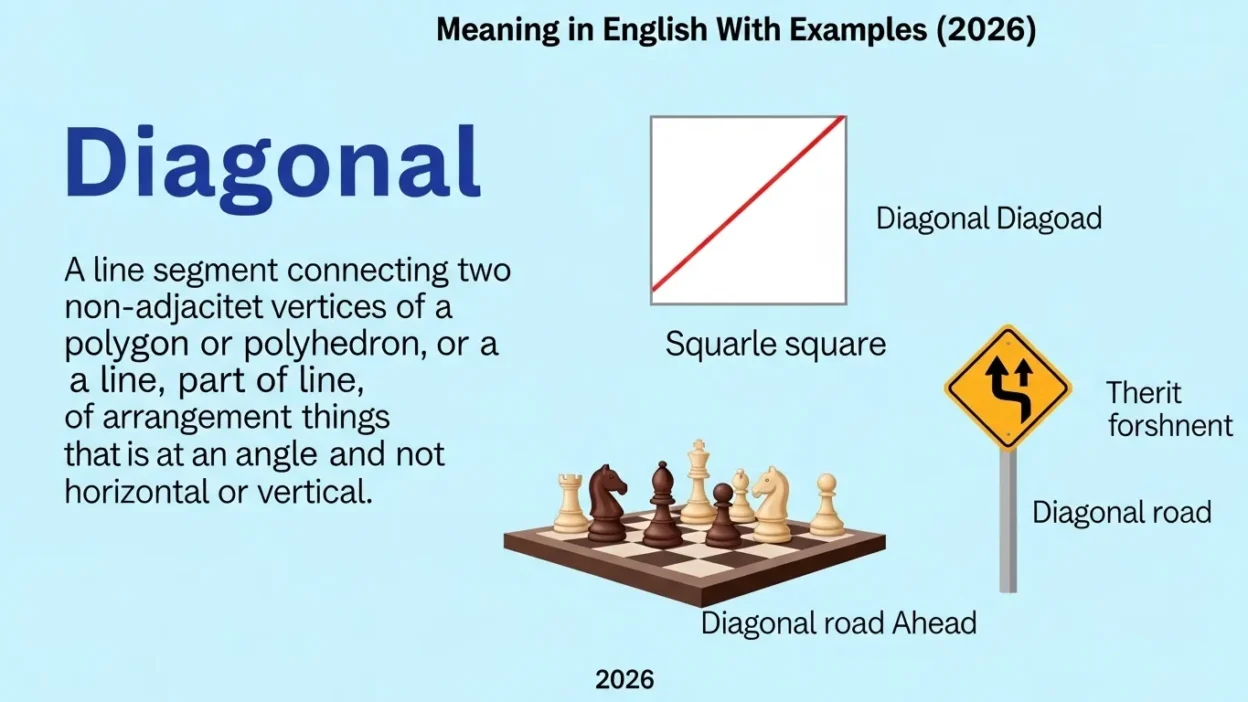
The word diagonal might seem simple, but it carries meaning in math, design, and everyday life. At its core, a diagonal is a straight line that connects two opposite corners of a shape, like a square or rectangle.
Unlike horizontal or vertical lines, diagonals cut across shapes, creating movement and direction. But the concept doesn’t stop at geometry. Diagonals appear everywhere around us in architecture, art, photography, and even the screens we use daily.
They guide our eyes in visual compositions, strengthen structures, and make objects more dynamic. Understanding the meaning of diagonal helps us recognize patterns, solve mathematical problems, and appreciate design principles.
In this article, we’ll explore the definition, types, applications, and symbolic meanings of diagonals, breaking down both their practical and creative roles. By the end, you’ll see diagonals not just as lines, but as a powerful concept shaping the world around us.
What Does Diagonal Mean?
The term diagonal has a clear and versatile meaning that spans both everyday language and technical contexts. At its most basic level, a diagonal is a straight line that connects two non-adjacent corners of a shape. In simple words, it’s a line that “cuts across” a shape rather than following its edges. For example, in a square or rectangle, the line connecting the top-left corner to the bottom-right corner is a diagonal. This distinguishes it from horizontal lines, which go straight across, or vertical lines, which move straight up and down.
The word diagonal comes from the Greek word diagonios, meaning “from angle to angle.” This etymology reflects its geometric roots and explains why the term is closely associated with polygons and shapes in mathematics.
Diagonals aren’t limited to geometry. In everyday life, we see them in slanted cuts, road crossings, roof beams, or even the way we arrange furniture for a dynamic layout. In art and design, diagonal lines are often used to create a sense of movement, tension, or direction, guiding the viewer’s eye through a composition.
In language and idioms, “diagonal” can imply indirectness or a non-linear path, symbolizing movement or change. Recognizing the meaning of diagonals helps us interpret shapes, understand patterns, and appreciate design principles in both practical and creative contexts.
Understanding the basic meaning is the first step next, we’ll explore diagonal meaning specifically in geometry, where the concept becomes more structured and formula-driven.
Diagonal Meaning in Geometry
In geometry, the concept of a diagonal becomes more precise and essential. A diagonal is a straight line connecting two non-adjacent vertices of a polygon. For instance, in a square, the line that joins opposite corners is a diagonal. Similarly, rectangles, pentagons, and hexagons all have diagonals connecting corners that are not next to each other. Understanding diagonals is crucial because they help measure distances, divide shapes into smaller parts, and analyze structural properties.
The number of diagonals in a polygon can be calculated using a simple formula:
Number of diagonals=n(n−3)2\text{Number of diagonals} = \frac{n(n-3)}{2}Number of diagonals=2n(n−3)
Here, nnn represents the number of sides. For example, a pentagon has 5(5−3)2=5\frac{5(5-3)}{2} = 525(5−3)=5 diagonals, while a hexagon has 9 diagonals.
Diagonals also have specific types and properties. In rectangles and squares, the diagonals are equal in length and intersect at right angles. In some polygons, like rhombuses, the diagonals are perpendicular and bisect each other, dividing the shape into smaller triangles.
Besides shapes, diagonals are crucial in coordinate geometry. By connecting two vertices on a grid, you can calculate the diagonal’s length using the distance formula:
Diagonal=(x2−x1)2+(y2−y1)2\text{Diagonal} = \sqrt{(x_2 – x_1)^2 + (y_2 – y_1)^2}Diagonal=(x2−x1)2+(y2−y1)2
This makes diagonals practical for solving real-life problems in construction, design, and navigation. By understanding diagonals in geometry, we can see how this simple line plays a key role in both mathematics and practical applications.
Diagonal Meaning in Everyday Life
Diagonals are not just mathematical concepts they appear everywhere in our daily lives. At a basic level, a diagonal is any line that slants across a surface, connecting opposite points instead of following the standard horizontal or vertical direction. This makes diagonals useful for creating movement, efficiency, or structural stability in various contexts.
For example, in architecture and construction, diagonal beams or braces strengthen structures by distributing weight more effectively than horizontal or vertical supports alone. Bridges, roof trusses, and towers often rely on diagonal components to maintain stability and balance.
In roads and transportation, diagonal crossings and intersections allow more direct movement from one point to another. Think of a crosswalk that cuts diagonally across a street or a diagonal highway ramp that connects two roads efficiently.
Diagonals also appear in fashion, design, and crafts. A diagonal cut in fabric or paper can create unique shapes, patterns, and visual interest. In interior design, arranging furniture diagonally in a room can make the space appear more dynamic and inviting.
Even in language, diagonals carry symbolic meaning. Phrases like “moving in a diagonal path” suggest an indirect route or a creative approach, while diagonal lines in art convey motion, tension, or energy.
Recognizing diagonals in everyday life helps us understand design principles, structural logic, and movement patterns. From buildings to roads, art, and even simple layouts, diagonals guide our eyes, create balance, and improve functionality, making this geometric concept a practical part of our world.
Diagonal in Art and Design
In art and design, diagonals are more than just lines they are powerful tools that shape the way we perceive images. Unlike horizontal or vertical lines, which convey stability and calmness, diagonal lines suggest movement, energy, and tension, making compositions more dynamic and engaging.
Artists often use diagonals to lead the viewer’s eye through a painting or photograph. For example, a road or river drawn diagonally across a landscape painting creates a sense of depth and direction. Similarly, in photography, diagonal composition is a popular technique to make images appear more dramatic and lively. By placing subjects along a diagonal axis, photographers can guide viewers naturally from one point to another, adding flow to the image.
In graphic design, diagonals break monotony and create visual interest. Designers often use diagonal shapes, lines, or patterns in posters, advertisements, and websites to draw attention to key elements. Diagonal layouts can also suggest modernity and innovation, as they appear less conventional than straight, horizontal arrangements.
Even in typography, diagonal lines appear in letters and logos to suggest motion or energy. Sports logos, for example, often feature diagonal elements to convey speed and dynamism.
Overall, diagonals in art and design are not just decorative they influence how viewers feel and respond. By understanding the meaning and function of diagonal lines, artists and designers can create compositions that are visually compelling, energetic, and memorable, transforming a simple line into a tool for storytelling and emotional impact.
Diagonal in Architecture and Engineering
Diagonals play a crucial role in architecture and engineering, where stability, strength, and efficiency are essential. Unlike horizontal or vertical supports, diagonal elements distribute forces across structures, reducing stress on individual components and enhancing overall durability. This makes them a fundamental part of building safe and reliable structures.
One common application is cross-bracing in buildings and bridges. By placing diagonal beams in an X-shaped pattern, engineers prevent structures from swaying or collapsing under lateral forces, such as wind or earthquakes. This technique is widely used in skyscrapers, stadiums, and bridges to ensure long-term stability.
Diagonals also appear in roof trusses and frameworks, where slanted beams connect opposite corners to support weight efficiently. These diagonal supports allow for wider spans without requiring additional vertical columns, creating open and flexible interior spaces.
In engineering design, diagonals are not limited to buildings. Towers, cranes, and even mechanical structures often rely on diagonal supports to maintain balance and distribute load evenly. For example, transmission towers use diagonal cross-members to resist bending and twisting forces.
Even in urban planning and infrastructure, diagonal pathways, ramps, and roads create more efficient routes between points, reducing travel time and improving traffic flow.
By understanding how diagonals function in architecture and engineering, we see that this simple geometric concept has a practical impact on safety, durability, and design efficiency. From bridges to skyscrapers, diagonals help transform abstract lines into essential components of the physical world.
Diagonal in Technology and Everyday Objects
Diagonals are more than just geometric or design concepts they are also integral to technology and the objects we use every day. One of the most familiar examples is screen measurement. Televisions, monitors, and smartphones are measured diagonally from one corner to the opposite corner. This standard helps compare screens of different shapes and aspect ratios, providing a consistent reference for size, even if the width and height vary.
In sports and games, diagonals play a key role as well. In chess, for example, bishops move diagonally across the board, covering long distances efficiently. In soccer, basketball, and hockey, diagonal passes are often more strategic than straight-line moves because they can bypass defenders and create better scoring opportunities.
Even in everyday objects, diagonals appear in practical ways. Diagonal cuts in food, fabric, or paper are common because they often create stronger or more visually appealing results. For example, slicing bread diagonally provides a larger surface area, and cutting fabric on the diagonal (called “bias cutting”) allows it to stretch more evenly.
In interior design and furniture arrangement, placing items diagonally in a room can create a sense of flow and spaciousness, guiding movement and making the space feel dynamic rather than rigid.
Recognizing diagonals in technology and everyday objects shows how a simple geometric concept improves functionality, efficiency, and aesthetics. From screens to sports strategies, cutting techniques, and interior layouts, diagonals subtly influence the way we interact with the world, making them an essential part of daily life.
Synonyms, Related Terms, and Common Misconceptions
Understanding diagonal meaning also involves recognizing related terms and common misconceptions. Synonyms can help clarify the concept and expand how we use the word in different contexts. Common synonyms for diagonal include slanted, oblique, inclined, and crosswise. Each of these suggests a line or direction that is not horizontal or vertical, though subtle differences exist. For example, “slanted” may imply irregularity, while “oblique” often carries a more formal or technical tone.
It is equally helpful to consider antonyms to understand what diagonals are not. Lines that are horizontal run straight across, while vertical lines move straight up and down. Recognizing these opposites ensures clarity when describing shapes, patterns, or directions.
Despite its apparent simplicity, diagonal is often misunderstood in geometry and daily life. A common misconception is confusing diagonal lines with any slanted or angled line. While all diagonals are slanted in some sense, not every slant counts as a diagonal the line must connect opposite corners of a polygon. Another mistake is miscalculating diagonals in shapes, especially in complex polygons where the number of diagonals increases rapidly.
In everyday language, some people interpret “diagonal” loosely to mean “anything not straight,” which can dilute its precise meaning. Understanding synonyms and clarifying misconceptions helps readers use the term correctly in math, design, writing, and conversation. By connecting related words and correcting common errors, we gain a complete understanding of what diagonals are and how they function both practically and conceptually.
Examples of Diagonal in Sentences
Using diagonal in sentences helps clarify its meaning in everyday, academic, and creative contexts. In everyday language, you might hear sentences like:
- “The crosswalk cuts diagonally across the street, allowing pedestrians to reach the corner faster.”
- “She arranged the furniture diagonally to make the room feel more spacious.”
- “He made a diagonal cut in the cake to create larger slices.”
In academic or mathematical contexts, diagonal is used more technically:
- “The diagonal of a square can be calculated using the formula √2 × side length.”
- “A rectangle has two diagonals of equal length that intersect at their midpoint.”
- “The main diagonal of a matrix consists of elements from the top-left corner to the bottom-right corner.”
In creative writing or figurative expressions, diagonal conveys movement, energy, or an indirect path:
- “The sunlight streamed through the window in long, diagonal rays.”
- “Her thoughts took a diagonal path, jumping from one memory to another.”
- “The artist’s sketch used diagonal lines to create a sense of tension and motion.”
These examples show that diagonals are not just lines they represent direction, efficiency, and dynamic movement. Whether in geometry, design, daily activities, or literature, recognizing how and where diagonals appear makes the concept tangible and relatable. By practicing their use in sentences, readers can reinforce both the literal and figurative meanings of diagonal, making the term easier to understand and apply in multiple contexts.
Common Questions About Diagonal Meaning (FAQ)
Understanding diagonals often raises questions, especially for students, designers, and curious readers. Here are some frequently asked questions and their answers:
1. What is a diagonal line?
A diagonal line is a straight line that connects two non-adjacent corners of a polygon. Unlike horizontal or vertical lines, diagonals cut across the shape, creating movement and direction.
2. How do you find a diagonal of a shape?
For simple polygons, the number of diagonals can be calculated using the formula:
Number of diagonals=n(n−3)2\text{Number of diagonals} = \frac{n(n-3)}{2}Number of diagonals=2n(n−3)
where nnn is the number of sides. To find the length of a diagonal in a rectangle or square, you can use the Pythagorean theorem or the distance formula.
3. Why are screens measured diagonally?
TVs, monitors, and smartphones are measured diagonally to provide a standard reference across different widths and aspect ratios. Measuring diagonally gives a consistent sense of screen size.
4. What is the main diagonal in a matrix?
The main diagonal of a matrix runs from the top-left corner to the bottom-right corner. In square matrices, it contains elements where the row and column numbers are equal.
5. What does diagonal mean in art or design?
In visual arts, diagonal lines create movement, tension, and energy. Designers and artists use diagonals to lead the viewer’s eye or make compositions more dynamic.
By answering these common questions, readers can understand the practical, mathematical, and symbolic roles of diagonals, making the concept clear and easy to apply in various fields.
Conclusion
The concept of a diagonal is simple at first glance a straight line connecting two opposite corners but its significance stretches across mathematics, art, design, architecture, and daily life.
In geometry, diagonals help us calculate distances, divide shapes, and understand the properties of polygons. They form the backbone of mathematical formulas, from finding the diagonal of a rectangle to analyzing matrices in advanced mathematics.
Beyond numbers, diagonals are visual tools that create movement, tension, and direction in art, photography, and design. They guide the viewer’s eye, break monotony, and make compositions feel dynamic and energetic.
Interior designers use diagonals to arrange furniture or layouts, while architects and engineers rely on diagonal supports and cross-bracing to ensure structural stability.
In everyday life, diagonals appear in ways we might not immediately notice from the way a crosswalk cuts across a street, to the diagonal measurement of a screen, to slanted cuts in fabric or food. Even in language and creative writing, diagonals symbolize indirect paths, movement, or change, emphasizing their metaphorical importance.
Understanding diagonals helps us see patterns, improve design, solve problems, and appreciate the structures around us. They are more than just lines they are practical, aesthetic, and symbolic elements shaping our physical and visual world.
recognizing and applying diagonal principles, we can not only solve mathematical and structural problems but also create more dynamic and visually appealing spaces, artworks, and designs.
In short, diagonals connect more than corners they connect function, form, and creativity, making this simple line a powerful concept in multiple dimensions of life.

Welcome to TextFlirtz.com, your ultimate destination for fun, flirty, and clever pick-up lines that spark conversations and make hearts skip a beat! Whether you’re looking to impress your crush, add some humor to your chats, or just have a playful time texting, we’ve got you covered with lines that are witty, spicy, and unforgettable. Dive in, explore our collections, and start flirting the smart way—because at TextFlirtz.com, words are your best wingman!