
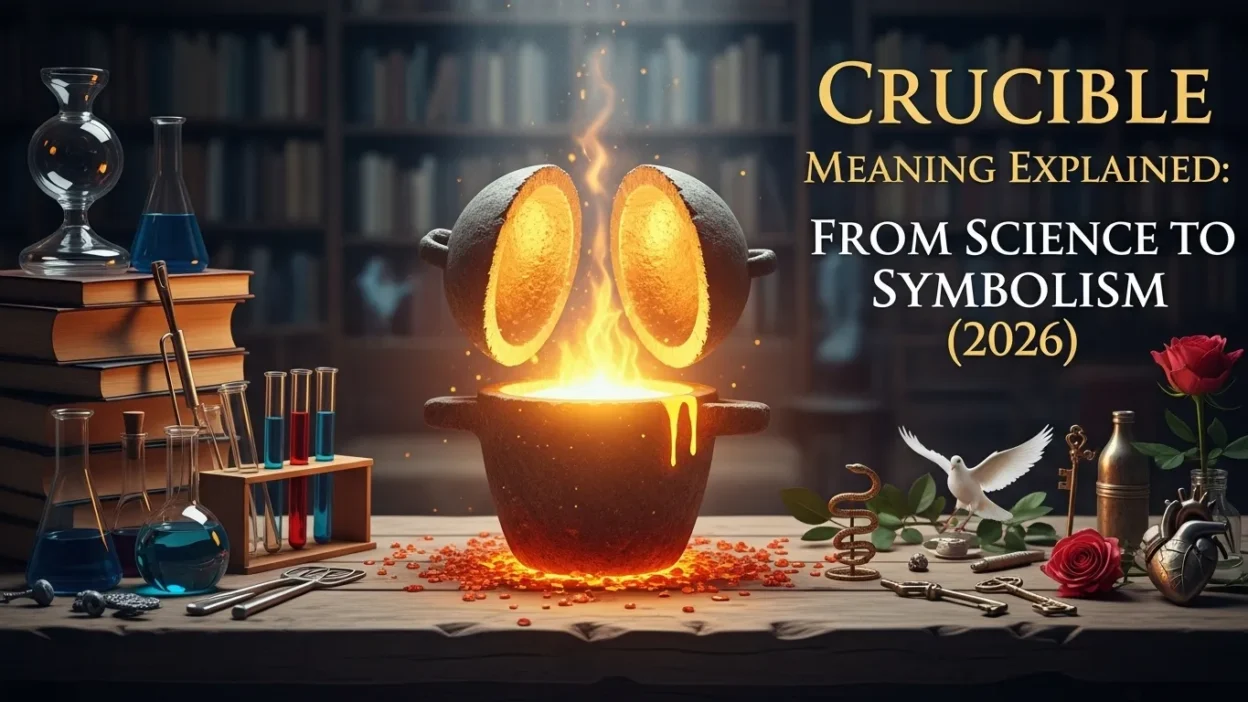
Understanding the crucible meaning can feel confusing at first because the word is used in very different contexts. You might hear it in a science class, read it in literature, or see it used metaphorically to describe a difficult life experience. So, what does crucible actually mean?
At its core, a crucible refers to something that involves intense pressure, heat, or testing either literally or figuratively. In scientific terms, a crucible is a container designed to withstand extremely high temperatures, often used in chemistry and metallurgy.
Beyond the laboratory, the meaning of crucible expands into everyday language, where it describes a severe trial that leads to change or transformation.
This article explores the meaning of crucible in simple words, covering its definition, origin, literal and metaphorical uses, and real-life examples. By the end, you’ll clearly understand how and when to use the word crucible correctly.
What Does Crucible Mean? (Simple Definition & Context)
The word “crucible” has both literal and figurative meanings, making it a versatile term in English. At its most basic, a crucible is a strong, heat-resistant container used in science and metallurgy to melt or purify metals. This literal meaning emphasizes the ability to endure extreme heat without breaking, which is why the word is often associated with strength, resilience, and transformation.
However, in everyday language, crucible is most commonly used metaphorically. When someone says, “That period in my life was a crucible,” they mean it was a severe test or challenge that forced them to grow, adapt, or change. Essentially, a crucible represents intense pressure or hardship that results in transformation, whether in personal life, society, or even leadership situations.
Understanding the meaning of crucible requires recognizing its dual nature. In literal terms, it’s a physical object with practical applications in laboratories and industries. In figurative terms, it becomes a symbol of trials, struggles, and the process of purification or refinement.
For students, writers, or professionals, knowing both sides of the word is essential. The literal definition helps in academic and scientific contexts, while the metaphorical meaning enriches writing, speech, and comprehension of literature. Later in this article, we will explore examples from literature, life, and science to illustrate how the meaning of crucible applies in different situations.
Dictionary Definitions of Crucible
To fully understand the meaning of crucible, it helps to look at what authoritative dictionaries say. Different sources highlight both its literal and figurative uses, giving a complete picture of the word.
Oxford Dictionary defines a crucible as “a ceramic or metal container in which metals or other substances can be heated to very high temperatures”. This literal meaning emphasizes the strength and durability of a crucible, highlighting its practical use in chemistry and metallurgy. Oxford also notes its figurative meaning, describing it as “a place or situation in which different elements interact to produce something new”, showing how the word is used metaphorically to indicate a test or trial that leads to transformation.
Merriam-Webster provides a similar explanation, defining crucible as “a severe test” or “a situation in which concentrated forces interact to cause or influence change or development”. This dictionary leans more toward the figurative sense, making it useful for understanding literature, history, and personal growth contexts.
Cambridge Dictionary explains crucible as “a container for melting metal or a severe test or trial”, reinforcing both the literal and metaphorical meanings.
By comparing these dictionary definitions, it’s clear that crucible is a word with dual significance. Literally, it is a tool designed for extreme heat, while figuratively, it represents challenging situations that test people’s character, resilience, or abilities. Understanding these definitions is key for using the word correctly in academic, literary, and everyday contexts.
Later in this article, we’ll explore examples of crucible in life, literature, and science to see how these dictionary meanings are applied in real-world situations.
Etymology and Origin of the Word Crucible
To truly understand the meaning of crucible, it helps to explore its etymology and historical origins. The word “crucible” comes from the Latin word crucibulum, which means “night-stool” or “a vessel for melting metals”. Over time, this Latin term evolved into Middle English as crucible, specifically referring to a container made of strong material used for melting metals at high temperatures.
Historically, crucibles have been used for thousands of years in metallurgy, alchemy, and early scientific experiments. Ancient civilizations, including Egyptians and Greeks, relied on crucibles to smelt metals like gold, silver, and copper, which were essential for tools, jewelry, and currency. This literal meaning of a crucible as a vessel for intense heat laid the foundation for its metaphorical use.
By the 16th and 17th centuries, writers and scholars began using “crucible” figuratively. It came to symbolize a severe trial or test that could transform a person’s character, much like metals are purified under extreme heat. This figurative meaning was popularized in English literature and philosophical writings, where challenging situations were compared to the intense heat inside a crucible.
Today, the word retains both its literal scientific meaning and its figurative metaphorical meaning in modern English. Understanding the etymology helps explain why crucible is often associated with strength, endurance, and transformation. Whether in science, literature, or life, knowing its origin gives a deeper appreciation of the word and its versatility in English usage.
Literal Meaning of Crucible: Science and Laboratory Use
In its literal sense, a crucible is a container designed to withstand extremely high temperatures, making it an essential tool in chemistry, metallurgy, and materials science. Typically made from ceramic, porcelain, or specialized metals, crucibles are used to melt, purify, or chemically process substances without breaking or contaminating the material inside.
In metallurgy, crucibles allow metals like gold, silver, copper, or iron to be heated until they melt, enabling alloying, casting, and refinement. The material of the crucible is carefully chosen to resist the chemical reactions of molten substances and the extreme heat required for processing. Similarly, in chemistry labs, crucibles are used to conduct experiments involving reactions that require high temperatures, such as burning compounds to test composition or decomposing chemical substances.
The literal function of a crucible—withstanding intense heat to purify or transform materials—is why the term later gained a metaphorical meaning. Just as a crucible melts and purifies metals, life’s trials or challenges are seen as figurative crucibles that test and refine a person’s character.
Crucibles come in various sizes and types, including lidded and crucible tongs for safe handling. They are fundamental in scientific experiments, educational laboratories, and industrial processes, highlighting the practical, literal side of the word. Understanding the literal definition not only clarifies its scientific use but also enriches the understanding of its figurative applications in literature and everyday language.
Figurative and Metaphorical Meaning of Crucible
Beyond its literal use in science, the word crucible has a powerful figurative meaning, referring to a severe test, trial, or situation that challenges a person or group. In this sense, a crucible is not a physical container but a metaphorical space where intense pressure forces growth, change, or transformation.
For example, someone might say, “The first year of starting a business was a crucible for me,” meaning that the experience tested their resilience, skills, and determination. Similarly, social, political, or historical events can act as crucibles, shaping societies, cultures, and individuals under extreme conditions.
The metaphorical use of crucible emphasizes stress and refinement. Just as metals are purified in a literal crucible, people and ideas are tested in life’s crucibles. Challenges such as exams, leadership trials, ethical dilemmas, or personal hardships are all considered figurative crucibles because they can reveal true character and produce growth.
In literature and storytelling, the crucible is often a central theme. Characters may face moral, emotional, or societal pressures that force them to evolve. The term conveys not only difficulty but also opportunity, implying that what emerges from the crucible—whether a person, idea, or society—is stronger, wiser, or more resilient.
Understanding the metaphorical meaning of crucible is essential for writers, speakers, and learners, as it adds depth to language and comprehension. It explains why the word appears frequently in literature, motivational contexts, and philosophical discussions.
Crucible Meaning in Literature: Symbolism and The Crucible by Arthur Miller
In literature, the word crucible often symbolizes a trial, test, or transformative experience. Writers use it to describe situations where characters face intense pressure that challenges their beliefs, morality, or identity. This literary use stems directly from the literal meaning of a crucible—a container that withstands extreme heat to purify or transform substances.
A famous example is Arthur Miller’s play, The Crucible, written in 1953. The play is set during the Salem witch trials, a historical event in colonial America where fear, suspicion, and social pressures led to devastating consequences. Here, the term “crucible” represents the extreme moral and social pressure the characters face, forcing them to reveal their true values and confront difficult choices. The title itself reflects both the trial by fire experienced by the community and the metaphorical purification that comes through facing intense challenges.
Literary uses of crucible often extend beyond historical events. Authors may depict wars, personal conflicts, or societal changes as crucibles that test characters’ courage, integrity, or resilience. By understanding this symbolic meaning, readers can better appreciate the depth of literature and how authors convey themes of transformation, endurance, and human strength.
In short, in literature, a crucible is never just a physical object—it is a symbol of challenge, testing, and growth, showing how individuals or societies are shaped when confronted with extreme circumstances. Recognizing this meaning enriches reading comprehension and adds nuance to literary analysis.
Crucible Meaning in History: Trials and Transformations
The concept of a crucible extends beyond science and literature into history, where it is used metaphorically to describe events that put societies, nations, or groups under extreme pressure. In historical contexts, a crucible is any period of intense challenge or crisis that tests resilience, leadership, and social cohesion.
For example, wars, revolutions, and social upheavals often serve as historical crucibles. The American Revolution, the French Revolution, and major civil rights movements were all crucibles in the sense that they subjected communities to extreme challenges, forcing rapid change and shaping the future of nations. These events reveal how pressure, conflict, and adversity can purify or transform societal structures, much like a literal crucible refines metals under heat.
Historical crucibles are not limited to political events. Natural disasters, pandemics, and economic crises also function as crucibles, testing human endurance, leadership, and collective problem-solving. Societies that survive and adapt often emerge stronger, more organized, and wiser, illustrating the transformational power of trials.
Using the metaphor of a crucible in historical analysis helps us understand cause and effect during periods of stress. It emphasizes that significant growth, reform, or innovation often arises from intense pressure rather than calm conditions. Recognizing history as a series of crucibles also helps readers and scholars appreciate the resilience and adaptability of people in the face of adversity.
In summary, historical crucibles highlight the universal theme of challenge leading to transformation, bridging literal, metaphorical, and societal applications of the word.
Crucible Meaning in Psychology and Personal Growth
In psychology and personal development, the term crucible is used metaphorically to describe experiences that test an individual’s character, resilience, and emotional strength. Life’s challenges such as loss, failure, career pressures, or difficult relationships act as crucibles, putting people under intense psychological and emotional “heat.” These experiences can reveal hidden strengths, foster growth, and shape personality in ways that calm, stress-free situations cannot.
Psychologists often emphasize that crucibles are transformational moments. Just as metals are refined in a literal crucible, humans are refined through trials that challenge their beliefs, habits, and coping mechanisms. For example, overcoming a significant personal setback may teach patience, self-discipline, or empathy, turning adversity into an opportunity for self-improvement and growth.
In personal growth literature, the crucible concept is frequently linked with resilience-building. It suggests that confronting and enduring hardships is necessary for developing inner strength and achieving long-term goals. Leaders, entrepreneurs, and creatives often describe formative experiences as crucibles because these moments forced them to make critical decisions, adapt to pressure, and discover their capabilities.
Understanding crucibles in the context of psychology also encourages a positive perspective on challenges. Instead of fearing stress or difficulty, individuals can see these trials as opportunities for refinement and personal transformation. Recognizing life’s crucibles empowers people to approach challenges with resilience, learning, and a sense of purpose, reinforcing the metaphorical meaning of the word in real-life applications.
Crucible Meaning in Modern Usage: Business, Education, and Everyday Life
Today, the word crucible is commonly used in modern contexts to describe situations that test skills, decision-making, or resilience. Beyond science and literature, crucibles appear in business, education, and everyday life, reflecting challenges that lead to growth or transformation.
In business, a crucible can refer to high-pressure projects, tight deadlines, or leadership challenges. For instance, an entrepreneur launching a startup may describe the first year as a crucible, where long hours, financial pressure, and competition test creativity, resilience, and strategic thinking. Corporate leaders often face crucibles when navigating crises, mergers, or ethical dilemmas, which shape both their decision-making and their team’s culture.
In education, students encounter crucibles in the form of exams, rigorous research projects, or competitive environments. These academic challenges push learners to develop critical thinking, discipline, and problem solving skills. Similarly, in everyday life, personal trials such as moving to a new city, coping with illness, or managing relationships can serve as crucibles, testing one’s adaptability and emotional strength.
The modern usage of crucible emphasizes transformation through pressure. It’s not just about surviving a challenge but emerging stronger, wiser, and more capable. By framing experiences as crucibles, individuals and organizations can better understand the purpose of difficult situations and approach them as opportunities for growth.
In essence, the word crucible today represents a universal concept of testing, refining, and developing linking literal, metaphorical, and practical applications across all areas of life.
Example Sentences Using Crucible
Using the word crucible correctly in sentences helps reinforce both its literal and metaphorical meanings. Here are examples across different contexts to show how versatile the word is.
Literal usage (science and metallurgy):
- “The chemist carefully poured the metal into the crucible to melt it for the experiment.”
- “High-quality porcelain crucibles can withstand temperatures exceeding 1,200°C.”
- “In the laboratory, the substance was heated in a crucible until all impurities were burned away.”
Metaphorical usage (trials and personal growth):
4. “The first year at her new job was a crucible that tested her patience and resilience.”
5. “Living through the economic crisis became a crucible that shaped his leadership skills.”
6. “The challenges of training for a marathon acted as a crucible for both his body and mind.”
Literary usage:
7. “In Arthur Miller’s play, the Salem witch trials serve as a crucible that exposes the moral weaknesses and strengths of each character.”
8. “The novel depicted war as a crucible, revealing both heroism and cruelty in humanity.”
Everyday usage:
9. “Raising children during a pandemic was a crucible for many parents, testing their patience and adaptability.”
10. “The intense debate over policy reforms became a crucible for the lawmakers’ decision-making abilities.”
By studying these examples, readers can see how crucible functions in multiple contexts, from scientific experiments to personal challenges, literature, and daily life. Using the word appropriately enriches writing and communication while demonstrating an understanding of its full meaning.
Synonyms and Related Words of Crucible
Understanding the synonyms and related words of crucible helps expand vocabulary and ensures precise usage in different contexts. Since crucible has both literal and figurative meanings, its synonyms vary depending on whether it’s used in science, literature, or metaphorical speech.
Literal / scientific synonyms:
- Melting pot often used interchangeably in metallurgy or chemistry to describe a container where materials are melted.
- Furnace a high-temperature device, sometimes used figuratively as well.
- Vessel / container general terms for an object that holds materials under heat.
Figurative / metaphorical synonyms:
- Trial emphasizes a test of character or endurance.
- Ordeal highlights hardship and difficulty.
- Test a general synonym for a challenging situation.
- Tribulation implies suffering or difficulty that refines character.
- Stress test often used in modern, professional, or psychological contexts.
Related expressions / idioms:
- Trial by fire closely aligned with the figurative sense of crucible, emphasizing extreme pressure that leads to growth.
- Pressure cooker metaphorically describes high-stress situations, similar to a crucible.
- Baptism by fire often used for first-time challenges that are particularly tough.
Choosing the correct synonym depends on the context. For example, in a science experiment, words like furnace or melting pot are appropriate, while in literature or personal growth, words like trial, ordeal, or trial by fire are more fitting.
Using synonyms carefully can enhance writing, avoid repetition, and ensure the meaning of crucible is communicated accurately, whether in academic, professional, or everyday contexts.
Common Misunderstandings About the Word Crucible
Despite its frequent use, the word crucible is often misunderstood because it has both literal and figurative meanings. Confusion typically arises when people assume it only refers to one context either science or personal challenges without recognizing its versatility.
One common misunderstanding is thinking that crucible always refers to a physical container. While it literally describes a heat-resistant vessel used in chemistry or metallurgy, its figurative meaning a severe test or trial is more common in literature, history, and everyday speech. For example, saying, “Her first year in college was a crucible” does not involve a literal container; it refers to life’s challenges shaping her character.
Another mistake is using crucible synonymously with any difficult situation without emphasizing transformation. A crucible is not just any challenge; it is a trial that tests, refines, or transforms someone or something. Saying, “Cleaning the house was a crucible” would be incorrect unless the experience genuinely tested endurance or led to growth.
Some people also confuse crucible with furnace or pot, which are literal synonyms but lack the metaphorical nuance of testing or purification. Likewise, phrases like “trial” or “ordeal” capture part of the meaning, but without context, they may not fully convey the idea of growth or transformation under pressure.
By understanding these common misunderstandings, readers can use the word crucible accurately, whether discussing science, personal growth, literature, or historical events. Correct usage ensures clarity, precision, and a deeper appreciation of the word’s full meaning.
Why the Word Crucible Is Important
The word crucible is significant because it captures both literal and metaphorical concepts of transformation, testing, and resilience. Its importance extends across language, literature, education, history, and personal development, making it a versatile term that enriches communication.
In literature, crucible allows authors to symbolize intense trials that shape characters’ morals, decisions, and identities. Understanding this meaning helps readers grasp deeper themes and character development in works like Arthur Miller’s The Crucible, where societal pressure and moral dilemmas act as a test for the community.
In education and personal growth, the concept of a crucible helps students and professionals frame challenges as opportunities for learning and self-improvement. Recognizing difficult experiences as crucibles encourages resilience, adaptability, and problem-solving, turning stress or failure into a transformational experience rather than a setback.
In historical and social contexts, using the word crucible emphasizes how nations, communities, and movements undergo testing periods that lead to significant change. It provides a lens through which scholars and students can analyze transformative events, such as revolutions, wars, or social reforms.
Even in everyday language, crucible communicates more than just difficulty—it conveys intense pressure, purification, and growth, which makes the word precise and impactful.
Ultimately, understanding the word crucible is important because it allows people to describe challenges, transformations, and tests with clarity and nuance, connecting literal, metaphorical, and practical applications in a single, powerful term. It’s a word that bridges science, life, and human experience.
Frequently Asked Questions (FAQs) About Crucible Meaning
1. What is a crucible used for?
A crucible is a heat-resistant container used in chemistry and metallurgy to melt, purify, or conduct reactions at extremely high temperatures. It is designed to withstand intense heat without breaking or contaminating the material inside.
2. What does crucible mean metaphorically?
Metaphorically, a crucible refers to a severe test, trial, or challenging situation that tests a person’s strength, resilience, or character. Life experiences such as hardships, competitions, or crises can act as figurative crucibles, shaping personal growth and transformation.
3. Is crucible positive or negative?
A crucible is neither inherently positive nor negative. While it involves hardship or intense pressure, the purpose is refinement and transformation. The outcome can be positive if it leads to growth, learning, or improvement, even though the process may be difficult.
4. Why is Arthur Miller’s play called The Crucible?
Miller used the title to symbolize the intense moral and social trials of the Salem witch trials. The characters face extreme pressure that exposes their true nature, reflecting the figurative meaning of crucible as a test of integrity, courage, and morality.
5. Can crucible refer to everyday situations?
Yes. Challenges in work, education, relationships, or personal development can all be considered crucibles. The key is that the situation tests abilities or character and leads to growth or transformation.
These FAQs address common questions about the literal, figurative, and modern uses of crucible, helping readers understand and use the word accurately in multiple contexts.
Conclusion:
The word crucible is a powerful and versatile term that spans science, literature, history, personal growth, and everyday language. Literally, it refers to a heat resistant container used in chemistry and metallurgy to melt or purify metals.
This literal meaning emphasizes strength, durability, and the ability to withstand extreme conditions, providing the foundation for its broader, metaphorical uses.
Figuratively, a crucible represents any severe test or trial that challenges a person, group, or society. Life experiences, historical events, academic pressures, and professional challenges can all function as crucibles, testing resilience, integrity, and adaptability.
Just as metals are refined in a literal crucible, these trials shape character, reveal strengths, and foster personal or collective transformation.
In literature, the crucible is often a symbol of moral, social, or emotional pressure, as exemplified in Arthur Miller’s The Crucible. Understanding this symbolic meaning enhances reading comprehension and appreciation of literary themes.
Similarly, in psychology and personal growth, viewing challenges as crucibles encourages resilience, learning, and self-improvement.
The word crucible is also relevant in modern contexts, from business and education to everyday life, highlighting the universal idea that growth often comes through pressure and testing.
By understanding its literal and figurative meanings, along with synonyms, examples, and common usage, readers can use the term accurately and effectively in writing and speech.
Ultimately, crucible is more than just a word it is a concept that conveys transformation, endurance, and the power of overcoming trials, making it an essential addition to anyone’s vocabulary.

Welcome to TextFlirtz.com, your ultimate destination for flirty, fun, and clever text messages! Whether you’re looking to break the ice, charm your crush, or keep the sparks alive in your relationship, we’ve got a treasure trove of pick-up lines, flirty texts, and witty messages that make flirting effortless and exciting. Dive in, explore, and let your words do the magic—because at TextFlirtz.com, every message is a chance to flirt smarter, not harder.